
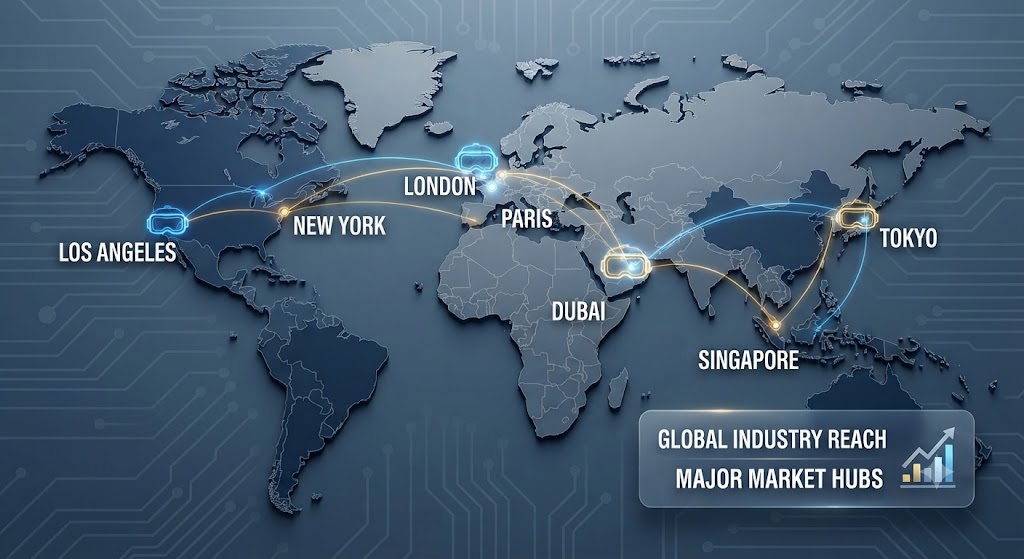
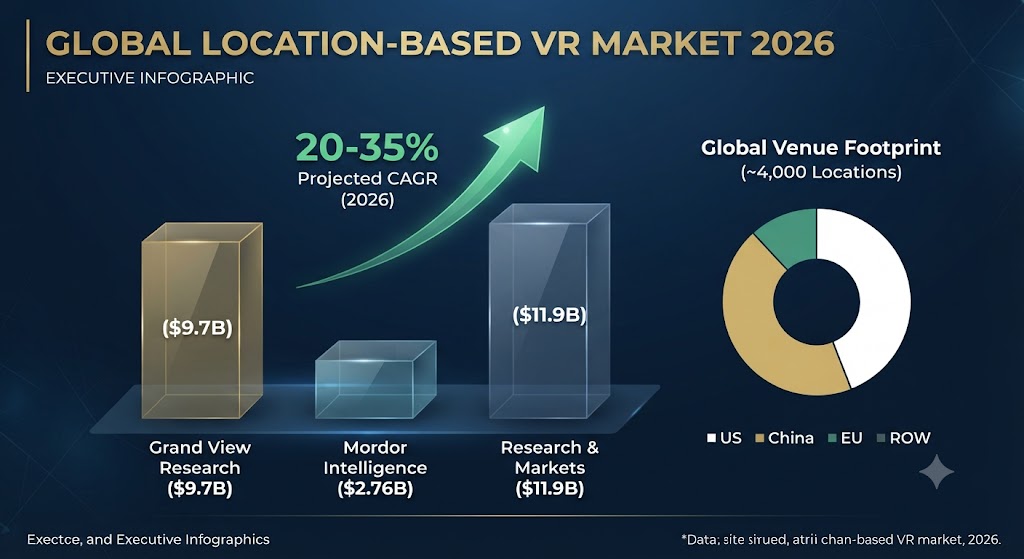
The global location-based VR market is growing faster than almost any other entertainment category right now, but the exact size depends entirely on who you ask, estimates range from $2.7 billion to $11.9 billion for 2026 alone. What every serious research firm agrees on, though, is the direction: 20-35% annual growth, driven by real venues in real cities, not speculative hype.
This guide is the global map. It covers what actually counts as a VR arcade, how big this industry genuinely is, which companies are building it worldwide, and how to choose a venue wherever you happen to be, whether that’s Dubai, London, New York, or somewhere we haven’t covered yet.
Here’s what we’ll walk through:
- What actually defines a “VR arcade” versus other immersive formats
- How this industry actually got here
- The real global market size, with every major estimate and why they differ
- The companies and franchise models actually building this industry
- How to choose the right venue for your group, wherever you are
- What it actually costs, and the honest downsides nobody advertises
If you want the fuller picture of what’s out there before narrowing in on arcades specifically, our guide to VR experiences in 2026 and roundup of the best VR experiences right now are good starting points.
How VR Arcades Actually Got Here
The location-based VR industry didn’t emerge fully formed, it went through a genuine boom-and-correction cycle worth understanding before diving into today’s numbers. If you want the fuller timeline, we cover it in our history of VR piece, but the short version matters here too.
Early venues in the mid-2010s largely failed to find sustainable business models, equipment was expensive, content libraries were thin, and consumer awareness of VR itself was still limited. Several high-profile venues closed within a few years of opening, and for a while the entire category looked like it might not survive contact with reality.
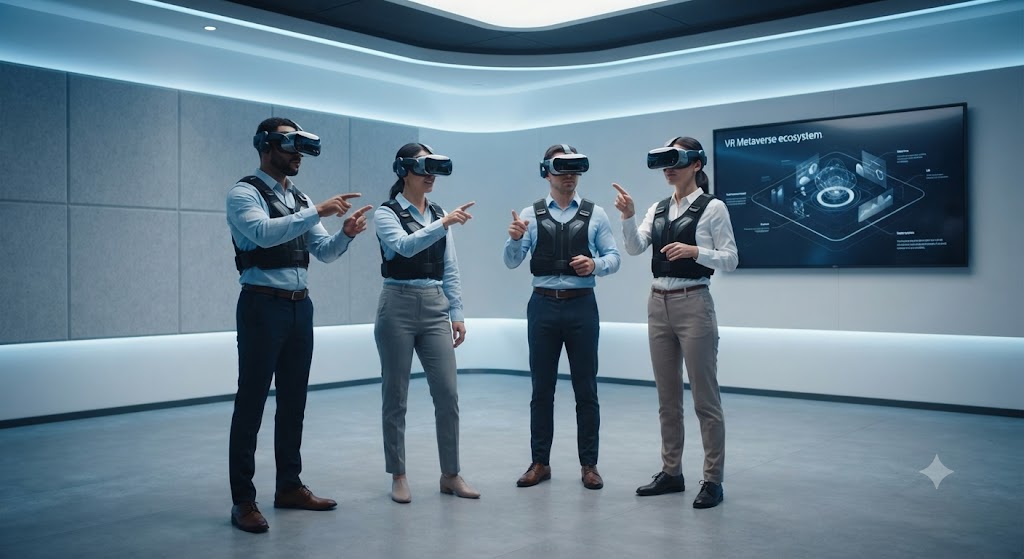
What changed the trajectory was a combination of falling hardware costs, better content, and crucially, the franchise model pioneered by companies like Sandbox VR, which let local investors take on individual venue risk rather than requiring one company to fund global expansion alone. That structural shift, more than any single technology breakthrough, is why the industry looks genuinely different in 2026 than it did a decade ago.
What Actually Counts as a “VR Arcade”?
The term gets used loosely, so it’s worth being precise before going further.
A VR arcade, in the strict sense, is a physical venue where visitors pay to use professional-grade VR equipment they don’t own themselves. But that covers a genuinely wide range of formats, and the differences matter more than most guides admit:
| Format | How It Works | Example |
| Tethered booth | Seated or standing, headset wired to a fixed PC | DNA VR, London |
| Full-body motion capture | Wearable sensors track your entire body, not just headset and hands | Sandbox VR |
| Free-roam / untethered | Wireless headset, walk freely through a real space | Zero Latency, VR Park Dubai’s larger attractions |
| Walking theatre | Lightweight headset, narrative-driven, no controllers or scoring | Immersia XR, London |
| Simulator-based | VR paired with physical motion rigs (racing, flying, free-fall) | Burj Drop at VR Park Dubai |
Each format suits a genuinely different kind of visitor. Tethered booths are the cheapest to operate and typically the most affordable to visit. Full-body motion capture delivers the most immersive experience but costs more and needs larger physical spaces. Walking theatres are the most accessible to VR skeptics and first-timers specifically because the format minimizes motion sickness, a genuine physiological reaction we explain in more detail below and in that dedicated piece.
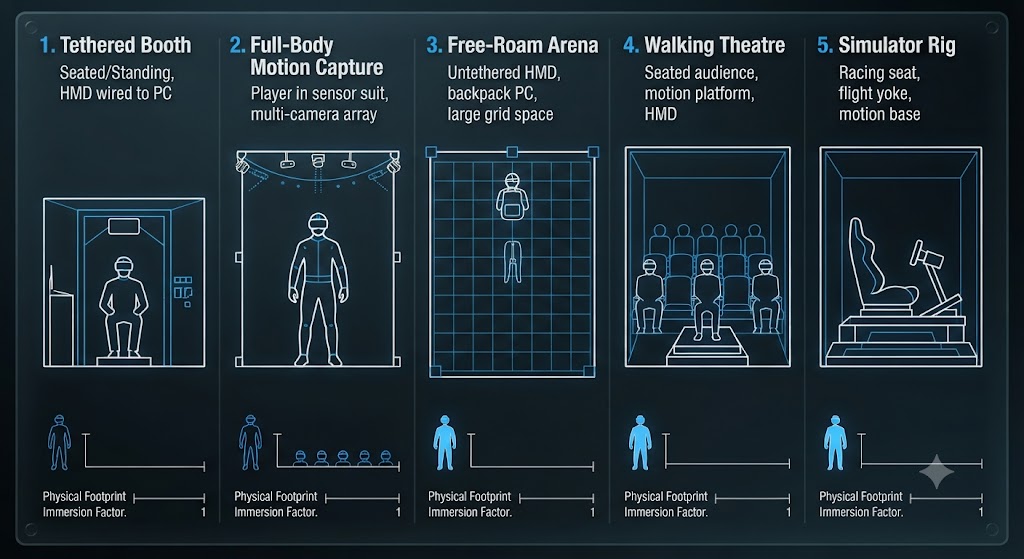
Simulator-based experiences occupy their own niche entirely, they’re less about the hardware inside the headset itself and more about pairing VR visuals with physical motion, a free-fall rig, a racing seat, a flight simulator cockpit. These tend to be the shortest experiences on this list, often just a few minutes, but deliver the most intense sensory payoff per minute of any format here. Free-roam formats also lean on precise motion tracking rather than handheld controllers, which is part of why they feel so different to use in person.
If you’re building a mental model of the space, this is the framework to hold onto, not every “VR experience” is the same product, and the right venue depends entirely on which format actually fits what you want.
Global VR Arcade Market Size in 2026 (Why Estimates Differ)
Here’s an honest look at the numbers, rather than picking whichever figure sounds most impressive. One quick term worth defining before the table: CAGR (compound annual growth rate) is just industry shorthand for the average rate a market grows each year over a multi-year period, it’s not a single-year figure.
| Source | 2026 Estimate | Growth Rate | Scope |
| Grand View Research | $9.7B (broader LBE market) | 26.2% CAGR to 2033 | All location-based entertainment, not VR-only |
| Mordor Intelligence | $2.76B (VR-specific) | 31.1% CAGR to 2031 | Location-based VR only |
| Research and Markets | $11.9B (VR-specific) | 32.3% CAGR to 2030 | Location-based VR, broader definition |
| Fortune Business Insights | ~4,000 venues globally | — | Count of physical location-based VR centers |
Research and Markets’ location-based VR report attributes its higher figure partly to including adjacent categories like VR cinemas and esports lounges alongside traditional arcades, while Fortune Business Insights’ broader location-based entertainment data puts the physical venue count at roughly 4,000 globally, a genuinely useful number since it’s a real count rather than a revenue projection open to interpretation.
The gap exists for the same reason we’ve seen in every market-size discussion in this space: some firms measure the entire location-based entertainment category (arcades, theme parks, cinemas, escape rooms), while others measure VR-specific venues only. Neither is wrong, they’re just answering different questions. Grand View Research’s location-based entertainment report takes the broader view, while Mordor Intelligence’s location-based VR analysis narrows specifically to VR venues, which is exactly why their numbers land so far apart.
What’s consistent across every single estimate, regardless of scope, is that this is a fragmented, fast-growing market. Mordor Intelligence notes specifically that no single operator holds more than 15% of the global installation share (industry-speak for what percentage of all physical VR venues worldwide belong to one company), this isn’t a market being consolidated by one dominant player, it’s genuinely competitive and still expanding into new cities. That competitiveness is part of a broader trend we track in our look at the companies building spatial computing, a space that increasingly overlaps with location-based VR.
Regionally, the United States remains the largest single market by revenue share, while China is posting some of the fastest growth of any country, an expansion Mordor Intelligence links to government-backed smart-city technology initiatives alongside a broader wave of large-scale venue construction across major cities. Falling hardware costs are part of what’s making this expansion possible everywhere, not just China, a trend we cover in our breakdown of the current VR hardware landscape.
The Companies Building the Global VR Arcade Industry
A handful of companies and models explain most of what you’ll actually encounter when you walk into a VR arcade anywhere in the world.
Sandbox VR
It operates on a franchise model that’s expanded rapidly, Mordor Intelligence reports the company has over $200 million in lifetime sales with 127 additional locations in its pipeline, spanning cities from London to Riyadh to Singapore. This franchise approach, where local investors take on the build-out risk rather than the parent company, is a major reason full-body VR experiences have spread so quickly across such different markets. It’s a similar playbook, in some ways, to how enterprise VR training programs have scaled by licensing a proven setup rather than building custom infrastructure at every site.
This franchise strategy is one of the biggest reasons full-body VR experiences have expanded so quickly worldwide. Unlike traditional entertainment businesses that often spend decades refining their franchise systems, location-based VR has been able to scale much faster because the underlying hardware and software are already standardized. Franchisees are licensing a complete experience rather than building VR infrastructure from scratch.
Zero Latency
Founded in Australia, Zero Latency pioneered the free-roam, untethered VR format now used in venues across the world, including Dubai. Its wireless backpack-PC system allows players to move naturally through large physical arenas without being connected to fixed computers, helping establish the free-roam experience as one of the industry’s defining formats.
Regional flagship venues
Large destination venues such as VR Park Dubai follow a different strategy. Instead of franchising a single experience, they combine dozens of VR attractions, simulators, and immersive experiences under one roof. This model works particularly well in tourism-driven cities, where visitors are looking for a full-day entertainment destination rather than a single activity.
Independent, format-specific venues
Operators such as Immersia XR represent a third approach. Rather than competing through size, they focus on delivering one highly specialized experience, such as walking narrative theatre. These venues attract visitors looking for a unique concept that larger entertainment centers may not offer.
What to Actually Expect When You Visit
If you’ve never been to a location-based VR venue, the format itself takes a bit of explaining before you book, our full walkthrough of what to expect at a VR arcade covers check-in, gear-up time, and typical session length in more detail than we have room for here. The short version: budget more time than you’d expect for a traditional arcade visit, briefing and equipment fitting alone can take 10-15 minutes before gameplay even starts.
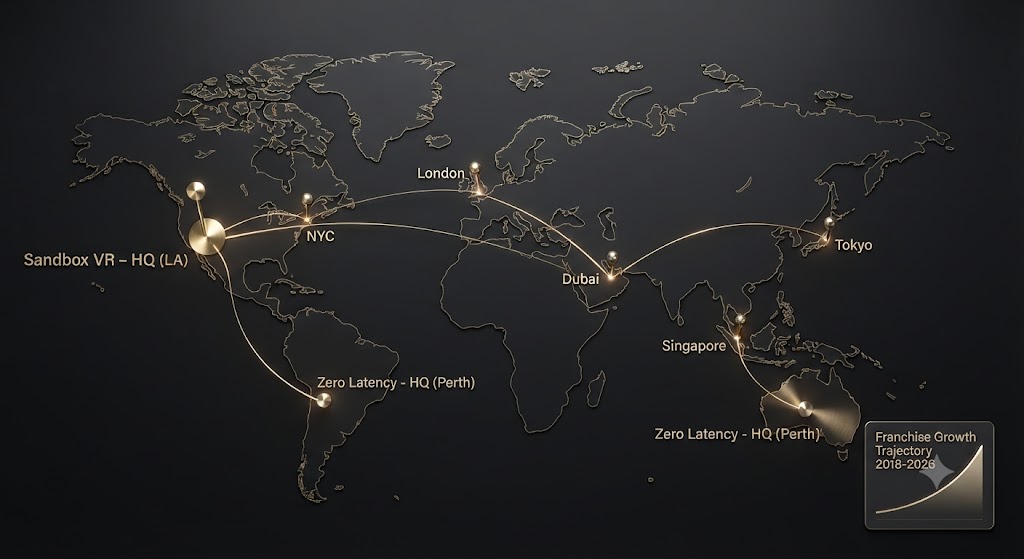
Regional Guides: What VR Arcades Actually Look Like City by City
The honest truth is that “VR arcade” means something different depending on where you are, shaped by local tourism economics, real estate costs, and cultural entertainment habits. A flagship, destination-scale venue makes economic sense in a city built around tourism spending, while a distributed scene of smaller, format-specific venues makes more sense in a city with strong existing entertainment and gaming culture but less tourist-driven mall traffic.
We’re building out detailed, venue-by-venue guides for major cities, and each one follows the same standard: real, currently operating venues verified across multiple sources, honest and specific pricing rather than vague “starting from” language, and no recommending anywhere we can’t confirm is actually still open.
- Best VR Experiences and Arcades in Dubai, home to the world’s largest indoor VR park, built around a single flagship, mall-based destination model
- Best VR Experiences in London, a more distributed scene shaped by the city’s theatre culture and gaming industry, spanning full-body immersion, walking narratives, and classic arcades
- Virtual Reality in NYC, a market shaped by dense real estate and a mix of tourist- and local-facing venues
- Singapore’s Best VR Arcades and Experiences, a compact, density-driven scene where six genuinely different venue formats sit within a short MRT ride of each other
- VR Tourism in the Gulf: How the UAE and Saudi Arabia Are Using Virtual Reality to Attract Visitors, covering NEOM and giga-project VR previews, museum and heritage-site VR, and tourism-board digital strategy
More city guides are in progress as we expand this series. Dubai in particular has a fast-moving VR scene beyond arcades alone, worth exploring in our coverage of Dubai’s wider VR and spatial computing landscape and VR in Dubai’s healthcare sector.
How to Choose the Right VR Arcade, Wherever You Are
A few principles hold true regardless of which city you’re in.
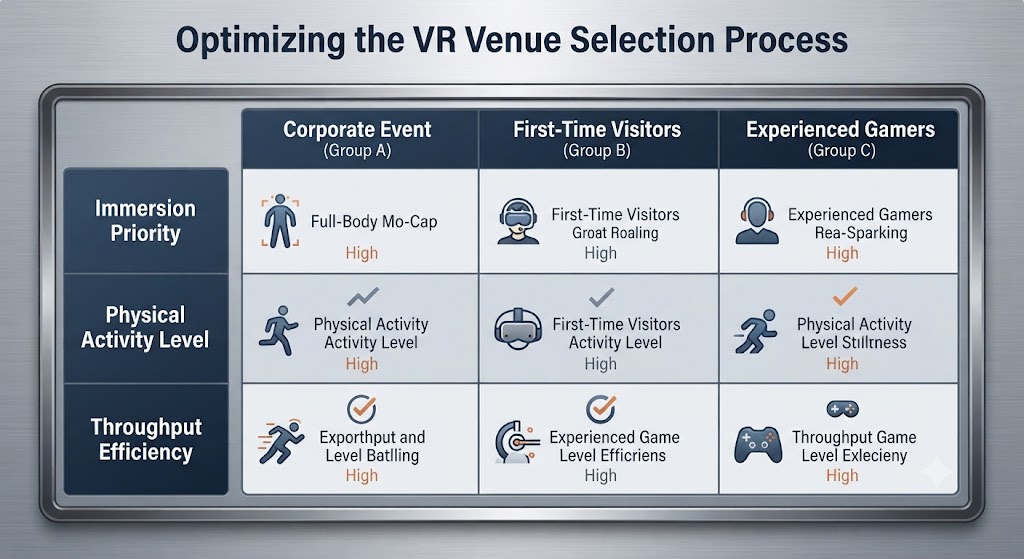
- Match the format to your group
Full-body venues like Sandbox VR need a genuine appetite for physical activity and work best for groups of 4-6. Walking theatres suit mixed-age groups and VR skeptics, particularly anyone who finds the idea of VR itself a little anxiety-inducing, a reaction that’s genuinely common and something we look at directly in our research on VR and anxiety. Simulator rides suit thrill-seekers wanting a shorter, more intense experience.
- Book online wherever possible
This holds true globally, walk-up pricing is almost always worse than pre-booked pricing, and popular venues sell out on weekends regardless of which city you’re in.
- Check age and height restrictions before you commit
Full-body and simulator experiences commonly have minimum height or age requirements that catch families off guard at the door. Sandbox VR’s own guidance, for example, sets a minimum height of 1.2 meters (4 feet) and notes guests need to carry roughly 9 kilograms (20 pounds) of gear for 30-40 minutes, which in practice means most of their experiences suit players around age 8 and up, though this varies by specific location and experience.
- If you’re prone to motion sickness, start with a walking or narrative format.
This isn’t a minor quirk, it’s a well-documented physiological response: VR-induced motion sickness happens because your eyes report movement your inner ear doesn’t feel, a genuine visual-vestibular mismatch that researchers have studied directly. Formats where your physical movement matches what you see on screen genuinely reduce that mismatch, and the disorientation it causes.
- Verify the venue is actually still operating before you travel there specifically for it.
Location-based VR has real churn, venues open and close faster than traditional attractions, and outdated “best VR arcades” lists are one of the most common sources of wasted trips in this space. If you’re searching more broadly rather than picking from a curated list, our guide to finding VR venues near you walks through how to vet a venue before you book.
What VR Arcades Actually Cost
Pricing varies enormously by format and region, but a few patterns hold globally:
- Tethered booth experiences are typically the cheapest entry point, often priced per game or per credit rather than a flat admission fee.
- Full-body and premium group experiences command the highest prices, reflecting the equipment cost and physical space required, expect this to be genuinely the most expensive format almost everywhere.
- Walking theatre and narrative formats often undercut both, since they require less specialized hardware per visitor.
- Group and off-peak discounts are common across nearly every venue type and region, worth actively asking about rather than assuming the listed price is fixed.
The Honest Downsides Nobody Advertises
A genuinely useful guide includes the real friction points, not just the highlights.
Motion sickness affects a meaningful share of first-time visitors, particularly with fast-movement formats like racing or free-fall simulators. This isn’t rare or embarrassing, it’s a known, common reaction rooted in that same visual-vestibular mismatch between what your eyes see and what your body physically feels, and it’s a big part of why we dedicated a full explainer to the topic.
Hygiene is a legitimate concern with shared equipment. Reputable venues sanitize headsets and gear between uses, but it’s a fair question to ask before booking, especially given heightened awareness of shared-surface hygiene across the entertainment industry more broadly in recent years.
Venue closures happen more often than in traditional entertainment. The location-based VR market’s rapid growth comes with genuine churn, some venues fail to find sustainable footfall and close within a few years of opening. Always verify current operating status through official channels before planning a trip around a specific venue.
Pricing can escalate quickly for groups. A “starting from” price often reflects the cheapest possible configuration, real costs for a group of four or five can run considerably higher once you add premium experiences or peak-time surcharges.
Review scores can be misleading for newer venues. A brand-new location with only a handful of reviews isn’t necessarily unreliable, but it also hasn’t been tested by enough visitors to know if early positive reviews reflect genuine consistency or just opening-week enthusiasm. Venues with a longer track record and larger review volume are generally the safer bet if you’re planning a special trip around one specific experience.
Frequently Asked Questions
What is the biggest VR arcade in the world?
VR Park Dubai, located inside The Dubai Mall, holds the title of the world’s largest indoor VR park, spanning 7,000 square meters with over 30 attractions.
How much does a typical VR arcade experience cost?
Costs vary widely by format:
- Tethered booth experiences often run the equivalent of $15-45 USD per ride or game
- Full-body group experiences typically cost more, reflecting premium equipment and space, this is a meaningfully different price bracket to renting or owning a consumer headset like the Vision Pro or Quest 3, since arcades are pricing in staff, real estate, and shared high-end gear
- Walking theatre formats can start as low as $7-10 USD per story, among the most affordable options
Is the VR arcade industry actually growing, or is this hype?
It’s genuinely growing. Every major market research estimate, despite disagreeing on exact figures, agrees on 20%+ annual growth, and the industry has expanded to an estimated 4,000+ physical venues worldwide.
Which company operates the most VR arcade locations globally?
Sandbox VR has one of the most aggressive global expansion models, using a franchise system that has produced over $200 million in lifetime sales and a reported 127 additional locations in its pipeline as of 2026.
Do VR arcades close down often?
More often than traditional entertainment venues, yes. The industry’s rapid growth comes with genuine churn, some locations fail to find sustainable footfall within their first few years. This is exactly why it’s worth verifying a venue’s current operating status through official sources before planning a trip specifically around it, rather than trusting an older “best VR arcades” list without checking.
Final Thoughts on VR Arcades Around the World
VR arcades have moved well past the novelty phase, genuine market data, real global expansion, and a fragmented but genuinely competitive industry all point to a category that’s here to stay, even if research firms can’t agree on exactly how big it is. What matters more than the headline number is that this is now a real, verifiable part of entertainment infrastructure in major cities worldwide.
Whichever city you’re in or planning to visit, the same principles apply: match the format to your group, book ahead, verify the venue is still open, and go in knowing the real costs and honest limitations rather than just the marketing. Explore our city-specific guides above for the exact venues worth your time, or check our homepage as we continue expanding this series.
Pingback: Best VR Experiences in London for 2026 (Full Guide)