
Which VR Headset Should You Actually Buy in 2026?
VR headsets have become increasingly popular in recent years, as technology has advanced and prices have become more affordable. VR headset allows users to immerse themselves in a virtual world, whether it’s for gaming, watching movies, or even exploring new places.
What Is a VR Headset, and What Is It Actually Used For?
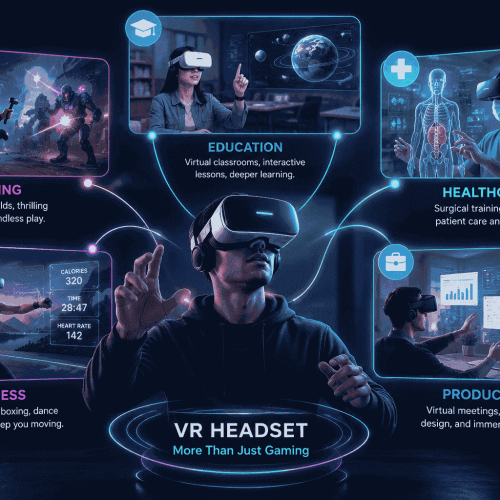
A VR headset is a wearable display that puts a screen in front of each eye and tracks your movement, so instead of looking at a digital world, you feel like you’re standing inside one. Gaming is usually where people start, but honestly, that’s just the tip of it these days.
Schools are using headsets for virtual labs and immersive lessons now (we go deep on this in our virtual reality in education guide). Hospitals are piloting them for surgical training and even exposure therapy; you can read more in our VR in healthcare breakdown. Some people use VR purely for fitness, boxing or dancing games that genuinely leave you sweating. And lately, work has crept in too; the Apple Vision Pro in particular is being pitched less as a toy and more as a floating desktop you strap to your face.
So before you get lost comparing specs, ask yourself what you’d actually use it for. That one answer matters more than any brand name, and it’s really what the rest of this guide is here to help you figure out.
Types of VR Headsets: Understanding the Main Categories
Not all VR headsets work the same way. Some are designed for convenience, while others focus on performance, mixed reality, or professional applications. Understanding the main categories can help you choose the right headset for your needs.
Standalone VR Headsets
Standalone VR headsets run on their own hardware and don’t require a PC or console. They’re easy to set up, portable, and ideal for most users. Devices like the Meta Quest series have made this the most popular category of virtual reality headset.
PC VR Headsets
PC VR headsets connect to a gaming computer and use its graphics power to deliver more demanding experiences. They’re popular among simulation enthusiasts, developers, and gamers seeking maximum visual quality.
Mixed Reality Headsets
Mixed reality headsets combine digital content with the physical world using cameras and spatial mapping technology. This category is becoming increasingly important for productivity, collaboration, and spatial computing experiences.
Mobile VR Headsets
Mobile VR headsets use a smartphone as the display and processor. While once popular, they have largely been replaced by more capable standalone VR systems.
Popular VR Headsets Available Today
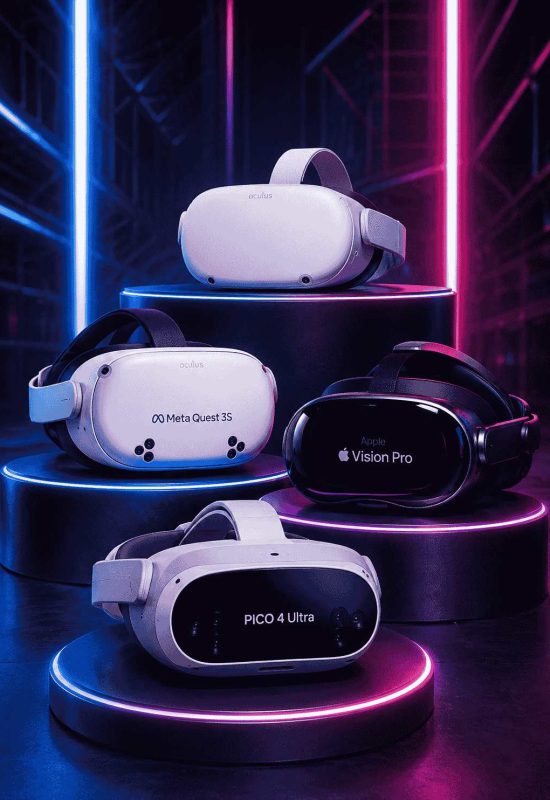
The VR market continues to evolve, with manufacturers focusing on better displays, mixed reality features, and improved comfort. These are some of the most relevant VR headsets currently available.
Meta Quest 3S
Meta Quest 3S offers an affordable entry point into virtual reality. It combines standalone convenience with mixed reality capabilities, making it a strong option for new users.
Meta Quest 3
Meta Quest 3 delivers sharper visuals, improved optics, and enhanced mixed reality functionality. It remains one of the most versatile consumer VR headsets available today.
Apple Vision Pro
Apple Vision Pro focuses on spatial computing, productivity, and immersive media experiences. It represents a different approach to mixed reality beyond traditional gaming.
PICO 4 Ultra
PICO 4 Ultra combines standalone VR and mixed reality features with modern hardware, making it a competitive option for both entertainment and productivity.
Valve Index
Valve Index remains a respected PC VR headset known for precise tracking and strong support among enthusiasts and simulation users.
VR Headset Comparison
| Headset | Type | Best For | Standalone | Mixed Reality | PC Compatible |
|---|---|---|---|---|---|
| Meta Quest 3S | Standalone VR | Beginners and Everyday Use | Yes | Yes | Yes |
| Meta Quest 3 | Standalone VR | Gaming and Mixed Reality | Yes | Yes | Yes |
| Apple Vision Pro | Mixed Reality | Productivity and Spatial Computing | Yes | Yes | Limited |
| PICO 4 Ultra | Mixed Reality | Entertainment and Productivity | Yes | Yes | Limited |
| Valve Index | PC VR | Enthusiasts and Simulation Users | No | No | Yes |
Who Should Buy Which Type of VR Headset?
Many buyers focus on specifications, but the best VR headset often depends on how you plan to use it. A student exploring educational experiences may have different needs than a simulator enthusiast or a remote worker interested in mixed reality productivity tools.
| If You Want To… | Recommended Headset Type |
|---|---|
| Try VR for the First Time | Standalone VR |
| Play VR Games | Standalone VR or PC VR |
| Use Flight or Racing Simulators | PC VR |
| Explore Mixed Reality | Mixed Reality Headset |
| Use VR for Work | Mixed Reality Headset |
| Learn Through Immersive Experiences | Standalone VR |
| Train Employees | Standalone or Mixed Reality |
Every VR Headset Brand and Model at a Glance
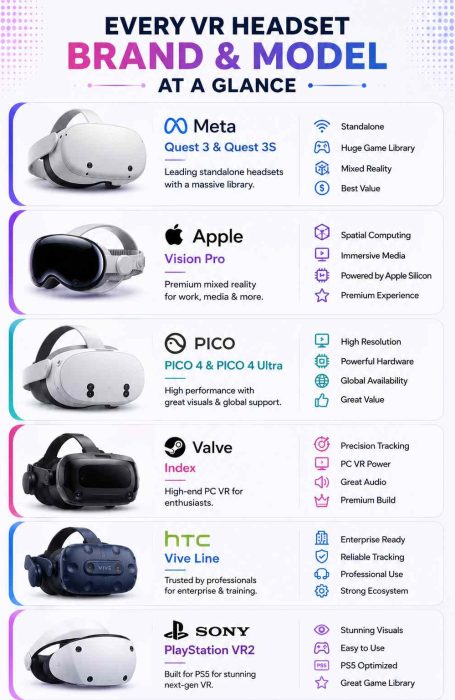
Not sure where to even start? Here’s every brand actually worth knowing about in 2026, and what each one is really good at.
Meta basically owns the standalone headset game right now. Quest 3 and Quest 3S cover most of the mainstream market, and Meta’s app store is the biggest library out there, which honestly matters more than people think.
Apple showed up with the Vision Pro and skipped gaming almost entirely. Think of it less as a headset and more as a floating Mac you wear on your face, built for visionOS and Apple’s whole ecosystem.
PICO, backed by ByteDance, makes the PICO 4 and PICO 4 Ultra. Similar mixed reality tricks to Quest, friendlier pricing, and a much bigger footprint outside the US.
Valve built the Index for people who care about raw visual quality over convenience, cables and all. A standalone headset called Steam Frame is on the way sometime in 2026.
HTC created the Vive line and was once a PC VR heavyweight. These days it’s leaned hard into enterprise and business use rather than chasing casual buyers.
Sony keeps it simple with the PlayStation VR2, made exclusively for PS5 owners who want VR without leaving their console setup.
Bigscreen makes the Bigscreen Beyond, a featherweight headset custom-molded to your face. Niche, pricey, but genuinely loved by VR enthusiasts who’ve tried it.
How to Choose the Right VR Headset
The best VR headset depends on how you plan to use it. While specifications matter, factors such as comfort, software availability, and intended use often have a bigger impact on the overall experience.
Budget
Standalone VR headsets generally offer the lowest barrier to entry, while premium mixed reality devices are designed for users seeking advanced features and productivity tools.
Content Library
A headset is only as good as the experiences available on it. Before buying, consider the games, applications, and services supported by the platform.
Comfort
Weight, head strap design, ventilation, and facial padding all affect long-term comfort, especially during extended VR sessions.
Tracking and Performance
Tracking quality plays a major role in the overall VR experience. Accurate tracking helps ensure smooth movement, responsive controls, and reliable interaction with virtual environments, especially during gaming, training, and simulation activities.
Intended Use
Some headsets are designed primarily for gaming, while others focus on productivity, collaboration, training, or mixed reality experiences.
Key VR Headset Features Explained
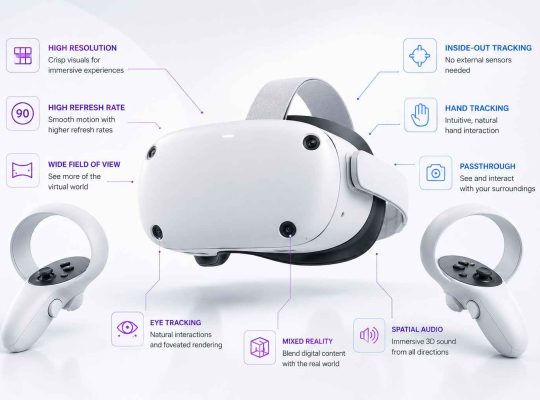
- Resolution – Determines image sharpness and clarity.
- Refresh Rate – Controls how smooth motion appears.
- Pancake Lenses – Improve clarity while reducing headset bulk.
- Field of View (FOV) – Defines how much of the virtual world you see.
- Inside-Out Tracking – Tracks movement using built-in cameras.
- Hand Tracking – Enables controller-free interaction.
- Eye Tracking – Detects where users are looking.
- Passthrough Cameras – Blend virtual content with the real world.
- Mixed Reality (MR) – Combines physical and digital environments.
- Spatial Audio – Creates realistic directional sound.
Best VR Headsets in 2026
The VR headset market has shifted significantly in recent years. Meta has rebranded from Oculus, and several headsets once considered top picks are now discontinued. Here’s what’s actually current.
Meta Quest 3S is the most accessible standalone option, starting at 349.99 dollars for 128GB or 449.99 dollars for 256GB. It runs on the same Snapdragon XR2 Gen 2 chip as the higher-end Quest 3, giving it access to the full Meta Horizon OS game library, though it uses simpler Fresnel lenses instead of the sharper pancake optics found on its pricier sibling.
Meta Quest 3 sits at 599.99 dollars for its 512GB configuration and delivers noticeably sharper visuals thanks to pancake lenses and a higher-resolution display, plus a more complete mixed reality sensor stack for color passthrough.
Apple Vision Pro starts at 3,499 dollars for 256GB, climbing to 3,699 dollars for 512GB and 3,899 dollars for 1TB. Apple positions it as a spatial computing device rather than a gaming headset, and the price reflects that.
PICO 4 Ultra offers a genuinely competitive mixed reality alternative at a fraction of Apple’s price, with a 4K+ binocular display and Snapdragon XR2 Gen 2 performance.
Valve Index remains available for PC VR enthusiasts who want maximum visual fidelity and are willing to stay tethered to a gaming PC, though it hasn’t seen a hardware refresh in several years.
| VR Headset | Type | Price (2026) |
|---|---|---|
| Meta Quest 3S | Standalone | $349.99 – $449.99 |
| Meta Quest 3 | Standalone | $599.99 |
| Apple Vision Pro | Mixed Reality | $3,499 – $3,899 |
| PICO 4 Ultra | Mixed Reality | ~$749 |
| Valve Index | PC-tethered | $999 |
AI, Spatial Computing, and the Future of VR Headsets
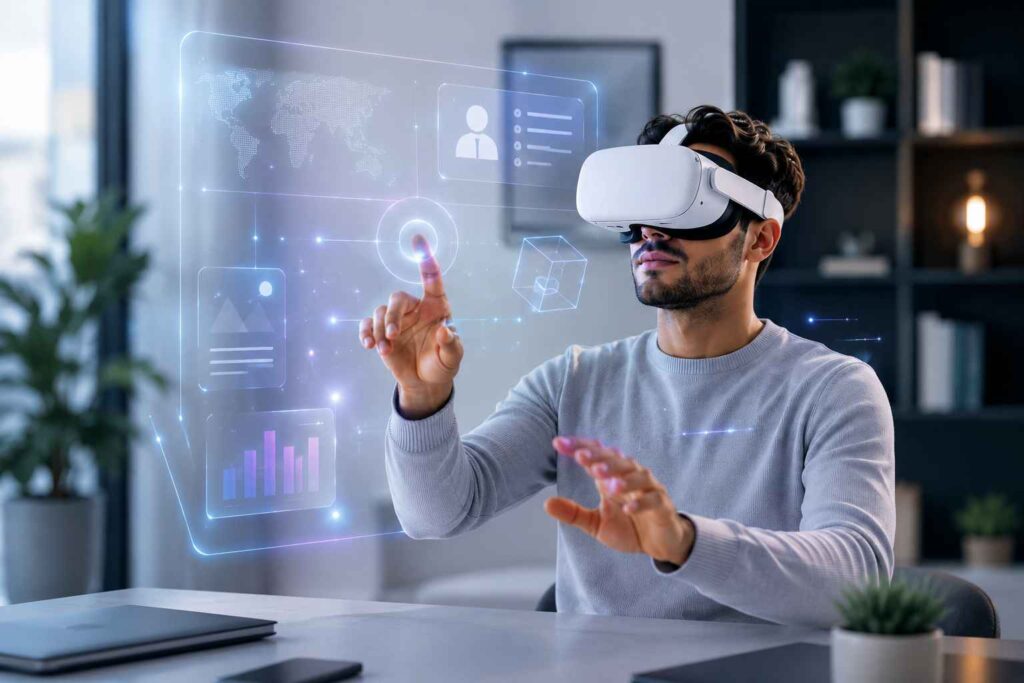
Virtual reality is evolving beyond gaming and entertainment. Artificial intelligence and spatial computing are helping transform VR headsets into more intelligent, versatile devices capable of supporting work, learning, collaboration, and content creation.
AI-powered features can personalize experiences, improve virtual interactions, and assist users with navigation, communication, and training. Meanwhile, spatial computing enables digital content to interact more naturally with physical environments, creating experiences that blend the virtual and real worlds.
As these technologies continue to mature, future VR headsets are expected to become lighter, more powerful, and increasingly integrated into everyday digital workflows. The line between virtual reality, mixed reality, and traditional computing devices is already beginning to blur, opening new possibilities for education, healthcare, enterprise training, and productivity.
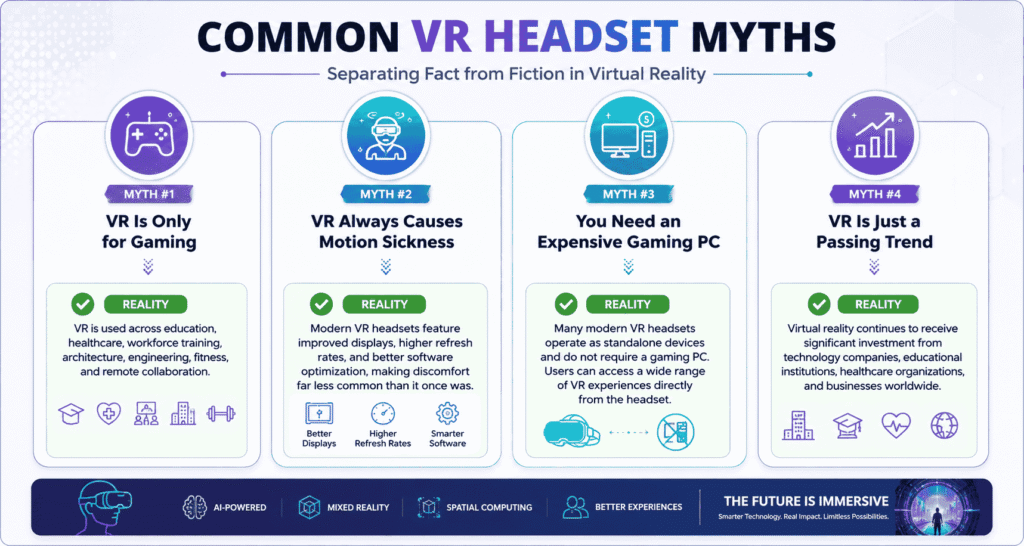
COMMON VR HEADSET MYTHS
Latest VR Technology and What's Coming Next
VR hardware has moved fast, and two shifts matter most right now. Pancake lenses, first popularized by the Quest 3, have become the new standard, sharper, slimmer, no more glare at the edges. And mixed reality passthrough, seeing your real room in full color while virtual stuff floats around you, has gone from a fancy extra to just expected, it’s on the Quest 3, Quest 3S, Vision Pro, and PICO 4 Ultra alike.
What’s next is worth watching too. Valve’s standalone Steam Frame is expected sometime in 2026, aiming to bring PC-level VR without an actual PC. A Meta Quest 4 and a cheaper Vision Pro are also being rumored, though nothing’s confirmed yet.
The bigger trend: VR and AR are quietly merging into one category. Good news for you, most headsets today already do more than gaming, work, fitness, socializing, all genuinely usable now, not just marketing talk.