
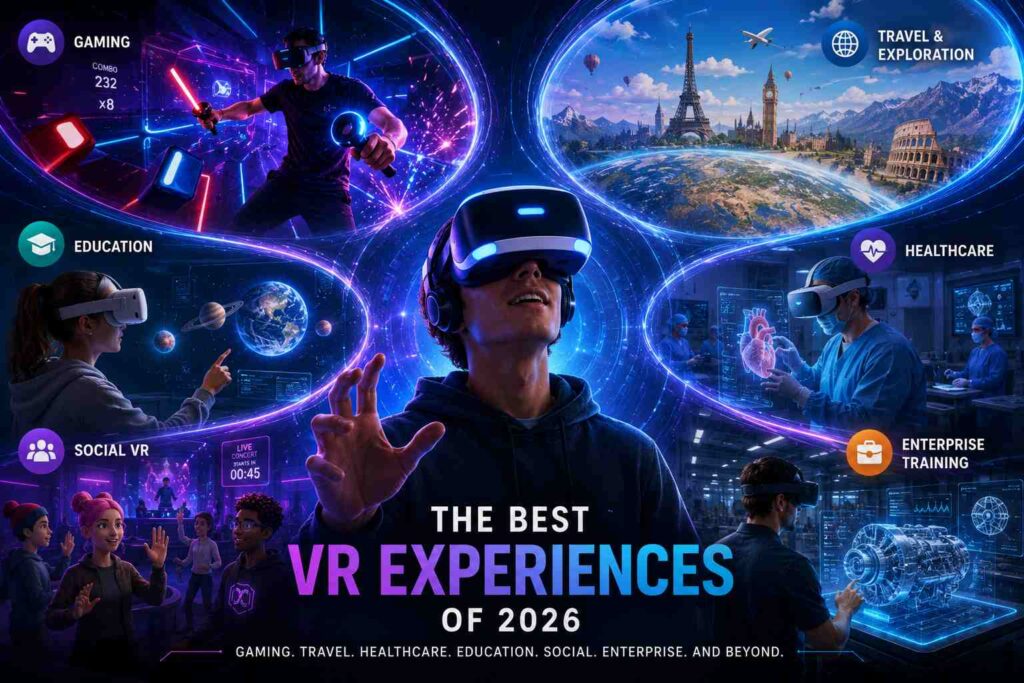
The catalog of virtual reality experiences in 2026 is enormous and genuinely disorganized. You could spend three weekends trying things at random. Some will feel transformative. Some will give you a mild headache. A few will change how you think about what software can actually do.
This guide cuts through the catalog. Clear breakdown by category. What’s worth your time. How to match experience types to the headset you own or are planning to buy. The numbers behind the market are real: 65.9 million VR users in the US alone in 2023 (Statista). The global AR/VR headset market projects from $16.9 billion in 2025 to $262 billion by 2034.
Here is what’s actually out there.
VR Gaming: The Best Immersive Experiences for Every Headset
VR gaming is where most people start, and the catalog quality has changed significantly from the short, overpriced demos that characterized the first wave of consumer headsets.

Best VR Experiences 2026: Gaming Category
| Title | Genre | Platform | Price (2025) | Nausea Risk | Why It Stands Out |
| Beat Saber | Rhythm/Fitness | All major platforms | $29.99 | Very Low | Best intro to VR. Teaches presence immediately. |
| Half-Life: Alyx | Action/Narrative | SteamVR (PC VR) | $59.99 | Low | Highest-quality VR narrative game. Built VR-first. |
| Alien: Rogue Incursion | Horror | PSVR2, PC VR, Quest | $39.99 | Low | Benchmark for VR horror. Spatial audio excellence. |
| Horizon Call of the Mountain | Action/Adventure | PSVR2 only | $59.99 | Low | Best exclusive. PSVR2 haptic feedback showcase. |
| Walking Dead: S&S | Survival/Narrative | All major platforms | $39.99 | Moderate | Best long-form VR narrative outside Half-Life. |
| VRChat | Social/Sandbox | Most platforms | Free | Low | 65M+ users. Social VR benchmark platform. |
| Rec Room | Social/Gaming | All platforms incl. mobile | Free | Low | Best cross-platform social gaming. Huge user base. |
Beat Saber is still the gateway drug of VR. It works on every major platform, runs on entry-level hardware, and delivers the feeling of genuine physical presence in a digital space within the first 60 seconds. It’s the experience that makes bystanders immediately want to try.
Half-Life: Alyx, released in 2020, remains the clearest proof that VR can hold a full-length AAA narrative. Valve built it from scratch for VR, refused to compromise for flat-screen compatibility, and the result is still unsurpassed in overall execution six years later. The physics interaction, environmental storytelling, and spatial audio are all still reference-class.
| Beat Saber for first-timers. Half-Life: Alyx for the definitive VR game experience. Alien: Rogue Incursion for horror. VRChat for social. Each is the category leader in its space as of 2026. |
Virtual Reality Travel: Going Places Your Body Cannot
This category does something genuinely unique. It places you in locations that your physical body cannot reasonably access.
Google Earth VR places you anywhere on the planet at ground level. You fly over mountain ranges, descend into city streets, and stand at locations most people will never visit in person. It’s free on SteamVR and consistently demonstrates that the most compelling VR experiences don’t always require a game engine or development budget.
Timelooper reconstructs historical moments in the cities where they happened. Users in London, New York, and other cities see the same streets across different historical periods with period-accurate reconstruction. It’s one of the few VR experiences that genuinely changes how users perceive familiar places after the headset comes off.
Marriott Hotels tested VRoom Service, a program offering guests VR preview experiences of travel destinations before booking. The concept of virtual preview before physical commitment is a natural fit for the technology. Major travel platforms are developing similar tools for 2026 and 2027 deployment.
| The VR experience catalog in 2026 is larger and better than most people realize. Gaming leads adoption. Enterprise and clinical applications drive the most significant real-world outcomes. |
| • 65.9 million VR users in the US alone in 2023 (Statista). Global AR/VR headset market projects from $16.9B in 2025 to $262B by 2034. |
| • Beat Saber and Google Earth VR are the best starting points for first-time users: low nausea, immediately impressive, available on all major platforms. |
| • Half-Life: Alyx (2020) remains the benchmark for VR narrative game design. Nothing has surpassed it in overall execution as of 2026. |
| • AppliedVR’s RelieVRx is the first FDA-authorized VR treatment program. Osso VR shows 230% improvement in surgical training outcomes. |
| • Meta Quest 3 has the widest experience catalog. Apple Vision Pro has the best display. PC VR via SteamVR has the largest game library. |
Educational VR Experiences: Learning Through Immersion
While gaming dominates public attention, education may ultimately become one of the most impactful applications of immersive technology. Schools, universities, and training organizations are increasingly adopting virtual reality learning environments to place students inside experiences that would otherwise be inaccessible, dangerous, or prohibitively expensive to recreate.
Platforms such as VictoryXR, ENGAGE XR, and ClassVR allow learners to explore ancient civilizations, conduct virtual science experiments, and interact with complex concepts in three-dimensional space. Medical students can practice procedures in realistic simulations, while engineering students can examine machinery and infrastructure from every angle before entering real-world environments.
The growing interest in educational VR is closely tied to broader research into the benefits of virtual reality, particularly its ability to improve engagement, knowledge retention, and learner confidence. Studies continue to show that immersive experiences can help students understand abstract concepts more effectively than traditional instruction alone.
Organizations are also seeing measurable value from VR-based training initiatives. Research into enterprise VR training programs has shown improvements in onboarding speed, procedural learning, and workforce preparedness across multiple industries.
Fitness VR Experiences: Exercise That Doesn’t Feel Like Exercise
One of the most surprising success stories in the industry has been VR fitness. Instead of viewing exercise as a repetitive routine, users can engage in immersive workouts that combine entertainment with physical activity.
Applications such as Supernatural, FitXR, and Les Mills Bodycombat VR transform living rooms into virtual gyms, helping users stay active while maintaining motivation. These experiences are powered by increasingly sophisticated VR headset technology, which tracks movement with remarkable accuracy and enables responsive real-time interactions.
Even entertainment-focused titles such as Beat Saber can deliver meaningful cardiovascular exercise when played at higher difficulty levels. For many users, the immersive nature of VR makes workouts feel less like a chore and more like an engaging experience.
Several studies suggest that active VR experiences can achieve exercise intensities comparable to conventional fitness activities, making them an increasingly attractive option for users looking to improve health while enjoying immersive technology.
Social VR Experiences: More Than Just Games
Although gaming remains the primary gateway into virtual reality, social platforms have quietly become one of the fastest-growing segments of the industry. Millions of users now spend time in shared virtual spaces where they can meet friends, attend live events, collaborate on projects, or simply explore digital worlds together.
Platforms such as VRChat, Rec Room, and Meta Horizon Worlds allow users to create custom avatars and participate in communities that often feel far more immersive than traditional social media platforms. Unlike video conferencing, social VR creates a stronger sense of presence, making interactions feel more natural and engaging.
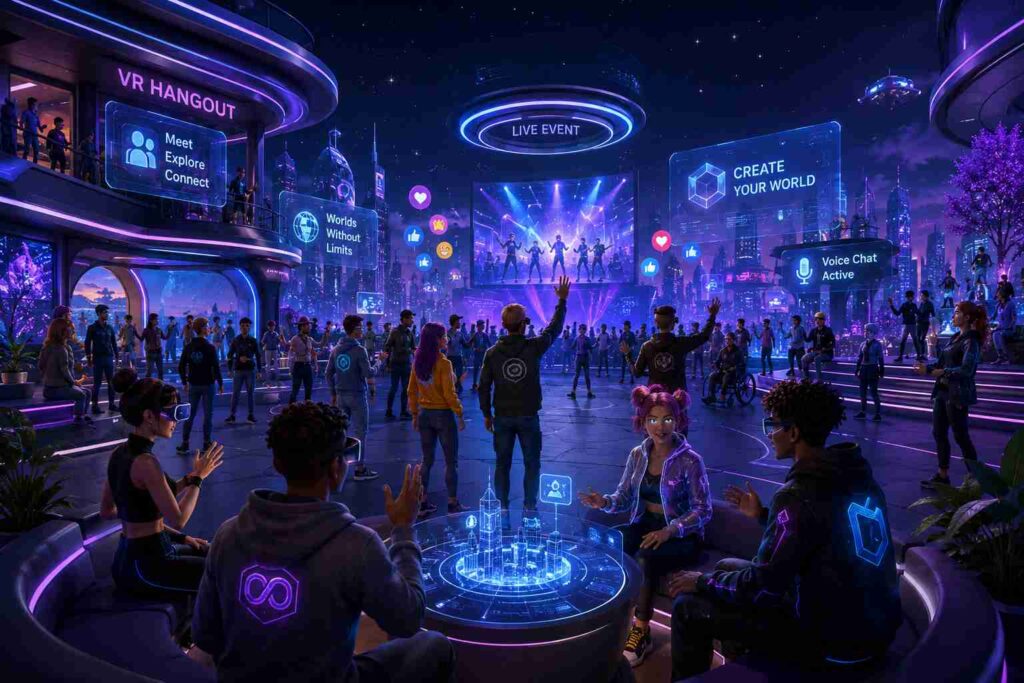
The next generation of these experiences is already being shaped by AI-powered NPCs and smart environments, which can adapt conversations, create dynamic interactions, and make virtual spaces feel increasingly alive.
As adoption continues to grow, many experts believe that social experiences will become a significant component of the future of virtual reality, extending far beyond gaming and entertainment.
Clinical VR Experiences: Therapy, Pain Management, and Mental Health
These experiences are serious medical applications. The claims behind them come from clinical trials, not marketing campaigns.
AppliedVR’s RelieVRx received FDA De Novo authorization in 2021 for chronic lower back pain treatment. That regulatory distinction matters. It separates the program from wellness marketing. The 8-week protocol combines attentional distraction with pain reprocessing therapy delivered through daily VR sessions.
| “VR gives clinicians a level of control over therapeutic environments that was simply not possible before. We can adjust stimulus intensity, duration, and context in real time. That precision is transformative for exposure therapy.”
Dr. Albert ‘Skip’ Rizzo | Director, Medical Virtual Reality, USC Institute for Creative Technologies Dr. Rizzo has led VR therapy research for over two decades. His team’s work on PTSD treatment through VR exposure therapy is the foundation of the VA hospital VR therapy programs. |
SnowWorld, the pain distraction program from the University of Washington’s HIT Lab, has 20 years of clinical data. Burn patients using it during dressing changes consistently report lower pain scores. The mechanism is attentional: immersion occupies cognitive bandwidth that would otherwise amplify pain signals.
Limbix and Psious are therapist-delivered anxiety platforms designed specifically for clinical use. Limbix targets adolescents with diagnosed anxiety disorders. Psious gives therapists real-time control over stimulus intensity during sessions. These are not consumer wellness apps with clinical-sounding language. They require a clinical prescription and are delivered in therapeutic settings.

Professional VR Experiences: Training, Surgery, and Architecture
Enterprise VR is growing faster than consumer VR by most metrics. The AR/VR headset market projects $262 billion by 2034 (IDC/NextReality, 2025), with enterprise driving a significant portion of that growth.
Professional VR Experience Platforms (2025-2026)
| Platform | Industry | Key Feature | Training Outcome | Headset Compatibility | Pricing Model |
| Osso VR | Surgical training | Patient-specific anatomy | 230% technique improvement | Enterprise headsets | Subscription |
| Touch Surgery | Medical education | Procedure step-through | Risk-free repetition | Enterprise/iOS | Per seat |
| Strivr | Corporate training | Analytics dashboard | 4x faster onboarding | Meta Quest series | Enterprise |
| FlightSafety VR | Aviation training | Cockpit simulation | Reduced sim hours needed | PC VR / custom | Enterprise |
| Mursion | Soft skills | AI-driven role-play | Communication skills | PC VR | Per session |

Flight simulation through VR has replaced significant portions of traditional simulator time for commercial aviation training programs. A physical Level D flight simulator costs $10 million to $15 million to build and $1,000 or more per hour to operate. VR handles a substantial portion of procedural training at a fraction of that cost. Airlines with tight training margins have been among the most enthusiastic institutional adopters.
Related Reading: Learn how organizations are measuring the return on immersive learning through our guide to enterprise VR training ROI.
Mixed Reality Experiences: When Digital Content Enters the Real World
Not every immersive experience requires users to leave the physical world behind. Many modern applications blend virtual elements with real-world surroundings, creating experiences that combine the strengths of both environments.
Understanding the differences between VR vs AR vs Mixed Reality helps explain why this category is gaining momentum. Mixed reality applications allow users to interact with digital objects while remaining aware of their physical surroundings, making them particularly useful for productivity, education, and creative work.
Experiences such as Demeo Mixed Reality, LEGO Bricktales Mixed Reality, and PianoVision demonstrate how digital content can enhance everyday environments. Users can place virtual objects on tables, receive guided visual instructions, or transform living spaces into interactive learning environments.
This shift toward blended experiences is one reason analysts increasingly view spatial computing in 2026 as the next major stage in immersive technology. Rather than choosing between physical and virtual environments, users are beginning to benefit from systems that seamlessly combine both.
What Makes a VR Experience Genuinely Immersive?
Technical specs create the floor. Content design builds the ceiling. The experiences that feel genuinely immersive share three things, and none of them appear in the spec sheet.
First, they were built for VR from the beginning. Ports of flat games rarely reach the same sense of presence because the interaction design doesn’t translate at a fundamental level. You can tell immediately. Second, spatial audio is done properly. Sound in VR is triangulated to virtual positions and changes as you move. When it works, you stop consciously noticing the audio. When it fails, every scene feels slightly wrong. Third, user comfort is treated as a design priority, not an afterthought. Experiences that offer locomotion options, adjustable comfort settings, and vignetting controls last longer in regular rotation because more users can engage with them without discomfort.
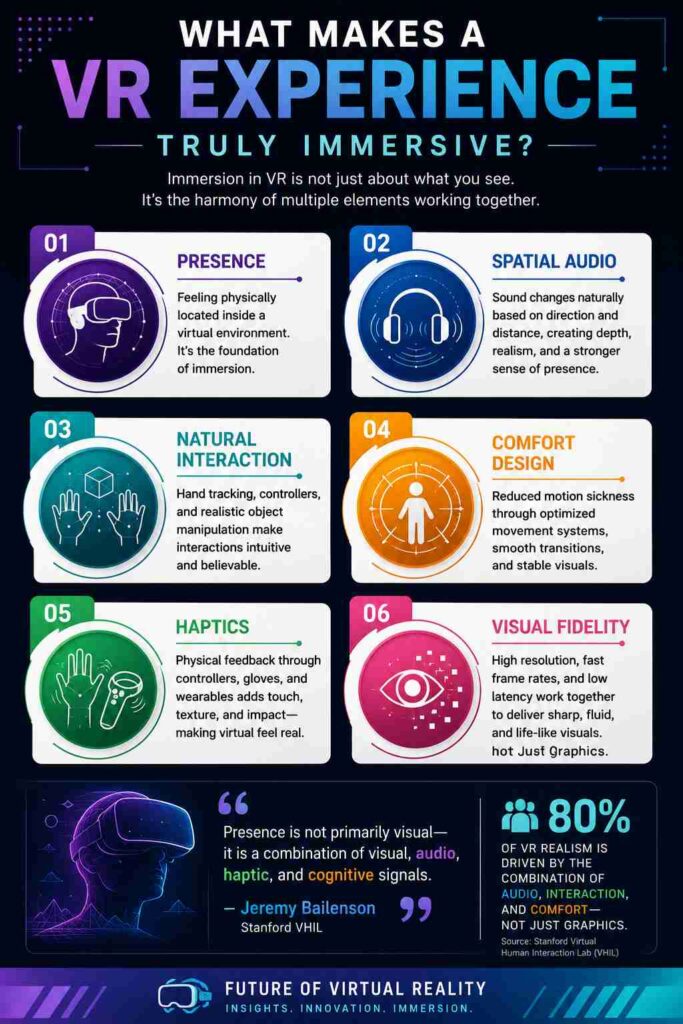
| “Presence in VR is not primarily a visual phenomenon. It’s a full sensory and cognitive construct. You feel present in a virtual space when every signal- visual, audio, haptic, even proprioceptive- tells the same story at the same time.”Jeremy Bailenson | Founding Director, Stanford Virtual Human Interaction Lab (VHIL)
Bailenson’s lab at Stanford has produced landmark research on VR presence theory, empathy applications, and immersive learning. His book ‘Experience on Demand’ (2018) remains the most widely cited popular introduction to VR research. |
Which VR Headset Should You Use for Which Experience?
Not every experience runs on every device. Headset-experience compatibility matters for practical planning.
VR Headset vs Experience Compatibility (2026)
| Experience Type | Meta Quest 3 | PSVR2 | Valve Index | Apple Vision Pro | Best Pick |
| Gaming (casual) | Best (widest catalog) | Good | Good (PC Steam) | Limited | Meta Quest 3 |
| Gaming (hardcore) | Good | Excellent (haptics) | Excellent (fidelity) | Limited | Valve Index / PSVR2 |
| Virtual travel | Google Earth VR | Limited | Google Earth VR | Limited | Meta Quest 3 or Valve Index |
| VR therapy (consumer) | TRIPP, guided meditation | Limited | Limited | Limited | Meta Quest 3 |
| Professional training | Strivr, Osso VR | Limited | Some platforms | Limited | Quest 3 or Enterprise |
| Creative work (3D art) | Tilt Brush | Limited | Full Tilt Brush | Spatial tools | Valve Index / Quest 3 |
| Media & productivity | Mixed Reality mode | No | No | Best in class | Apple Vision Pro |
Meta Quest 3 at $499 has the widest catalog across all experience categories. It’s the default recommendation for most users buying their first headset in 2026. The combination of standalone convenience, solid display quality, and hybrid PC streaming covers the vast majority of use cases without compromise.
Apple Vision Pro at $3,499 delivers the best display technology currently available to consumers but has a limited games and interactive experience catalog in 2026. Its strength is spatial computing for productivity, media consumption, and professional creative work. It’s a compelling device for the right use case.
Best Apple Vision Pro Experiences in 2026
Although the content ecosystem remains smaller than Meta Quest’s, Apple Vision Pro offers some of the most refined immersive experiences currently available. Users interested in productivity, media consumption, and creative workflows often find the device particularly compelling.
For readers comparing hardware options, the ongoing debate around Apple Vision Pro vs Meta Quest 3 highlights two very different approaches to immersive computing. While Meta emphasizes gaming and content variety, Apple focuses on premium displays, productivity, and spatial experiences.
Vision Pro excels in immersive movie viewing, spatial photography, virtual workspaces, and professional creative applications. As more developers embrace the platform, its role within broader spatial computing applications is expected to expand significantly.
What Makes a VR Experience Worth Trying in 2026?
The best virtual reality experiences are not necessarily the most expensive or technologically advanced. Instead, they are the experiences that create a genuine sense of presence while remaining intuitive, comfortable, and meaningful to the user.
For newcomers, Beat Saber and Google Earth VR remain among the strongest introductions to immersive technology. Gamers continue to view Half-Life: Alyx as the benchmark for premium VR experiences, while professionals increasingly rely on immersive platforms for training, collaboration, and simulation.
The growing integration of AI and virtual reality innovations is also expanding what immersive experiences can accomplish. From intelligent virtual characters to adaptive environments, AI is helping create more responsive and personalized digital worlds.
As hardware improves and software ecosystems mature, the line between novelty and utility continues to blur. The most successful experiences increasingly solve real-world problems while demonstrating the broader future of virtual reality and its role in education, healthcare, entertainment, and professional work.
Frequently Asked Questions
Q1. What are the best virtual reality experiences for first-time users?
Beat Saber and Google Earth VR are the strongest starting points. Beat Saber teaches physical presence in VR without overwhelming movement. Google Earth VR demonstrates what the medium can do with spatial data. Both are low nausea, immediately impressive, and available on most major platforms.
Q2. Do you need an expensive headset for a good immersive VR experience?
No. The Meta Quest 3S at $299 delivers fully immersive VR for gaming, travel, and most entertainment content. The gap between entry-level and premium has narrowed significantly since 2022. You notice the difference in extended professional or visual fidelity applications, not in general use.
Q3. Are virtual reality experiences safe for children?
Most manufacturers recommend age 13 or older for headset use. Short supervised sessions under 30 minutes with appropriate content are generally acceptable for children 10 and older. Meta recommends against use for children under 10. Consult a pediatrician for children with any vision development concerns.
Q4. What is the difference between a VR experience and a VR game?
VR experiences are typically passive or guided: virtual tours, 360-degree films, guided meditations, therapeutic sessions. VR games require active participation with mechanics, objectives, and progression. Many titles sit at the intersection, with interactive narrative games like Walking Dead: Saints and Sinners combining both approaches.
Q5. Can you watch movies as a virtual reality experience?
Yes. Netflix VR, Apple Vision Pro Environments mode, and Meta Horizon Home all support large virtual screen viewing. On headsets with 2,000-plus pixels per eye, quality is solid and the scale creates a genuine cinema atmosphere at home. The Bigscreen Beyond is purpose-built for this use case with reference-class display quality.
Pingback: The Complete History of VR: From 1838 to 2026
Pingback: VR Arcade in 2026: What to Expect, It Costs, and It Worth
Pingback: VR Experiences in Dubai: Best Arcades & Attractions (2026)
Pingback: VR Arcades Around the World: Ultimate 2026 Guide