
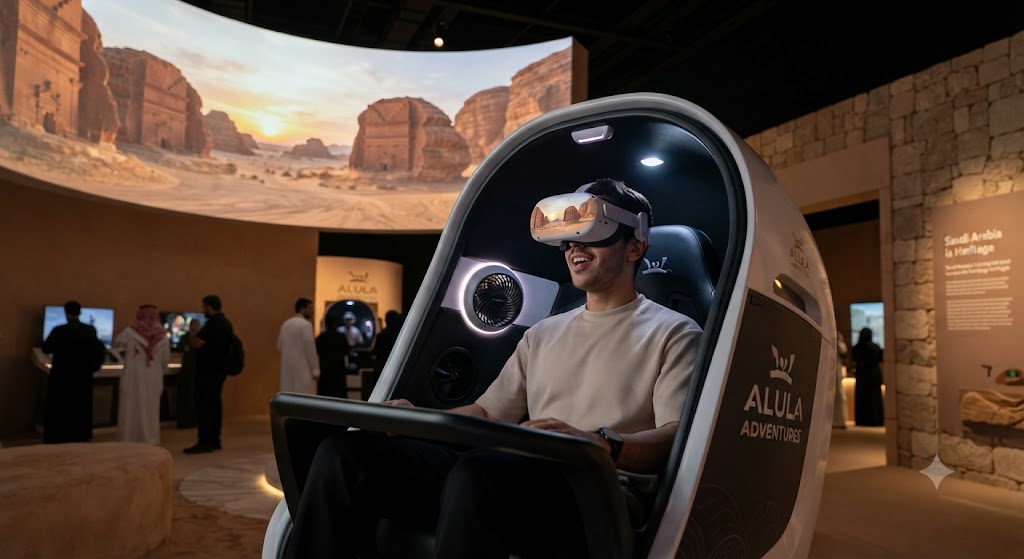
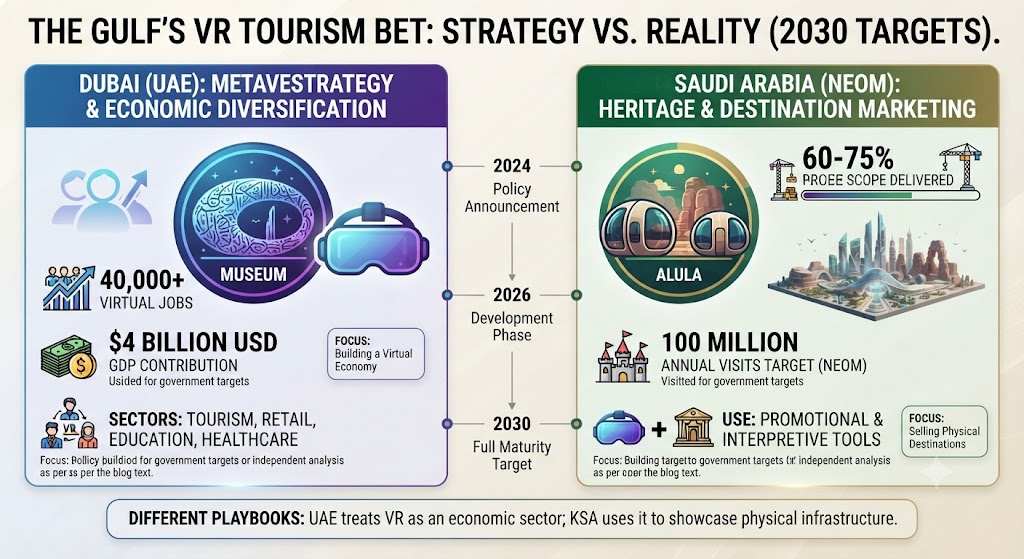
Two Gulf nations are betting on virtual reality to shape how the world sees them, and they’re taking genuinely different approaches. Saudi Arabia is using VR to bring ancient heritage sites to people who haven’t visited yet; AlUla’s VR pods let you feel simulated wind while “flying” through 2,000-year-old tombs. The UAE, meanwhile, has built VR into actual government policy, Dubai’s Metaverse Strategy targets $4 billion in GDP and 40,000 jobs by 2030.
Both approaches are genuinely interesting. Both also come with real gaps between the vision and what’s actually built today, and this guide won’t paper over that.
Here’s what we’ll cover:
- What’s genuinely live and bookable right now, not concept art
- Saudi Arabia’s real heritage VR products, led by AlUla
- The honest state of NEOM’s digital and physical tourism ambitions
- Dubai’s actual metaverse strategy, with real government targets
- Abu Dhabi’s museum VR and virtual destination projects
- What this means if you’re planning to actually visit
AlUla: Saudi Arabia’s Real VR Heritage Story
AlUla is where Saudi Arabia’s VR tourism ambitions are furthest from theory and closest to something you can actually experience today.
AlUla Adventures is a genuinely built product, not a rendering. It’s a 10-15 minute interactive VR pod experience that “teleports” visitors to ancient AlUla, complete with 360-degree sensory effects including wind and haptic sensations designed to make flying, driving, and floating through the landscape feel physically real.
The pod format itself is worth understanding, unlike a standard headset-only experience, visitors sit inside an enclosed unit where the physical sensations (wind, motion, vibration) are synchronized directly with what’s happening in the visual scene, closer to a themed motion-simulator ride than a typical seated VR session. You finish with a personalized digital journal of the experience to keep, turning what could be a purely passive preview into something with a tangible, shareable takeaway.
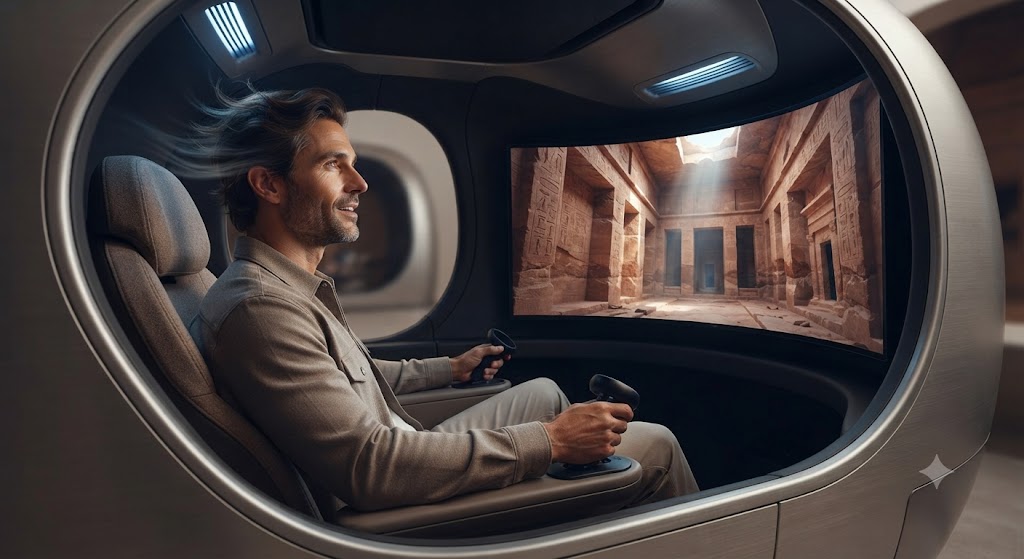
Separately, the Royal Commission for AlUla partnered with Dubai-based Limina Studios to build a full 3D virtual tour of Hegra, Saudi Arabia’s first UNESCO World Heritage Site. That tour has been shown at the Saudi Tourism Forum, Arabian Travel Market in Dubai, and World Travel Market in London, part of a deliberate international promotional push rather than a one-off tech demo.
On-site, augmented reality is already live for real visitors, smartphones and wearable smart glasses overlay digital reconstructions of tombs and inscriptions directly onto the physical ruins at Hegra. This is worth understanding as a distinct layer from the VR pod experience, AR enhances an in-person visit, while the VR products let people experience AlUla remotely before ever booking a flight.
This dual approach, remote VR previews plus on-site AR enhancement, reflects a deliberate strategy from the Royal Commission for AlUla. Rather than treating VR as a replacement for visiting, it’s positioned explicitly as a promotional tool, giving international audiences at travel trade shows a taste of the destination before they commit to booking flights to a region many first-time visitors know little about.
Two Different National Strategies, One Shared Bet
Stepping back from individual venues and projects, Saudi Arabia and the UAE are actually running two genuinely different playbooks, and understanding the difference matters if you’re trying to predict where this space goes next.
Saudi Arabia’s approach centers on heritage and physical destination-building. AlUla, Diriyah, and NEOM all represent enormous physical infrastructure investments, with VR and AR serving primarily as promotional and interpretive tools layered on top of real construction. The digital experiences exist to sell a physical destination, not to replace one.
The UAE’s approach, particularly Dubai’s, treats the metaverse and virtual reality as an economic sector in its own right, not just a marketing tool for physical tourism. The 40,000 jobs and $4 billion GDP target aren’t about selling more hotel rooms, they’re about building an actual virtual economy, digital real estate, virtual retail, and metaverse-native jobs, that exists alongside physical tourism rather than purely serving it.
Neither approach is inherently better, they reflect different national economic priorities. Saudi Arabia is earlier in its tourism development cycle and genuinely needs promotional tools to build initial visitor awareness for destinations most international travelers have never heard of.
The UAE, with a far more mature tourism sector already established through Dubai and Abu Dhabi’s decades of infrastructure investment, has more room to experiment with the metaverse as a standalone digital economy play rather than purely a marketing function.
There’s a useful test for telling these two approaches apart when you encounter Gulf VR tourism content going forward: ask whether the digital experience is selling you a specific physical place you could visit, or selling you participation in a broader digital economy. AlUla Adventures and Louvre Abu Dhabi’s tours are unambiguously the former.
Some of the more speculative elements within Dubai’s original 2022 metaverse strategy documents lean closer to the latter, and that’s exactly the category facing the most scrutiny as the broader metaverse concept has cooled.
Is This Genuine Strategy or Metaverse Hype?
It’s worth asking this directly, since the term “metaverse” itself has taken a real reputational hit since 2022, when Dubai’s strategy was first announced.
The broader metaverse concept has cooled considerably industry-wide, our own honest look at what happened to the metaverse covers this shift in detail. Meta’s own metaverse division has scaled back dramatically from its original ambitions, and “metaverse” as a standalone buzzword has largely fallen out of favor in mainstream tech conversation.
That context matters here, but it doesn’t necessarily invalidate what Dubai and Saudi Arabia are building. The distinction worth drawing is between speculative consumer metaverse products (virtual real estate speculation, NFT-based digital goods, persistent social worlds nobody actually uses) and applied VR tourism tools (AlUla’s pods, Louvre Abu Dhabi’s museum tours, AR heritage overlays), which solve a specific, real problem: letting people experience a destination before committing to travel there.
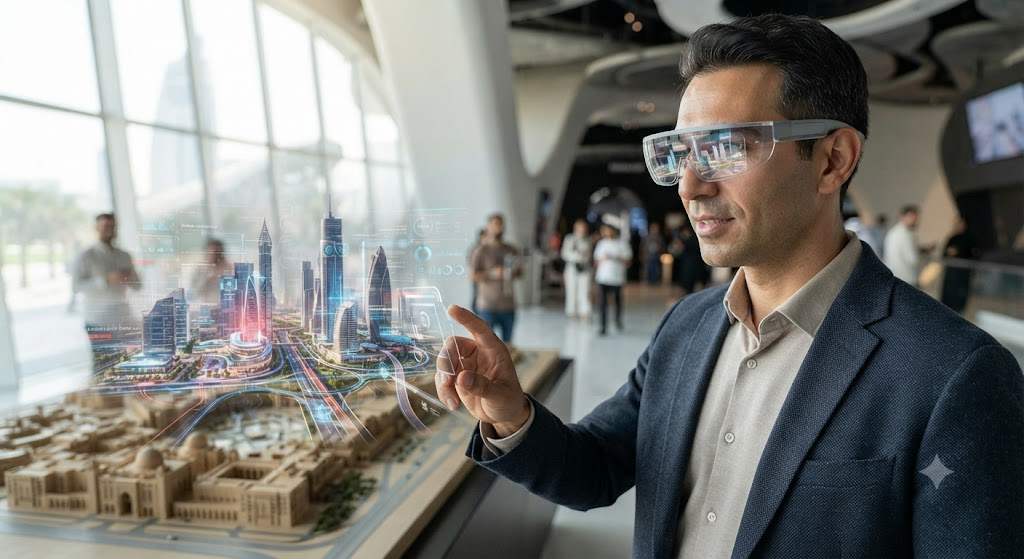
Dubai’s own strategy documents from 2022 leaned heavily on the broader speculative metaverse language that’s since fallen out of fashion, virtual real estate, digital economies, NFT-adjacent concepts. Whether the $4 billion GDP target survives contact with that broader cooling trend is a genuinely open question worth watching, separate from whether the tourism-specific VR applications themselves are useful.
NEOM: The Honest State of Saudi Arabia’s Most Ambitious Vision
NEOM gets the most attention of any Gulf giga-project, and it deserves an honest assessment rather than repeated marketing language.
The vision remains genuinely ambitious: NEOM’s tourism vertical targets 100 million annual visits at full maturity, with destinations like Sindalah, Trojena, and Magna positioned to capture international luxury tourism that doesn’t currently exist in Saudi Arabia. International hotel operators including Marriott, Accor, and Aman have committed to properties there.
The reality has been more complicated. Trojena, the ski resort built to host the 2029 Asian Winter Games, faces real, publicly documented delays, including the practical challenge of maintaining snow in a desert region. The Mukaab, a related Riyadh giga-project, was suspended at the earthworks stage in January 2026, with completion pushed from 2030 to a notional 2040. A reported $10 billion logistics joint venture with DSV remained non-operational as of February 2026.
Independent giga-project analysis suggests Saudi Arabia’s broader portfolio will likely deliver 60-75% of its announced scope by 2030, with full build-out extending into the 2035-2040 range. That’s not necessarily a failure, Red Sea Global, a comparable giga-project, has already opened its first resort with a working airport and real guests.
It’s a reminder that digital previews and renderings move faster than concrete and steel, and treating NEOM’s VR marketing materials as a preview of an imminent reality would be misleading readers.
Dubai’s Metaverse Strategy: Real Government Targets, Not Just Buzzwords
Unlike NEOM’s tourism ambitions, Dubai’s metaverse push is genuinely policy, not just marketing.
The Dubai Metaverse Strategy was unveiled at the 2022 Dubai Metaverse Assembly, hosted at the Museum of the Future and organized by the Dubai Future Foundation. More than 500 global experts attended, with over 20,000 people present on the opening day alone. The strategy sets concrete targets: 40,000 additional virtual jobs and up to $4 billion in GDP contribution by 2030, concentrated heavily in augmented and virtual reality roles specifically.
Tourism was explicitly named as one of the sectors the strategy targets, alongside logistics, retail, education, and healthcare. Side sessions and activations at the assembly, run by companies including Microsoft, Binance, Mastercard, and Meta, demonstrated potential applications across these sectors, with the tourism-focused activations specifically showcasing virtual previews of attractions and destinations rather than purely speculative digital asset concepts.
This connects directly to the broader digital transformation happening across the emirate, our guide to spatial computing in Dubai and the UAE covers the wider technology infrastructure this tourism push sits within.
Abu Dhabi’s Approach: Museums and Virtual Destinations
Abu Dhabi has taken a more institution-led approach than Dubai’s broad economic strategy.
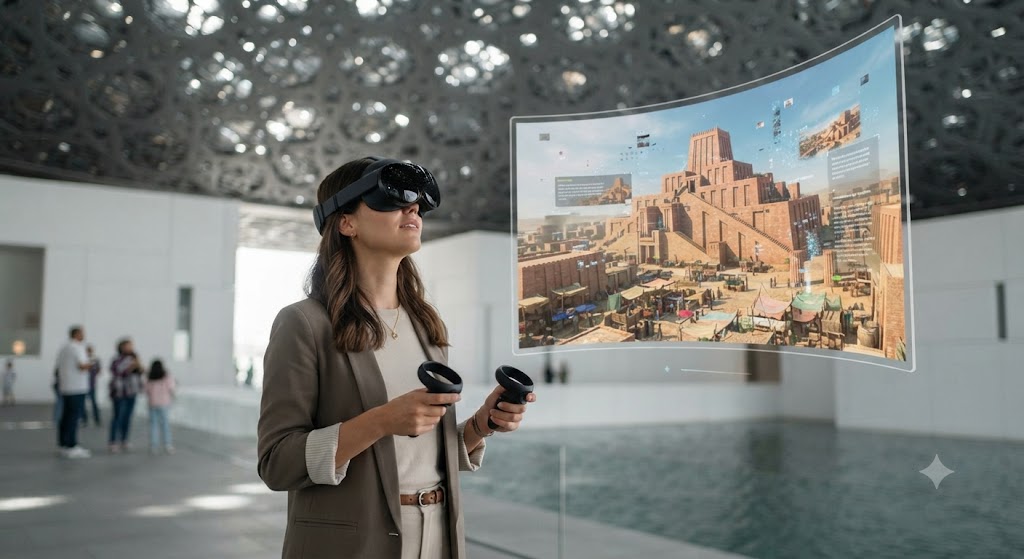
Louvre Abu Dhabi runs VR tours that let visitors “enter” reconstructed Mesopotamian ziggurats and Ottoman-era spaces, with AR overlays providing artifact-level detail as you explore. AI-driven chatbots also guide some tours in multiple languages, pulling from digitized archives to answer visitor questions about specific artifacts on display, a genuinely practical application of the same underlying AI technology powering more general virtual assistants.
The Zayed National Museum, still under development, is applying machine learning to analyze historical artifacts and trace trade routes from pottery patterns, a research application that will likely feed into future visitor-facing VR content once complete. This kind of behind-the-scenes ML work rarely gets covered in tourism content, but it’s genuinely relevant, the quality of future VR reconstructions depends directly on this underlying archival and analytical work happening now.
Separately, the Yas Island Metaverse project recreated the real Abu Dhabi tourist destination, home to Ferrari World and Yas Waterworld, as an explorable virtual space, letting users discover cultural attractions and virtual theme park content before ever booking a physical trip. This positions Yas Island alongside Dubai’s broader strategy of using virtual previews specifically to convert online interest into physical visits, rather than treating the virtual space as a destination in its own right.
What You Can Actually Try Today
Cutting through the announcements and giga-project renderings, here’s what’s genuinely available to experience right now:
- AlUla Adventures, Saudi Arabia, a bookable VR pod experience with sensory effects
- AR overlays at Hegra, Saudi Arabia, live on-site via smartphone or smart glasses
- Louvre Abu Dhabi’s VR tours, UAE, exploring reconstructed historical spaces
- Virtual AlUla’s 360° tours, accessible online from anywhere, no travel required
Notably, most of what NEOM and the broader Dubai Metaverse Strategy promise is either still in development or exists as policy targets rather than a specific bookable tourist product today. That’s not a criticism, ambitious infrastructure takes years, but it’s the honest distinction between what you can experience this month versus what’s being built toward 2030.
Planning a Trip Around These Experiences
If you’re genuinely considering a visit built around this technology rather than just reading about it, a few practical points are worth knowing.
AlUla requires real advance planning
Unlike Dubai’s more established tourism infrastructure, AlUla is a developing destination, flights, accommodation, and experience bookings should be arranged well ahead of a trip, and it’s worth checking current visitor guidelines directly through the Royal Commission for AlUla’s official channels rather than third-party resellers.
Combine AlUla with Hegra for the fullest picture
Since the AR overlay experience and the VR pod experience serve different purposes, one enhances the physical site, one previews it remotely, visitors who do both get a genuinely richer sense of the destination than either alone.
Dubai and Abu Dhabi are far easier to combine with existing travel plans.
Louvre Abu Dhabi sits within an already well-developed tourism infrastructure, making it straightforward to add to a broader UAE itinerary in a way AlUla, still earlier in its development, currently isn’t.
Don’t expect NEOM to be a bookable VR tourism stop yet
Based on the honest delivery timeline covered above, treat any NEOM-branded VR previews you encounter as promotional material for a future destination, not a current visitor experience.
Frequently Asked Questions
Is there a real VR experience of AlUla available today?
Yes. AlUla Adventures is a bookable VR pod experience with sensory effects like simulated wind, and Virtual AlUla offers free 360° online tours accessible from anywhere without needing to book a physical visit.
Is NEOM’s virtual reality tourism vision realistic?
Partially. The vision is genuine and well-funded, but independent analysis suggests the broader giga-project portfolio will likely deliver 60-75% of its announced scope by 2030, with some elements like Trojena facing real, publicly acknowledged delays.
Can I experience Gulf VR tourism without traveling there?
Yes, to a real extent. Virtual AlUla’s 360° tours and various museum VR previews are accessible online, though the full sensory pod experiences like AlUla Adventures do require an in-person visit to Saudi Arabia.
What is Dubai’s Metaverse Strategy actually trying to achieve?
Concrete, government-set targets:
- 40,000 additional virtual jobs by 2030
- Up to $4 billion in GDP contribution by 2030
- Tourism, logistics, retail, education, and healthcare named as target sectors
What’s the difference between Saudi Arabia’s and the UAE’s approach to VR tourism?
Saudi Arabia uses VR primarily as a promotional tool for physical destinations still being built, giving international audiences a preview of places like AlUla before they book travel. The UAE, particularly Dubai, treats the metaverse as its own economic sector, with government job and GDP targets that go beyond simply marketing physical tourism.
The Bottom Line
The Gulf’s VR tourism story genuinely splits into two honest categories: what’s built and bookable today, led by AlUla’s sensory VR pods and Abu Dhabi’s museum experiences, and what’s still a government target or investor rendering, most notably NEOM’s grander ambitions and parts of Dubai’s metaverse economy. Both are worth knowing about, but conflating the two does readers a disservice.
Saudi Arabia and the UAE are running genuinely different playbooks toward the same broad goal, and both are worth watching over the next few years as the gap between rendering and reality either closes or widens further.
For the global picture on this topic, see our guide on how virtual reality is revolutionizing travel and tourism, our honest look at what happened to the metaverse, our separate VR experiences and arcades in Dubai guide, or our homepage for ongoing coverage.
Author About
Aamir Khan is a senior technology writer with expertise in virtual reality, emerging technologies, digital transformation, and user experience. As a content specialist, he has developed and managed impactful content strategies for global audiences, which combine technical accuracy with practical insights. His work focuses on helping readers understand the real-world applications, innovations, and future impact of immersive technologies.