
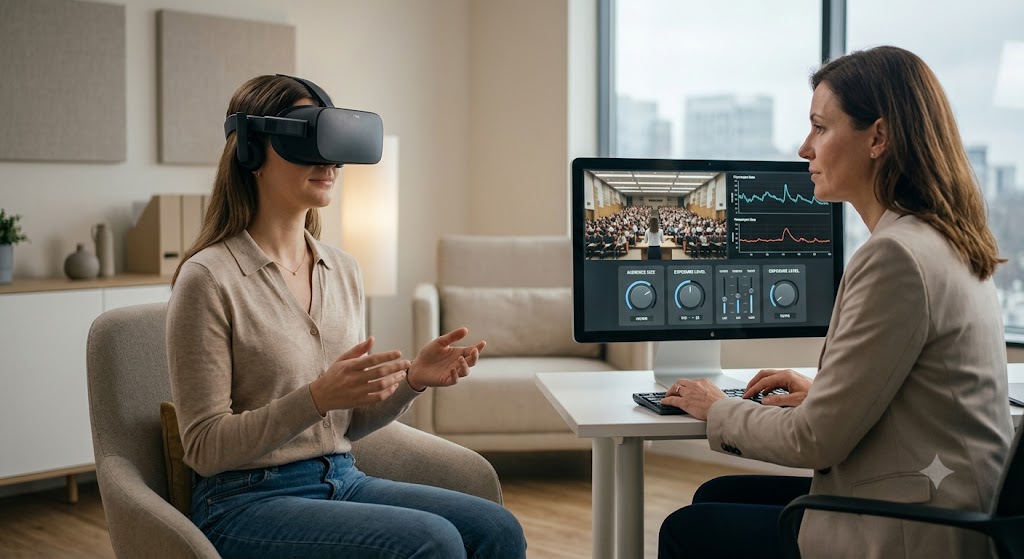
This is one of those questions where the gap between what the research shows and what most people believe is unusually wide. People who have read a few headlines about VR therapy often assume it is somewhere between a wellness gimmick and speculative technology. People working in clinical psychology research tend to regard VR exposure therapy as one of the best-supported treatments they have for several anxiety conditions, frustrated mainly by how slowly it has been adopted in actual practice.
So let’s answer the question properly: can VR help with anxiety? The short answer is yes, with real evidence behind it. But the longer answer includes important context about what VR for anxiety actually means clinically, who delivers it, and why the research does not always translate smoothly into what is available to patients right now. This article is an overview of the clinical evidence, not medical advice. If you are experiencing anxiety, the right next step is speaking with a qualified mental health professional.
At Future of Virtual Reality, we cover the full picture of how immersive technology is being applied in healthcare and wellbeing. Our VR health and wellness section covers the broader therapeutic landscape alongside this research overview.
What VR Exposure Therapy Is, and Why It Is Different From VR Relaxation
Before getting into the research, it helps to separate two very different things that often get conflated in popular writing about VR and mental health. The first is VR relaxation or mindfulness content: virtual nature environments, guided breathing exercises, or immersive meditation apps. There is some evidence these can reduce situational stress, but that is not what we are discussing here.
The second, and the subject of the research we are covering, is Virtual Reality Exposure Therapy (VRET). VRET is a specific clinical procedure, a digital adaptation of exposure therapy, which is itself one of the most well-established evidence-based treatments in all of psychology. Exposure therapy works by gradually and systematically exposing a patient to feared or anxiety-producing stimuli, under clinical supervision, until the fear response diminishes through a process called habituation or extinction.
VR makes this possible in situations where real-world exposure would be impractical, too costly, or too dangerous. If someone has a fear of flying, real-world exposure therapy would eventually involve getting on a plane. VRET can put that person inside a convincingly realistic plane simulation, with turbulence and takeoff sounds, under a therapist’s direct observation and control, in a clinical office. That is the core value proposition. The AI layer now entering VRET platforms is making these simulations smarter and more personalized, something we cover in detail in our piece on how AI and VR are creating smarter immersive experiences.

Why Researchers Became Interested in VR for Anxiety in the First Place
Exposure therapy has been a cornerstone of anxiety treatment for decades, but it has always faced a practical problem: creating real-world exposure scenarios can be difficult, expensive, or simply impossible in many situations.
A therapist treating a fear of flying cannot easily schedule repeated airline experiences for every patient. Someone struggling with social anxiety may require exposure to increasingly complex social situations that are difficult to reproduce consistently. For PTSD, recreating certain environments safely and ethically can be even more challenging.
Virtual reality emerged as a potential solution because it allows therapists to create realistic environments while maintaining complete control over the intensity of the experience. Sessions can be paused, repeated, adjusted, or personalized based on a patient’s response. This level of control is one of the reasons VRET attracted research attention long before consumer VR headsets became widely available.
Perhaps more importantly, VR often lowers the psychological barrier to beginning treatment. Patients who might initially refuse direct real-world exposure may feel more comfortable taking a first step inside a virtual environment. In clinical practice, that willingness to begin treatment can be a significant advantage.
Can VR Help With Anxiety Disorders? What Randomized Trials Show
The evidence base for VRET is now substantial. A 2026 meta-analysis published in the Journal of Global Health by Chang, Arifin, Hung, and colleagues, conducted across seven databases including PubMed, Embase, PsycINFO, Cochrane Library, and MEDLINE, analyzed randomized controlled trials examining VRET specifically for patients with clinically diagnosed anxiety disorders and PTSD. This distinction matters: some earlier meta-analyses included participants who were anxious but did not have formal clinical diagnoses, which produces more favorable but less clinically meaningful results. This 2026 study focused specifically on people with actual diagnosed anxiety disorders, and the findings confirm what a growing body of individual trials has shown: VRET produces significant reductions in anxiety, phobia symptoms, behavioral avoidance, and PTSD symptom severity.
A separate 2025 systematic review and meta-analysis in the Journal of Behavioral and Cognitive Therapy found that VRET produces positive outcomes comparable to in-vivo exposure therapy, meaning real-world exposure conducted with a therapist. That comparison is the key clinical benchmark: it suggests a VR session can produce similar therapeutic effects to the gold-standard alternative that involves actually facing the feared situation in the real world. For conditions where real-world exposure is logistically difficult or too distressing to initiate, that equivalence is clinically significant.
A Frontiers in Public Health protocol published in January 2026 further addresses self-guided VRET for social anxiety disorder, noting that self-guided virtual reality exposure therapy has been demonstrated to be an effective intervention for social anxiety disorder in multiple studies. Research compiled by Wray and colleagues described VR anxiety treatments as “unambiguously successful” in the clinical literature, while flagging the uncomfortable gap this creates: despite strong evidence, fewer than half of trained providers report using exposure therapy with anxious patients, and VRET adoption is even lower.
What Conditions Have the Most Evidence
- Specific phobias (fear of heights, spiders, flying, blood and needles, public speaking) have the longest and deepest evidence base for VRET. These conditions are well-suited to VR because the feared stimulus can be realistically simulated.
- Social anxiety disorder has a growing evidence base, with the 2025 meta-analysis and the 2026 Frontiers protocol both addressing it directly. VRET allows therapists to simulate social situations with configurable difficulty levels.
- PTSD has been studied particularly in military veteran populations, with encouraging results from several randomized trials. The ability to create controlled simulations of trauma-associated environments is clinically valuable.
- Panic disorder with agoraphobia has some trial evidence, particularly for the agoraphobia component where feared public settings can be simulated precisely.
- Generalized anxiety disorder has the least VRET-specific evidence, which makes sense given that GAD is characterized by pervasive, free-floating anxiety rather than specific triggers that can be simulated in a virtual environment.
Where VR Therapy Appears Most Effective
One pattern emerges repeatedly throughout the literature: VRET tends to perform best when anxiety is connected to identifiable situations, environments, or triggers.
This helps explain why specific phobias have become the strongest area of evidence. A virtual airplane, elevator, bridge, auditorium, or medical procedure room can be recreated with a high degree of realism. Therapists can gradually increase difficulty while maintaining complete control over the environment.
Social anxiety has also become an increasingly important focus for researchers because social interactions can be simulated in ways that are difficult to achieve through traditional role-playing exercises. Patients can practise presentations, conversations, interviews, or public speaking situations without the unpredictability of real-world exposure.
The further anxiety moves away from specific triggers and toward generalized worry, however, the more challenging it becomes to design targeted virtual environments. This is one reason generalized anxiety disorder remains a more complex area for VR-specific research.

Who Delivers VRET and Why That Matters
One finding that does not get enough attention in popular coverage is that VRET does not require a highly specialized VR technician. A 2025 ScienceDirect systematic review on immersive VR for anxiety disorders noted that trained non-specialists, including graduate students, postdoctoral fellows, and nurses with appropriate training, have successfully delivered VRET in trial settings with outcomes comparable to specialist-delivered therapy.
This is clinically significant because it suggests VR exposure therapy could be scaled more broadly than traditional specialist-delivered therapy, which faces real access constraints due to the ratio of trained clinical psychologists to the population needing them. A nurse-delivered VR anxiety protocol could reach patients who currently sit on long waiting lists for specialist services.
A 2026 JMIR Medical Education study from Brown University directly examined whether VR could help train therapists in delivering exposure therapy. Exposure-based CBT is, paradoxically, one of the least-used evidence-based practices for anxiety despite clear efficacy, partly because providers hold negative beliefs about patient tolerability. The study found VR was a feasible training tool for therapists, and notably observed that even lower-immersion desktop VR formats provided sufficient experiential learning, which matters enormously for scalability.
The AI layer is entering VRET meaningfully. A 2026 systematic review in Nature’s Translational Psychiatry specifically mapped AI applications for VRET, including conversational AI agents, machine learning for outcome prediction, and methods to personalize exposure scenarios based on real-time patient response data. These developments suggest the next generation of VRET platforms will be considerably more adaptive than current static scenario libraries.
The Honest Limitations
The research is genuinely promising, but a few limitations deserve naming directly. Most published trials are relatively small in sample size. The parameters of which patients benefit most, in which formats, with how much therapist involvement, and for which specific conditions are still being refined. That does not mean VRET does not work; it means the evidence base is still maturing.
VR-induced side effects are a real consideration. Some patients experience cybersickness during VR sessions, which can disrupt an exposure protocol at precisely the wrong moment. Modern headsets with high refresh rates have reduced this significantly, but it has not been eliminated, and patients with certain vestibular conditions or motion sensitivity may not tolerate extended VR sessions well.
Consumer headsets are not clinical VRET tools. The environments used in clinical VRET research are purpose-built clinical applications, controlled by a therapist, with specific therapeutic protocols. Using a consumer Meta Quest to watch a VR relaxation video at home is a completely different thing from a clinical VRET session. The confusion between these two things leads to either inflated expectations or dismissive scepticism, neither of which serves the people who might genuinely benefit from the clinical version.
Access remains a significant practical barrier. VRET is not available through most standard mental health services outside specialist clinics, university research programmes, and private practice providers who have specifically invested in the equipment and training. Demand considerably exceeds current availability.
Why Adoption Has Been Slower Than the Research
One of the most surprising aspects of VRET is the gap between scientific evidence and real-world adoption. This pattern appears repeatedly across healthcare innovation: evidence accumulates faster than implementation.
Part of the challenge is practical. Most therapists were trained before immersive technologies became widely available and may have limited experience using VR systems. Even when clinicians recognize the value of exposure therapy, introducing new technology into an established clinical workflow requires training, investment, and organizational support.
There is also a perception issue. Public discussions about virtual reality often focus on gaming, entertainment, or consumer applications. As a result, many patients and even some healthcare professionals underestimate how extensively VR has been studied within clinical psychology.
Research institutions frequently adopt new therapeutic technologies years before they become commonplace in everyday practice. VRET appears to be following that familiar pattern. The science has matured faster than the infrastructure needed to deliver it at scale.
What This Means Practically
If you are reading this because you are dealing with anxiety and wondering whether VR might help, the responsible answer is: there is solid evidence it can, specifically in the clinical form (VRET delivered by a trained therapist), for specific phobias, social anxiety, and PTSD in particular. The path to accessing it is through your GP, a mental health referral, or a private psychologist who specifically offers VRET.
If anxiety is significantly affecting your daily life, please speak with your doctor or a qualified mental health professional. If you are in crisis, please reach out to a helpline in your country. In the UK, you can call Samaritans at 116 123 (free, 24 hours a day). In the US, you can call or text 988 (Suicide and Crisis Lifeline, available 24 hours a day for emotional distress of any kind, not only suicidal crisis).
Key Takeaways
- VR exposure therapy has a genuine, peer-reviewed evidence base, confirmed by a 2026 Journal of Global Health meta-analysis and a 2025 ScienceDirect meta-analysis finding VRET outcomes comparable to in-vivo exposure therapy.
- Conditions with the strongest evidence: specific phobias, social anxiety disorder, and PTSD.
- VRET is a clinical tool delivered by trained therapists, not a consumer wellness application for self-treatment.
- Primary access barriers: shortage of trained providers, limited availability through standard health services, and cost of equipment and training for clinical practices.
- AI integration into VRET platforms is an active research area that will improve personalization and scalability significantly over the next few years.
Frequently Asked Questions
Can VR help with anxiety?
Yes, based on clinical research. VRET is supported by multiple randomized controlled trials and meta-analyses for specific anxiety disorders including specific phobias, social anxiety disorder, and PTSD. However, it is a clinical treatment delivered by trained therapists, not a consumer technology solution for self-treating anxiety at home.
What does VR exposure therapy involve?
VRET places a patient inside a virtual environment simulating their feared situation, under a therapist’s supervision, and gradually increases the intensity of exposure until anxiety diminishes through habituation. The therapist controls the virtual environment in real time and can adjust difficulty, duration, and content based on patient response.
Is VR as effective as real exposure therapy for anxiety?
A 2025 meta-analysis in the Journal of Behavioral and Cognitive Therapy found that VRET produces outcomes comparable to in-vivo exposure therapy for specific phobia and social anxiety disorder. For conditions where real-world exposure is logistically difficult, VR may be clinically preferable because it offers greater control over the exposure scenario.
Which anxiety conditions respond best to VR therapy?
Specific phobias (heights, flying, spiders, public speaking, needles) have the strongest evidence base. Social anxiety disorder and PTSD also have meaningful trial support. Generalized anxiety disorder has the thinnest VRET-specific evidence because it is not defined by specific triggers that can be simulated.
Can you do VR anxiety therapy at home with a consumer headset?
No, not in the clinical sense. Consumer VR headsets do not include purpose-built clinical applications, therapist oversight, or specific exposure protocols used in VRET research. Using a consumer headset for relaxation content may provide situational stress relief, but that is a different intervention from clinical VRET.
Is VR therapy approved by mental health professionals?
Many psychologists, psychiatrists, and researchers consider VRET a legitimate evidence-based intervention for certain anxiety disorders. Its effectiveness has been evaluated through randomized controlled trials, systematic reviews, and meta-analyses over multiple decades of research.
Why isn’t VR therapy available everywhere if the evidence is strong?
Availability is limited primarily because of practical factors rather than lack of evidence. Clinics require equipment, training, and appropriate software, while many therapists have not yet received formal VRET training. Adoption is increasing, but implementation remains slower than the pace of research.
Pingback: VR Arcades Around the World: Ultimate 2026 Guide