
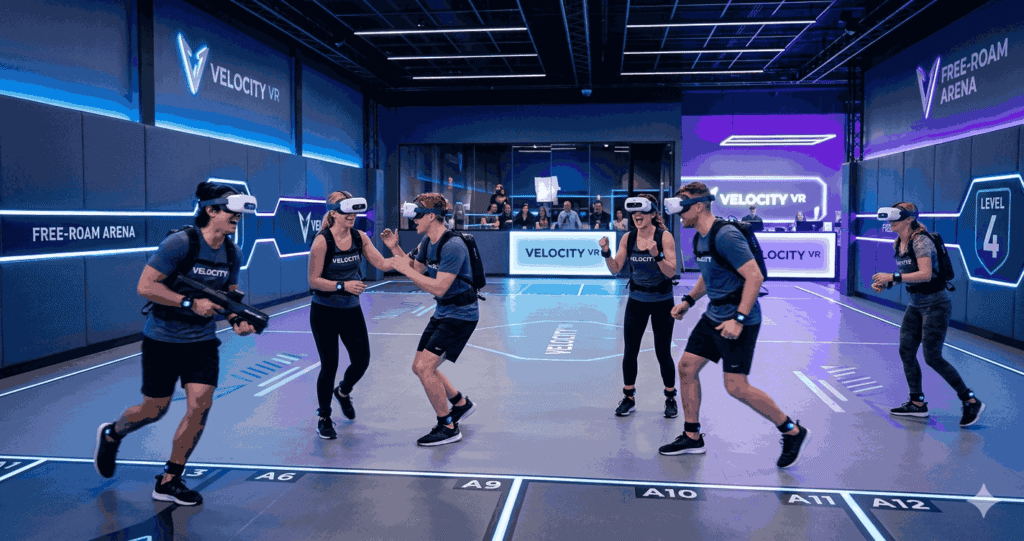
The location-based VR market was valued at $1.90 billion in 2025 and is projected to reach $2.76 billion in 2026, growing at a 31.1% CAGR through 2031 (Mordor Intelligence). VR arcades hold 45.21% of that market. Here’s what a modern VR gaming center actually offers, how much it costs to visit, and how the experience compares to owning a headset.
If you own a Meta Quest 3S and you’re wondering why anyone would pay to use VR at a commercial venue, that’s a fair question.
The answer isn’t about the headsets. A home VR setup can match or exceed the visual fidelity of many arcade systems. What it can’t match is physical space, full-body tracking, haptic feedback equipment, professional content licensed from major IP holders, and the multiplayer social experience of moving through a shared physical environment with other people.
That’s what a modern VR arcade sells. Not just VR. An experience you genuinely can’t replicate in your living room.
For context on the broader VR gaming landscape, see our breakdown of VR experiences in 2026 and the benefits of VR technology across entertainment and beyond.
What Is a VR Arcade and How Is It Different from Home VR?
Answer: A VR arcade (also called a VR gaming center, LBVR venue, or free-roam arena) is a commercial space equipped with professional-grade VR hardware, large physical play areas, and multiplayer content. The defining difference from home VR is scale: physical space, equipment investment, and IP-licensed content that isn’t available on consumer platforms.
The VR arcade category includes several distinct venue types:
- Free-roam arenas: Large spaces (typically 2,000 to 10,000 sq ft) where players physically walk and run through a shared VR environment. Full-body or partial-body tracking. Examples include Zero Latency, Sandbox VR, and The VOID format.
- Fixed-station arcade bays: Individual VR booths with tethered or standalone headsets, similar to traditional arcade machines. Lower setup cost, higher throughput.
- VR theme park zones: VR experiences within larger theme park contexts. Universal’s Epic Universe, which opened in May 2025, features VR zones that extend visitor dwell time and lift per-capita spending per Mordor Intelligence 2026 data.
- VR cinemas: Seated immersive film and media experiences. Less physically demanding, higher capacity.
- VR eSports lounges: Competitive gaming facilities built around VR titles. A growing category with over 200 VR-based competitive gaming events held worldwide in 2023.
How Big Is the VR Arcade Market in 2025 and 2026?
| Metric | 2025 Value | 2026 Projection | Source |
| Location-Based VR Market Size | $1.90 billion | $2.76 billion | Mordor Intelligence, March 2026 |
| VR Arcade Share of LBVR Market | 45.21% revenue share | Remains largest segment | Mordor Intelligence, Jan 2026 |
| LBVR Market CAGR (2026-2031) | 31.1% | Reaching $10.69B by 2031 | Mordor Intelligence, 2026 |
| Free-Roam Arena CAGR (2026-2031) | 31.54% | Fastest growing segment | Mordor Intelligence, Jan 2026 |
| Arcade Studios Share of Installations | 38.73% of 2025 installs | Growing | Mordor Intelligence, Jan 2026 |
| Asia-Pacific Revenue Share | 42.11% of global revenue | Fastest growing region | Mordor Intelligence, Jan 2026 |
| Mid East and Africa CAGR | 31.84% | Highest regional growth rate | Mordor Intelligence, Jan 2026 |
| New APAC Venues Opened (2025) | Nearly 30 in 2025 alone | Accelerating | Mordor Intelligence, Jan 2026 |
| Average VR Arcade Setup Cost | $150,000 to $250,000 | Lower end declining | Market Growth Reports, 2025 |
| Meta Quest 3S Operator Price | $299 door-buster (Q4 2025) | Sub-$300 entry tier | Mordor Intelligence, Jan 2026 |
| Location-Based VR Global Installs | 5,000+ as of 2023 | Increasing significantly | Market Growth Reports |
| Millennials Willing to Pay More for Immersive | 70%+ reported willing | Strong consumer demand | Market Growth Reports, 2025 |
What Does a VR Arcade Visit Actually Cost in 2026?
Pricing varies significantly by venue type, location, and experience duration. Here’s a realistic breakdown based on current market data:
| Venue Type | Typical Price Per Person | Duration | Notes |
| Fixed-station arcade bay | $15 to $30 | 15-30 minutes | High throughput, walk-in friendly |
| Free-roam multiplayer arena | $40 to $65 | 30-45 minutes | Group bookings common; Sandbox VR, Zero Latency |
| Premium free-roam (IP licensed) | $50 to $80 | 45-60 minutes | Stranger Things, Squid Game, IP content |
| VR theme park experience | $20 to $45 per ride | 10-15 minutes per attraction | Bundled in park entry at some venues |
| Private room/group booking | $150 to $400 per session | 60 minutes | Corporate, birthday, team bookings |
| VR eSports competition | $20 to $60 entry | Variable | Growing competitive format |
These figures represent 2025-2026 market averages. Prices in major metro areas (London, New York, Tokyo, Dubai) typically run 20-30% higher than secondary markets.

Which VR Arcade Operators Are Leading the Market in 2026?
The location-based VR market has several dominant operators globally:
Sandbox VR
Sandbox VR is one of the largest premium free-roam VR operators globally, known for its IP-licensed experiences. The company has partnered with Netflix to bring Stranger Things into its venue format, with Sandbox reporting that Netflix-branded experiences raised repeat visitation 30% above generic shooter titles (per Mordor Intelligence 2026 data). This demonstrates how licensed content converts existing fandom into commercial arcade revenue in a way that generic VR titles cannot.
Zero Latency
Zero Latency, founded in Melbourne, Australia, operates venues in North America, Europe, and Asia-Pacific. It focuses on free-roam arena formats for groups of 2 to 8 players, using proprietary untethered VR hardware and a large catalog of multiplayer experiences. Zero Latency is a benchmark for the free-roam arena category.
Hologate
Hologate provides a white-label VR multiplayer platform sold to entertainment venues, bowling alleys, and amusement centers globally. Its plug-and-play model has made it one of the most widely distributed VR gaming platforms in the fixed-station category, with installations across more than 50 countries.
Location-Based Expansion: The Asia-Pacific Surge
Asia-Pacific generated 42.11% of global location-based VR revenue in 2025 and is the fastest-growing region for the category (Mordor Intelligence, Jan 2026). China has over 100 VR mega-installations. Dense arcade networks in tier-1 Chinese and South Korean cities are driving commercial headset demand. Nearly 30 new APAC venues opened in 2025, confirming that commercial arcades are moving from niche pilots to scalable revenue operations.
VR Arcade vs. Home VR: Which Wins in 2026?
This isn’t actually an either-or question. They serve different functions.
| Factor | VR Arcade | Home VR (Meta Quest 3S, $299) |
| Physical space | 2,000+ sq ft free-roam possible | Living room only (typically 6×6 ft) |
| Body tracking | Full-body in premium venues | Controllers + hand tracking only |
| Haptics | Vests, props, wind effects at premium venues | Controller vibration only |
| Content | IP-licensed, multiplayer, exclusive titles | Growing library, some exclusives |
| Social multiplayer | Physically shared space with others | Online multiplayer only |
| Cost per session | $40-$80 for 45-60 minutes | Upfront $299 + game purchases |
| Accessibility | Requires travel to venue | Available at home anytime |
| Comfort duration | Designed for 30-60 minute sessions | Extended daily use possible |
| Motion sickness risk | Lower in high-quality venues (better hardware) | Variable by user and title |
The practical breakdown: if you want VR gaming regularly, home ownership is more cost-effective after 5-10 sessions compared to arcade pricing. If you want the best possible group multiplayer experience, a physically immersive event, or access to licensed IP content, a VR arcade delivers things a home setup genuinely cannot replicate.

What’s Driving VR Arcade Growth in 2026?
Three converging factors are accelerating the location-based VR market right now.
Hardware Costs Are Falling, Which Shortens Payback Periods
Meta Quest headset pricing dropped from more than $1,500 (commercial-grade hardware) to $249 for Quest 3S during Q4 2025 door-buster sales. Mordor Intelligence calculates that this price decline has reduced typical VR arcade break-even timelines from 18 months to approximately 12 months in high-footfall venues. Lower break-even times attract more operators and make bank financing available, replacing the earlier reliance on venture capital.
Pico’s Project Swan is expected in 2026 at approximately $1,500 to $2,000, targeting the premium enterprise and commercial tier. Its arrival creates a competitive alternative to Meta hardware for venue operators who want more control over software environments.
IP Licensing Is Converting Streaming Audiences into Arcade Visitors
Sandbox VR’s Netflix partnership demonstrates a distribution model that traditional arcades cannot replicate: converting an existing fan base into a paying experience audience. A Stranger Things VR experience at Sandbox is not competing with Netflix’s streaming service. It’s extending the IP into a physical format that a 65-inch OLED TV cannot provide. This type of IP synergy is expected to expand as streaming services seek new revenue formats.
5G and Edge Computing Are Reducing Technical Barriers
5G standalone deployments now cover most major metro areas in the United States, Germany, South Korea, and China. Edge rendering services are lowering latency to under 60 milliseconds in connected venues, enabling cloud-based VR content delivery on lightweight headsets without onsite server farms. This reduces the capital requirements for venue operators and opens the market to smaller or mobile VR operations.
What Are the Real Risks in the VR Arcade Market?
Honest risk assessment: location-based VR has genuine challenges.
High setup costs for premium venues: Building a single premium free-roam VR arena can cost $500,000 or more, including space rental, custom hardware, content licensing, and fit-out. This limits new entrants and concentrates the market around well-capitalized operators.
Content refresh requirement: VR arcade customers are repeat visitors only if the content library updates. A venue that launches with three experiences and doesn’t add new ones within 6 months will see declining return visits.
Motion sickness risk management: Not all users can tolerate even premium VR experiences. Venue staff need training to manage this. Refund and partial-refund policies are standard at well-run venues and should be factored into revenue projections.
Competition from improving home hardware: As home VR improves (eye tracking at $299 with Quest 3S, growing content library, improving haptics), the feature gap between commercial and consumer hardware narrows. VR arcades must continuously invest in differentiated experiences.
For a broader view of how VR technology is evolving across all these categories, see our future of VR overview and our deep dive on VR headset technology in 2026.
The VR arcade market’s 31.1% CAGR forecast is supported by structural tailwinds: falling hardware costs, IP licensing deal flow, 5G infrastructure, and the demonstrated consumer willingness to pay for social out-of-home experiences. The risk to the forecast is concentrated in content refresh rates and operator capital constraints. Venues that solve the content problem tend to retain customers. Those that don’t, don’t.
Frequently Asked Questions
What is a VR arcade?
A VR arcade is a commercial venue where customers pay to use professional-grade VR equipment, often in larger physical spaces than home setups allow. Venue types include free-roam arenas, fixed VR bays, VR cinemas, and multiplayer gaming centers. The key difference from home VR is physical scale, social multiplayer, and access to licensed IP content.
How much does a VR arcade visit cost?
Pricing ranges from $15 to $30 for a fixed-station session (15-30 minutes) to $40-$80 per person for a premium free-roam experience (45-60 minutes). Group or private bookings typically run $150-$400 per session. Prices in major global cities tend to run 20-30% higher than secondary markets.
Are VR arcades better than home VR?
They’re different, not simply better or worse. Home VR (Meta Quest 3S at $299) offers better cost-per-session economics for frequent use. VR arcades offer larger physical spaces, full-body tracking, haptic equipment, and licensed multiplayer content that consumer hardware cannot replicate. They serve different occasions.
Which VR arcade chains are the best in 2026?
Sandbox VR and Zero Latency are the most recognized premium free-roam operators globally, with the strongest IP content catalogs and established venue networks. Hologate is the leading white-label provider for fixed-station venues. Specific quality varies by individual location, so checking recent reviews for your nearest venue is advisable.
Is the VR arcade business still growing?
Yes. The location-based VR market was valued at $1.90 billion in 2025 and is projected at $2.76 billion in 2026, growing at a 31.1% CAGR through 2031 (Mordor Intelligence). Asia-Pacific is the fastest-growing region. Hardware cost declines and 5G edge computing are the primary structural drivers of continued expansion.
Mordor Intelligence’s Location-Based VR market report (mordorintelligence.com/industry-reports/location-based-virtual-reality-vr-market, updated March 2026) is the most comprehensive publicly accessible data source on the commercial VR venue market, with global and regional breakdowns.
Pingback: VR Arcades Around the World: Ultimate 2026 Guide