
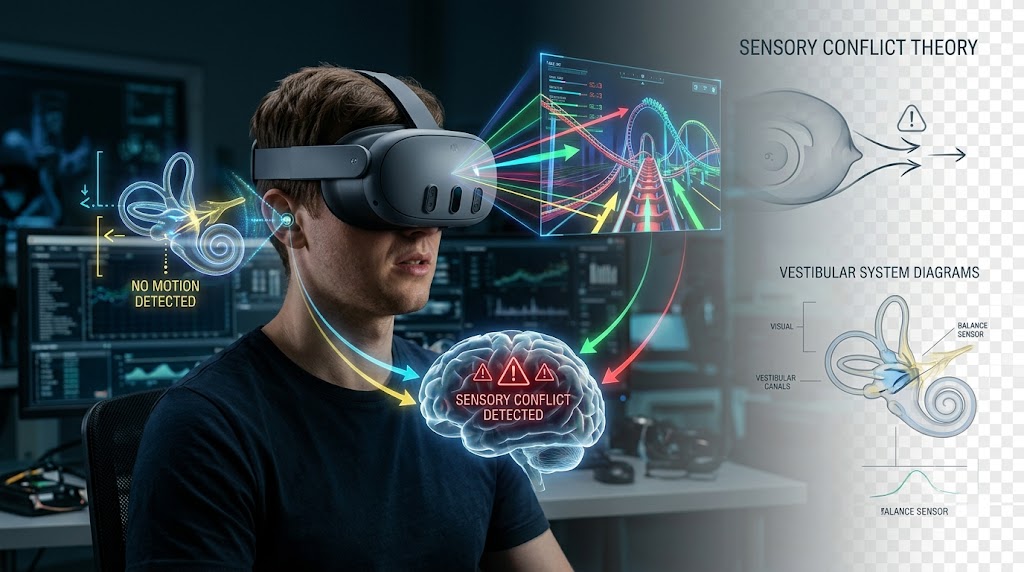
Virtual reality has advanced faster in the last five years than many experts predicted. Modern headsets offer sharper displays, better tracking, more realistic environments, and increasingly natural interactions. Yet despite these improvements, one challenge continues to affect millions of users worldwide:
VR motion sickness.
A person can spend hours playing a traditional video game without discomfort but feel nauseous after ten minutes inside a virtual world. Others can use VR for extended periods with no issues at all.
This difference raises an important question:
Why does virtual reality make some people feel sick when they are physically standing still?
The answer lies in how the human brain interprets movement.
Virtual reality is designed to convince the brain that a digital environment is real. When done well, the illusion becomes incredibly convincing. The challenge is that the human sensory system evolved for the physical world, not computer-generated environments.
As a result, the brain occasionally receives conflicting information about what is happening around it. This conflict can trigger symptoms ranging from mild dizziness to severe nausea.
Understanding this phenomenon is becoming increasingly important as VR expands into healthcare, education, training, tourism, engineering, and everyday entertainment.
If you’re new to immersive technologies, understanding how virtual reality works step by step provides useful background before exploring the science behind cybersickness.
What Is VR Motion Sickness?
VR motion sickness, often called cybersickness, refers to a collection of symptoms that occur when users experience discomfort inside virtual environments.
Common symptoms include:
- Nausea
- Dizziness
- Headaches
- Eye strain
- Sweating
- Fatigue
- Loss of balance
- Disorientation
Although these symptoms resemble traditional motion sickness, the underlying trigger is slightly different.
Traditional motion sickness typically occurs when your body is moving but your eyes fail to perceive that movement accurately.
For example:
- Reading a book in a moving car
- Looking down at a phone on a boat
- Sitting inside an aircraft during turbulence
Cybersickness works in the opposite direction.
Inside virtual reality, your eyes often perceive movement while your body remains completely still.
This mismatch creates confusion within the brain’s sensory processing system.
According to a comprehensive review published by the National Library of Medicine, cybersickness is largely associated with conflicts between visual information and vestibular signals responsible for balance and motion detection.
Why Does VR Cause Motion Sickness?
The simplest explanation is surprisingly straightforward:
Your eyes and your balance system disagree about what is happening.
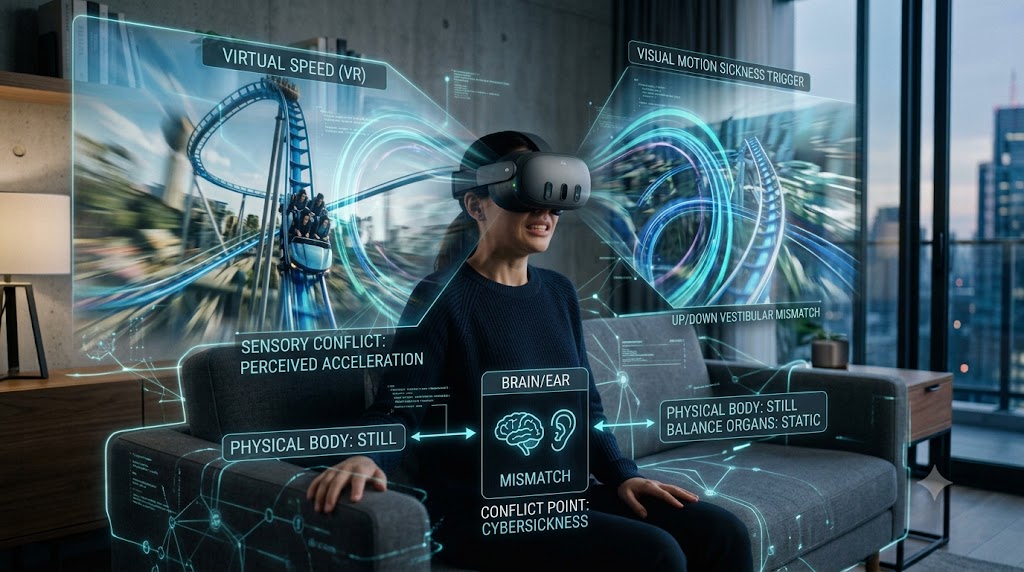
To understand why this matters, imagine sitting comfortably in your living room while wearing a VR headset.
Inside the headset, you’re exploring a futuristic city.
You can see:
- Buildings moving past you
- Roads scrolling beneath your feet
- Objects approaching from the distance
- Your virtual body walking forward
Everything visually suggests movement.
However, your physical body remains completely stationary.
Your legs are not moving.
Your muscles detect no forward motion.
Your inner ear senses no acceleration.
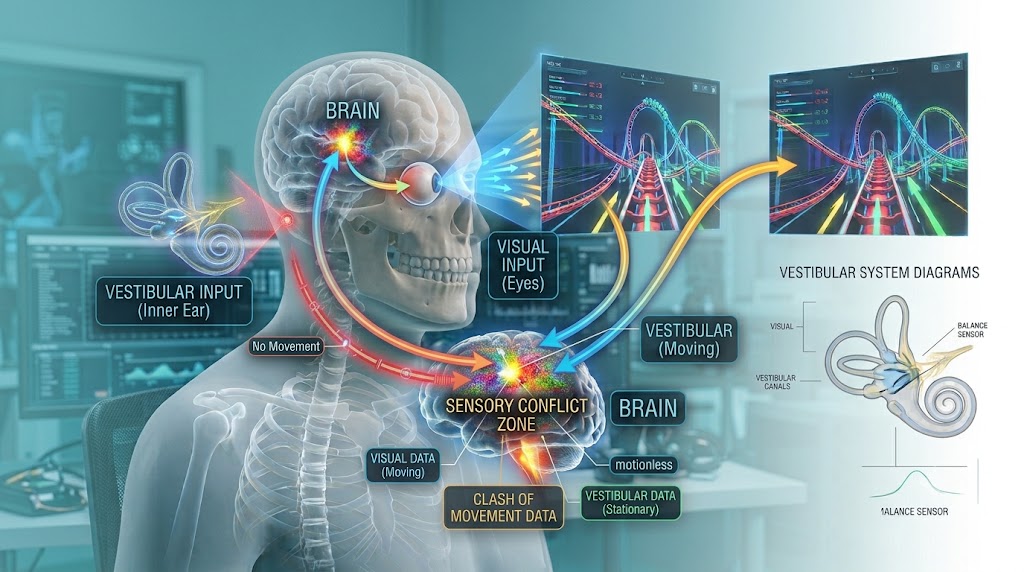
The brain suddenly receives two conflicting messages.
Message From Your Eyes
“We are moving.”
Message From Your Body
“We are standing still.”
The brain now has to determine which source of information is accurate.
This disagreement is widely recognized as one of the primary causes of cybersickness.
The Sensory Conflict Theory
Among all explanations proposed by researchers, one theory has received the strongest scientific support:
Sensory Conflict Theory
According to the CDC’s Motion Sickness Research, motion sickness often occurs when different sensory systems provide contradictory information to the brain.
Think of your brain as a judge reviewing testimony from three witnesses.
Witness #1: Your Eyes
Your eyes report:
“We are moving forward.”
Witness #2: Your Inner Ear
Your vestibular system reports:
“We are standing still.”
Witness #3: Your Muscles and Joints
Your body reports:
“No movement detected.”
The judge—the brain—now receives three different versions of reality.
The result is confusion.
That confusion manifests as symptoms commonly associated with cybersickness.
Table: How Sensory Conflict Develops in VR
| Sensory System | What It Detects | What Happens in VR |
| Eyes | Visual motion | Detect movement |
| Inner Ear | Balance and acceleration | Detects little or no movement |
| Muscles and Joints | Body position | Detect stillness |
| Brain | Combines sensory inputs | Receives conflicting information |
This mismatch may sound minor, but the human sensory system is incredibly sophisticated.
Even small inconsistencies can affect how comfortable a virtual experience feels.
The Hidden Role of the Vestibular System
Many people assume vision is responsible for most of their sense of movement.
In reality, your inner ear plays an equally important role.
Hidden deep inside the skull is a structure known as the vestibular system.
Its purpose is to help the brain understand:
- Direction
- Acceleration
- Rotation
- Head movement
- Balance
Every time you:
- Walk upstairs
- Ride a bicycle
- Turn your head
- Jump into a swimming pool
your vestibular system provides critical information about movement.
Normally, your visual system and vestibular system work together.
When you run forward:
- Your eyes see movement.
- Your vestibular system detects acceleration.
Both systems agree.
Virtual reality breaks this relationship.
Your eyes may perceive rapid movement while your vestibular system reports complete stillness.
The greater the mismatch, the greater the likelihood of discomfort.
Researchers publishing through Frontiers in Virtual Reality continue to identify vestibular conflict as one of the most significant contributors to cybersickness.
What Happens Inside the Brain During Cybersickness?
The brain constantly attempts to predict reality.
It combines information from multiple sources and creates a model of the world around us.
Most of the time, this process works remarkably well.
However, VR introduces situations the brain did not evolve to handle.
Consider a virtual roller coaster.
Visually, the environment suggests:
- Rapid acceleration
- Sudden drops
- Sharp turns
- High-speed movement
Your brain expects corresponding physical sensations.
Instead, your body remains stationary.
The prediction fails.
The brain now encounters conflicting sensory evidence.
Some researchers believe this conflict activates protective responses that evolved long before modern technology existed.
One popular evolutionary hypothesis suggests that the brain may interpret conflicting sensory signals as evidence of poisoning or neurological impairment, triggering nausea as a defense mechanism.
While scientists continue debating the exact mechanisms, the connection between sensory conflict and cybersickness remains strongly supported by evidence.
Real-World Scenario: The VR Roller Coaster Experiment
Imagine two individuals experiencing the same roller coaster.
Scenario A: Real Roller Coaster
The rider experiences:
- Physical acceleration
- Gravity changes
- Body movement
- Visual motion
Every sensory system agrees.
Scenario B: Virtual Roller Coaster
The rider experiences:
- Visual acceleration
- Visual drops
- Visual turns
However:
- No actual acceleration occurs.
- No physical drop occurs.
- No real force is experienced.
The brain receives incomplete information.
As a result, the virtual experience often feels less comfortable than the real one.
Ironically, increasing realism can sometimes increase cybersickness because the visual illusion becomes more convincing while the body remains stationary.
Why Some People Get Motion Sickness While Others Don’t
One of the most fascinating aspects of cybersickness is its variability.
Two people can use the same headset.
Play the same game.
Spend the same amount of time in VR.
Yet one person feels completely fine while the other experiences nausea within minutes.
Researchers have identified several contributing factors.
Previous Motion Sickness History
Individuals who frequently experience:
- Car sickness
- Sea sickness
- Air sickness
often report greater sensitivity to virtual reality.
Migraine Susceptibility
Studies suggest people with migraine histories may be more sensitive to immersive visual environments.
This doesn’t mean they cannot enjoy VR, but it may influence comfort levels.
Experience Level
First-time users are significantly more likely to experience discomfort.
Experienced VR users often develop greater tolerance through repeated exposure.
We’ll explore why this happens in Part 2.
Headset Fit and Optics
Improper headset configuration can dramatically increase symptoms.
Common issues include:
- Incorrect interpupillary distance (IPD)
- Lens misalignment
- Blurry visuals
- Poor headset positioning
Understanding VR headset technology can help users optimize these settings and improve comfort.
Age and Biological Differences
Research continues to investigate how factors such as:
- Age
- Vision characteristics
- Vestibular sensitivity
- Neurological variation
influence cybersickness risk.
Current evidence suggests there is no single profile that predicts susceptibility.
Every user responds differently.
What Research Actually Says About VR Motion Sickness
Although cybersickness remains an active research area, there is growing consensus on several key points.
Researchers Agree That:
- Cybersickness is real.
- Sensory conflict plays a major role.
- Individual susceptibility varies significantly.
- Better hardware reduces symptoms.
- Better software design reduces symptoms.
- Most users improve with experience.
These findings have shaped the design of nearly every major VR platform released in recent years.
As manufacturers continue improving displays, tracking systems, and rendering technologies, the industry is gradually moving closer to a future where motion sickness becomes far less common.
Which VR Experiences Cause the Most Motion Sickness?
Not all virtual reality experiences affect users equally.
Some applications are specifically designed to minimize sensory conflict, while others naturally create conditions that increase the likelihood of cybersickness.
One of the biggest misconceptions among new users is that all VR experiences are equally demanding. In reality, the difference between a stationary puzzle game and a high-speed flight simulator can be enormous.
The risk often depends on one simple factor:
How much virtual movement occurs without corresponding physical movement?
The greater the mismatch, the greater the potential for discomfort.
Table: Motion Sickness Risk by VR Experience Type
| VR Experience | Motion Sickness Risk | Why |
| Virtual Roller Coasters | Very High | Extreme visual acceleration without physical movement |
| Flight Simulators | Very High | Constant changes in speed, altitude, and direction |
| Racing Games | High | Rapid forward motion and sharp turns |
| First-Person Shooter Games | High | Continuous locomotion and quick camera movement |
| Open-World Exploration Games | Medium | Moderate movement through virtual environments |
| Sports Simulations | Medium | Varies depending on locomotion method |
| Educational Simulations | Low | Typically slower movement and controlled pacing |
| Puzzle Games | Very Low | Minimal artificial movement |
| Hand Tracking Experiences | Very Low | Natural interaction without locomotion |
| Mixed Reality Applications | Very Low | Users remain visually connected to the real world |
Why Roller Coasters and Racing Games Feel Worse
Let’s compare two experiences.
Scenario 1: Virtual Puzzle Room
You remain stationary.
You interact with objects using your hands.
You move only short distances.
Your brain receives mostly consistent information.
Result:
Low cybersickness risk.
Scenario 2: VR Roller Coaster
You visually accelerate to high speeds.
You drop hundreds of virtual feet.
You twist through loops and turns.
Your eyes report dramatic movement.
Your body remains still.
Result:
High cybersickness risk.
This is why many VR arcades and beginner experiences avoid intense locomotion during a user’s first session.
In fact, modern developers often include comfort warnings before launching high-intensity experiences.
The Gaming Industry’s Response to Motion Sickness
The gaming industry quickly discovered that immersion alone wasn’t enough.
If users felt sick, they stopped playing.
As VR adoption increased, developers began implementing design techniques specifically intended to reduce discomfort.
Today, most major VR titles include multiple comfort settings.
These features are now considered standard design practice.
Common Comfort Features in Modern VR Games
Teleport Movement
Instead of walking continuously through the environment, users instantly move from one location to another.
This eliminates much of the visual motion that causes sensory conflict.
Snap Turning
Instead of smooth rotation, the virtual camera rotates in small increments.
This significantly reduces vestibular mismatch.
Dynamic Field-of-View Reduction
Some games temporarily narrow peripheral vision during movement.
Research suggests peripheral motion contributes heavily to cybersickness.
Reducing visual input can lower symptom severity.
According to multiple studies available through the ACM Digital Library, limiting peripheral visual motion remains one of the most effective software-based mitigation techniques.
Stable Frame Rates
Maintaining smooth rendering performance is critical.
When frames are dropped or delayed, users often experience increased discomfort.
This is one reason modern hardware places such heavy emphasis on graphics optimization and low latency.
Case Study: Two New VR Users, Two Different Outcomes
Consider two first-time users purchasing identical headsets.
User A: The “Jump Right In” Approach
On the first day:
- Downloads a VR roller coaster.
- Tries a high-speed racing simulator.
- Plays for 90 minutes continuously.
Outcome:
- Dizziness
- Nausea
- Headache
User concludes:
“VR isn’t for me.”
User B: The Gradual Approach
On the first day:
- Starts with a stationary exploration experience.
- Uses VR for 15 minutes.
- Takes regular breaks.
Second week:
- Tries puzzle games.
- Experiments with teleport locomotion.
Third week:
- Begins playing moderate-motion games.
Outcome:
Minimal discomfort.
Gradual adaptation.
Continued headset use.
This scenario reflects findings repeatedly observed throughout cybersickness research.
The problem isn’t always the technology itself.
Sometimes it’s how users are introduced to the technology.
The Adaptation Effect: Can Your Brain Learn VR?
One of the most encouraging findings in VR research is that many users become more comfortable over time.
Researchers often refer to this process as habituation.
Habituation occurs when repeated exposure reduces sensitivity to a stimulus.
In simple terms:
Your brain learns how to interpret virtual environments more effectively.
Real-World Example
Think about your first day driving a car.
Many new drivers feel overwhelmed.
They must process:
- Speed
- Distance
- Traffic
- Mirrors
- Road signs
Eventually, these tasks become automatic.
VR adaptation works similarly.
The brain gradually becomes better at handling sensory inconsistencies.
Research Spotlight
Researchers from the Iowa State Navigation Laboratory have extensively studied cybersickness and adaptation.
Their work suggests that susceptibility can change over time and that repeated exposure may help many individuals tolerate virtual environments more comfortably.
This does not mean everyone adapts equally.
However, it helps explain why experienced users often report fewer symptoms than beginners.
Motion Sickness in Healthcare VR
Healthcare represents one of the fastest-growing areas of virtual reality adoption.
Hospitals, universities, and medical training centers increasingly use immersive simulations for:
- Surgical training
- Anatomy education
- Patient rehabilitation
- Mental health therapy
- Pain management
Yet healthcare professionals face the same challenge as gamers:
Patients must remain comfortable.
Example: VR Pain Management
A patient recovering from a painful medical procedure uses a calming VR environment.
The experience includes:
- Slow movement
- Guided breathing
- Relaxing scenery
Because visual motion is limited, cybersickness risk remains relatively low.
This controlled design approach has helped researchers explore VR’s potential in therapeutic environments.
You can see how medical institutions are increasingly using immersive technologies in Virtual Reality in Healthcare 2026.
Example: Surgical Training Simulations
Medical students often train using highly controlled virtual environments.
These simulations prioritize:
- Precision
- Stability
- Slow movement
Unlike roller coasters or racing games, the focus is skill development rather than rapid motion.
As a result, discomfort levels tend to remain lower.
Enterprise VR Training and Motion Sickness
Enterprise adoption presents another interesting case study.
Manufacturing companies, airlines, logistics providers, and energy firms increasingly use VR training programs.
The reason is simple:
VR can replicate expensive or dangerous situations safely.
However, organizations quickly learned that employee comfort directly affects training outcomes.
Case Study: Industrial Safety Training
Imagine a manufacturing company introducing VR safety training.
The simulation teaches workers how to respond during equipment malfunctions.
Employees navigate:
- Factory environments
- Machinery hazards
- Emergency procedures
Early versions used continuous movement.
Many participants reported discomfort.
Developers then introduced:
- Teleport locomotion
- Reduced camera acceleration
- Shorter sessions
Result:
- Higher completion rates
- Lower nausea reports
- Better training engagement
This mirrors trends observed across enterprise VR deployments.
For a deeper look at business applications, see Enterprise VR Training ROI.
Why Modern VR Headsets Cause Less Motion Sickness Than Older Ones
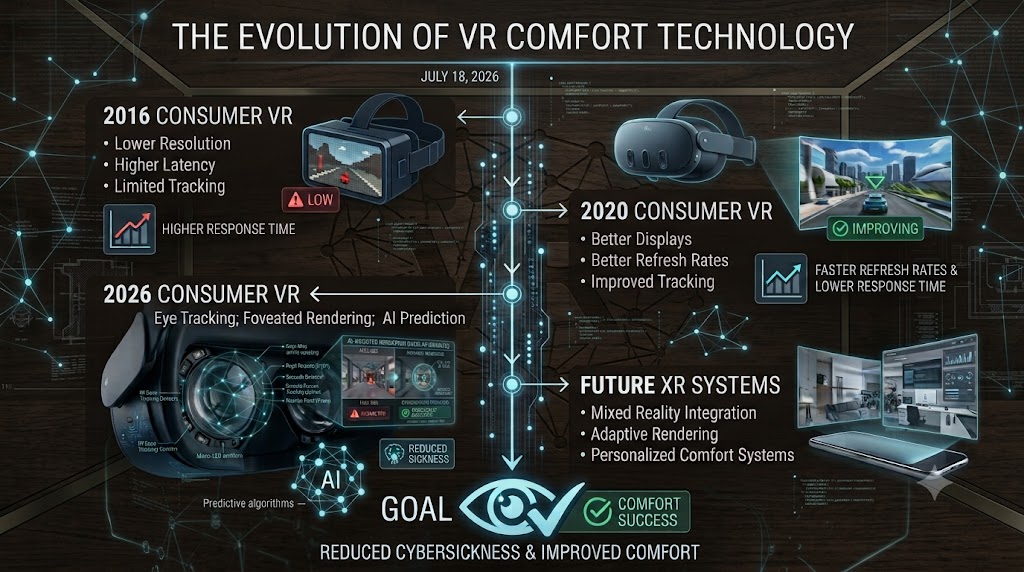
One reason VR adoption continues to grow is that today’s hardware is dramatically better than earlier generations.
The first consumer headsets proved virtual reality could work.
Modern headsets focus on making it comfortable.
Several technological improvements have contributed to this shift.
1. Higher Refresh Rates
Refresh rate refers to how often the display updates each second.
Higher refresh rates create smoother visual motion.
Smoother motion reduces sensory inconsistencies.
2. Lower Latency
Latency measures the delay between a user’s movement and the headset’s response.
Even small delays can increase discomfort.
Reducing latency improves realism and reduces conflict.
3. Improved Tracking Systems
Modern headsets track:
- Head position
- Rotation
- Hand movement
with far greater precision than earlier systems.
Accurate tracking reduces unexpected visual discrepancies.
4. Better Display Technology
New displays offer:
- Sharper images
- Reduced blur
- Faster response times
These improvements help reduce eye strain and improve visual stability.
Understanding what’s actually inside your VR headset reveals how these hardware components work together to improve user comfort.
The Industry’s Long-Term Goal
Every major company in immersive technology is working toward the same objective:
Make virtual reality feel natural enough that users forget they’re wearing a headset.
Whether it’s Meta, Apple, Samsung, Google, HTC, or enterprise-focused hardware manufacturers, reducing cybersickness remains a central engineering challenge.
The future of VR depends not only on more realistic graphics but also on creating experiences that align more closely with how the human brain naturally perceives motion.
And that future is already beginning to take shape.
15 Research-Backed Ways to Reduce VR Motion Sickness
The good news is that VR motion sickness is not inevitable.
Over the past decade, researchers, developers, and hardware manufacturers have identified several practical strategies that significantly reduce discomfort.
Some involve technology.
Others involve user behavior.
The most effective approach usually combines both.
1. Start with Short Sessions
One of the biggest mistakes beginners make is spending an hour inside VR during their first session.
A better approach is:
- 10–15 minutes initially
- Gradually increase exposure
- Stop before symptoms appear
This allows the brain to adapt gradually.
2. Choose Beginner-Friendly Experiences
Not all VR applications are created equal.
Start with:
- Puzzle games
- Educational experiences
- Virtual museums
- Hand-tracking applications
Avoid:
- Roller coasters
- Racing simulators
- Flight simulators
during your first week.
3. Use Teleport Locomotion
Whenever available, choose teleport movement instead of continuous locomotion.
This significantly reduces sensory conflict. Many of the most comfortable VR applications use this approach by default.
4. Adjust Your IPD Correctly
Interpupillary Distance (IPD) refers to the distance between your pupils.
An incorrect IPD setting can cause:
- Eye strain
- Headaches
- Blurry visuals
- Increased discomfort
Modern headsets often provide IPD adjustment tools.
5. Maintain a Stable Frame Rate
Frame drops can quickly increase nausea.
Developers and hardware manufacturers prioritize smooth performance because even small interruptions can affect immersion.
Understanding the different types of VR headsets can help users choose devices better suited to long-term comfort.
6. Increase Refresh Rate When Possible
Higher refresh rates create smoother visual experiences.
Many modern headsets support:
- 90Hz
- 120Hz
- Higher refresh modes
These settings often improve comfort.
7. Take Regular Breaks
Even experienced users benefit from short breaks.
A common recommendation is:
- 20–30 minutes of use
- 5-minute break
This helps reduce visual fatigue.
8. Stay Hydrated
While hydration does not directly eliminate cybersickness, dehydration can worsen symptoms such as headaches and fatigue.
9. Use a Fan
Many experienced VR users place a small fan nearby.
The airflow provides an additional physical reference point for the brain and can help reduce disorientation.
10. Avoid VR When Exhausted
Fatigue reduces the brain’s ability to process sensory information efficiently.
Using VR while tired often increases discomfort.
11. Avoid Heavy Meals Before VR
Large meals may worsen nausea in susceptible individuals.
Moderation is generally recommended before extended VR sessions.
12. Stop Immediately When Symptoms Begin
One of the most important rules in VR:
Never try to “push through” motion sickness.
If symptoms begin:
- Remove the headset
- Rest
- Return later
Ignoring symptoms often makes them worse.
13. Use Comfort Settings
Modern VR games frequently include:
- Snap turning
- Vignettes
- Teleport movement
- Reduced acceleration
These options exist for a reason.
Use them.
14. Keep the Headset Properly Positioned
Poor headset alignment can introduce visual distortions that increase discomfort.
Regularly adjust:
- Lens position
- Strap tension
- Eye alignment
for optimal comfort.
15. Build Tolerance Gradually
Perhaps the most effective strategy is consistency.
Research repeatedly shows that many users develop greater tolerance through gradual exposure over time.
Future Technologies Reducing Motion Sickness
The VR industry understands that comfort is essential for mass adoption.
As a result, some of the brightest minds in immersive technology are focused on reducing cybersickness.
Several emerging technologies are already making a measurable difference.
Eye Tracking: Helping Headsets Understand Human Vision
Eye tracking allows headsets to monitor where users are looking in real time.
This creates several advantages:
- More natural interaction
- Better visual rendering
- Improved performance
- Reduced visual strain
Eye tracking is becoming a major feature in premium devices and is expected to play an increasing role in future comfort improvements.
The technology is already influencing products such as those discussed in Apple Vision Pro vs Meta Quest 3.
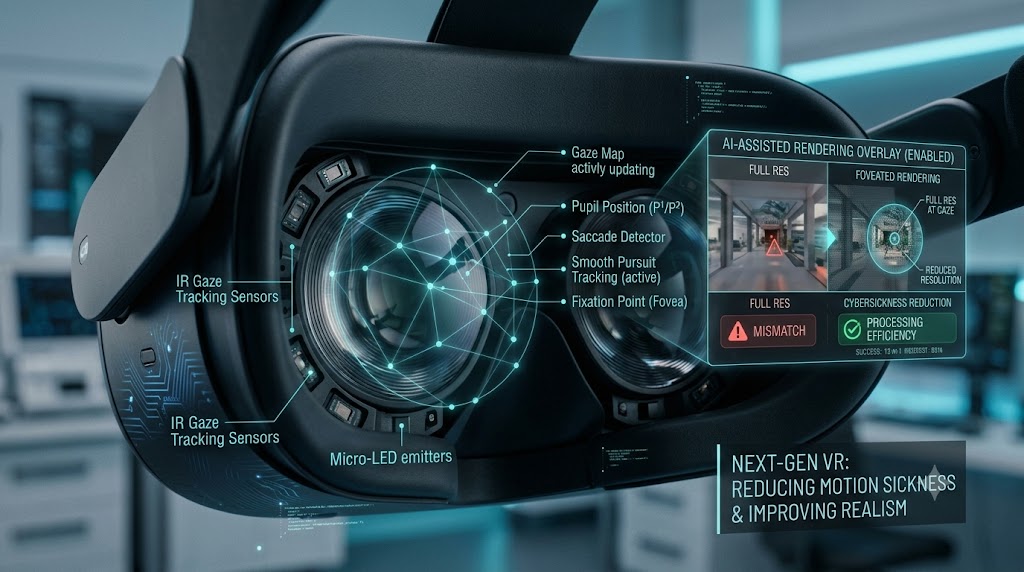
Foveated Rendering: Smarter Graphics Processing
The human eye sees sharp detail primarily in the center of vision.
Foveated rendering takes advantage of this fact.
Instead of rendering every pixel at maximum quality, the system prioritizes the area where the user is currently looking.
Benefits include:
- Improved performance
- Reduced processing load
- Lower latency
- More stable frame rates
All of these factors contribute to improved comfort.
Artificial Intelligence and Predictive Rendering
Artificial intelligence is beginning to influence VR comfort in new ways.
Future systems may predict:
- Head movements
- Eye movements
- User intentions
before they happen.
By anticipating user behavior, AI could help reduce latency and improve responsiveness.
The broader impact of these technologies can already be seen in developments discussed within AI and Virtual Reality in 2026.
Mixed Reality May Change Everything
One reason mixed reality is generating so much excitement is that it reduces the disconnect between digital and physical environments.
Unlike traditional VR:
- Users can still see portions of the real world.
- Spatial awareness improves.
- Balance cues remain available.
This can significantly reduce sensory conflict.
The growing importance of these technologies is closely tied to the evolution of spatial computing in 2026.
How Close Are We to Solving VR Motion Sickness?
| Technology | Available Today | Impact on Comfort |
| Higher Refresh Rates | Yes | High |
| Eye Tracking | Yes | Medium–High |
| Foveated Rendering | Yes | Medium |
| AI Motion Prediction | Emerging | High |
| Mixed Reality Pass-Through | Yes | High |
| Personalized Comfort Systems | Emerging | Very High |
Will VR Motion Sickness Ever Disappear Completely?
The honest answer is:
Probably not completely.
Human biology varies too much.
Some individuals are naturally more sensitive to sensory conflict than others.
However, the evidence strongly suggests that future generations of VR systems will continue reducing cybersickness.
Compared with early consumer headsets, today’s devices already offer:
- Better displays
- Better optics
- Better tracking
- Better software design
- Better comfort features
The trend is moving in the right direction.
The goal is not necessarily to eliminate cybersickness entirely.
The goal is to make it rare enough that it no longer acts as a barrier to adoption.
The Future of Comfortable Virtual Reality
VR motion sickness is often misunderstood.
Many people assume it is a sign that something is wrong with them or that virtual reality itself is flawed.
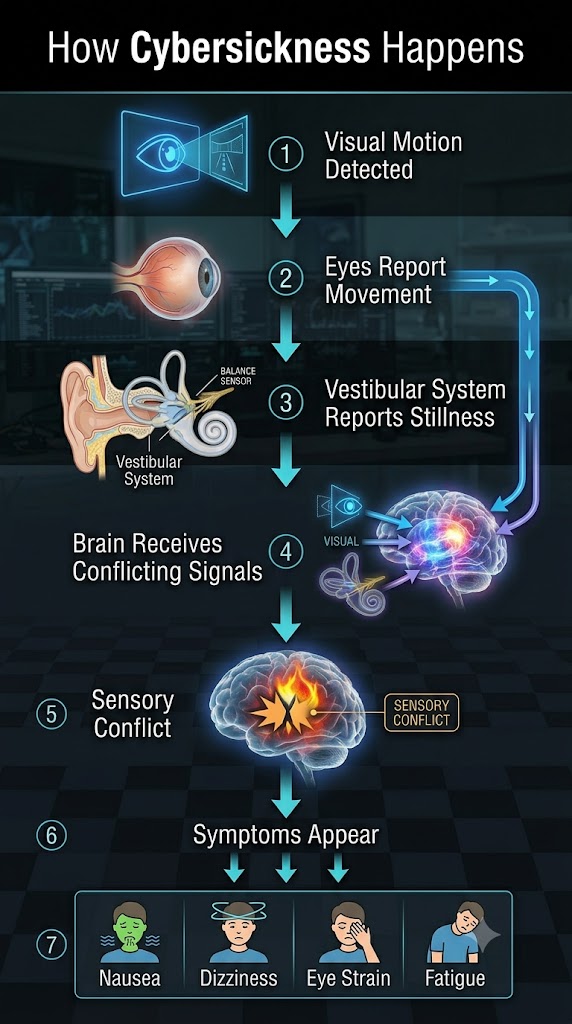
The science tells a different story. Cybersickness is primarily the result of sensory conflict.
Your eyes may perceive movement while your vestibular system detects stillness. The brain receives conflicting information and responds with symptoms such as nausea, dizziness, or fatigue.
Fortunately, researchers now understand this process far better than they did a decade ago.
Developers have introduced comfort settings. Manufacturers have improved hardware. Researchers continue exploring new solutions.
Most importantly, many users adapt over time and experience fewer symptoms as they become familiar with immersive environments.
As virtual reality expands into healthcare, education, enterprise training, entertainment, and spatial computing, solving the comfort challenge remains one of the industry’s highest priorities.
The future of VR will not simply be more immersive. It will be more comfortable, more accessible, and more human-centered.
Frequently Asked Questions
1. Why does VR make me feel nauseous?
VR can make you feel nauseous because your eyes perceive movement while your body remains stationary. This sensory mismatch creates cybersickness.
2. Is VR motion sickness dangerous?
For most people, VR motion sickness is temporary and not dangerous. Symptoms usually disappear after removing the headset and resting.
3. How long does VR motion sickness last?
Symptoms often resolve within minutes, although some users may experience mild discomfort for several hours.
4. Can you train yourself to stop getting motion sickness in VR?
Many users develop greater tolerance through gradual exposure and repeated use, a process known as habituation.
5. Which VR games cause the most motion sickness?
Roller coasters, racing simulators, flight simulators, and fast-paced first-person games generally cause the highest levels of cybersickness.
6. Do newer VR headsets reduce motion sickness?
Yes. Improvements in display quality, tracking accuracy, refresh rates, and latency have significantly reduced discomfort compared with earlier generations.
7. Does eye tracking help reduce cybersickness?
Eye tracking can improve rendering efficiency and visual responsiveness, which may contribute to a more comfortable experience.
8. Why do some people get sick in VR while others don’t?
Factors such as motion sickness history, vestibular sensitivity, headset fit, migraine susceptibility, and previous VR experience all influence how individuals respond to immersive environments.
More Sources To Visit
These sources can be naturally cited throughout the article during final publishing:
- National Library of Medicine — https://pubmed.ncbi.nlm.nih.gov/31264611/
- CDC Motion Sickness Research — https://www.cdc.gov/yellow-book/hcp/travel-air-sea/motion-sickness.html
- Frontiers in Virtual Reality — https://www.frontiersin.org/journals/virtual-reality
- Iowa State Navigation Laboratory — https://navlab.psych.iastate.edu/projects/cybersickness-research/
- Stanford Virtual Human Interaction Lab — https://vhil.stanford.edu/
- ACM Digital Library — https://dl.acm.org/
- IEEE VR Conference Research — https://ieeevr.org/
- MIT Media Lab — https://www.media.mit.edu/