
AI and virtual reality are merging in three concrete ways right now: AI is generating VR environments instead of designers building them by hand, AI is powering non-player characters that can actually hold a conversation instead of following a script, and AI is personalizing training simulations in real time based on how each individual person performs. None of this is science fiction anymore. All three are shipping in real products today.
That said, a lot of what you’ll read about “AI and VR converging” online is vague marketing language dressed up as insight. This guide skips that. Here’s what’s actually happening, what’s genuinely useful, and where the hype is still ahead of the reality. If you’re new to VR fundamentals first, our overview of how virtual reality actually works is worth reading before this one.
Here’s what we’ll cover:
- How generative AI is building VR worlds instead of human designers doing it manually
- Why AI-powered NPCs are a real technical leap, not just a buzzword
- How AI is personalizing training simulations for individual learners
- The honest gap between what’s marketed and what’s actually working
- Real 2026 products and research you can look into yourself
AI and Virtual Reality in 2026: The Rise of AI-Generated Virtual Worlds
For most of VR’s history, every object, texture, and environment had to be built by hand. That’s slow, expensive, and it’s why so many VR experiences have felt repetitive.
Generative AI changes that math. Instead of a design team manually modeling every tree in a forest or every prop in a room, AI models can generate entire 3D environments from a text prompt or a rough sketch, then adjust them on the fly based on what a user does inside them. This is closely tied to the broader shift we covered in our spatial computing guide, where AI assistants like Gemini are already built directly into headsets such as the Samsung Galaxy XR.
This matters for a simple reason: it makes VR content dramatically cheaper and faster to produce. A small team can now build the kind of expansive, varied environments that used to require a studio-sized budget. That’s a big part of why 2026 has seen a genuine jump in the amount and variety of VR content available, not just from major studios but from small independent developers too.
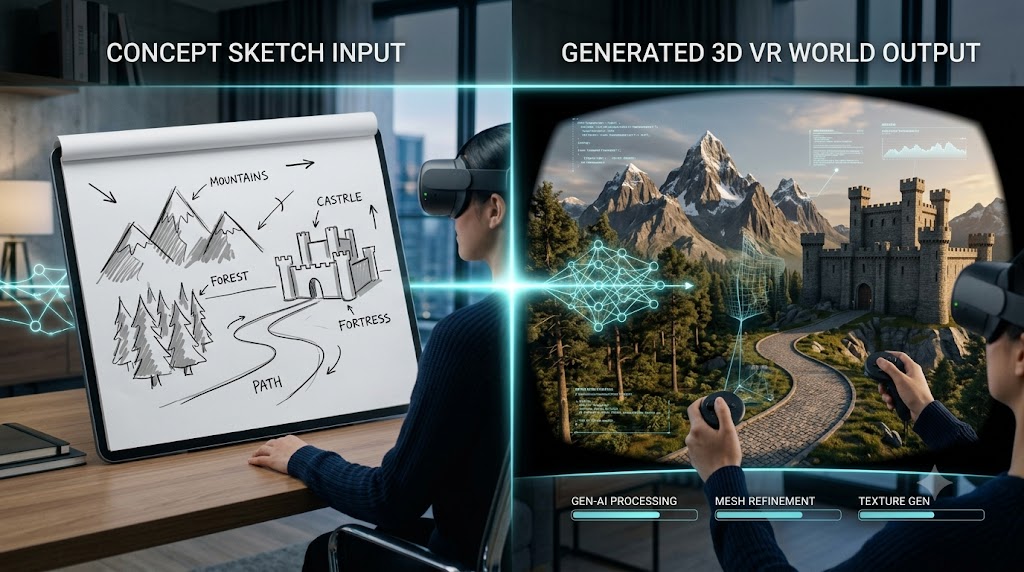
It’s worth being precise about what “generative” actually means here. It’s not that an AI just improvises visuals with no structure. Developers set rules, style guides, and boundaries, and the AI fills in the space within them. Think of it less like a robot painting freely and more like a very fast, very tireless assistant that still needs direction.
If you want to see this in action across actual hardware, our latest VR systems roundup covers which current headsets are built to handle this kind of real-time AI-generated content well.
AI-Powered NPCs: The Real Technical Leap
This is genuinely the biggest shift, and it’s worth explaining clearly because most articles gloss over what actually changed.
Old-school VR characters, non-player characters or NPCs, worked off scripted dialogue trees. You’d click an option, get a pre-written response, click another option, get another pre-written response. It worked, but it felt exactly like what it was: a menu pretending to be a conversation.
AI-powered NPCs work differently. They’re built on large language models, the same underlying technology behind tools like ChatGPT, connected to speech recognition and character animation systems. That means an NPC can understand what you actually say, in your own words, and generate a response on the spot instead of picking from a pre-written list.
A 2026 study published in the academic journal Frontiers in Computer Science demonstrated exactly this: researchers built a VR orientation platform for international university students using AI-powered NPCs that could hold real-time, context-aware conversations, understanding natural spoken language and adjusting their responses based on what each individual student needed. That’s not a demo reel, it’s peer-reviewed research with actual user testing behind it.
The clearest real-world proof point is NVIDIA ACE, a toolkit NVIDIA built specifically to power generative AI characters in games. NVIDIA’s own demo paired ACE with Convai, a startup building conversational AI for virtual worlds, to create Jin, a fully AI-driven noodle shop NPC. Nothing Jin says is scripted. A player named Kai could ask Jin literally anything, and Jin responds in character, in real time, because the character is built on a language model rather than a dialogue tree.
This isn’t a one-off demo either. Major studios including Tencent, Ubisoft, NetEase, and miHoYo have publicly adopted ACE-style tooling, and by 2026 the technology has moved into actually shipped titles: PUBG now includes AI teammates built on NVIDIA ACE, and games like inZOI and NARAKA: BLADEPOINT have integrated similar systems. Even the modding community got there first, LLM-powered dialogue mods for Skyrim and Mount & Blade II: Bannerlord were giving players AI conversations with NPCs years before major studios shipped the same idea officially.
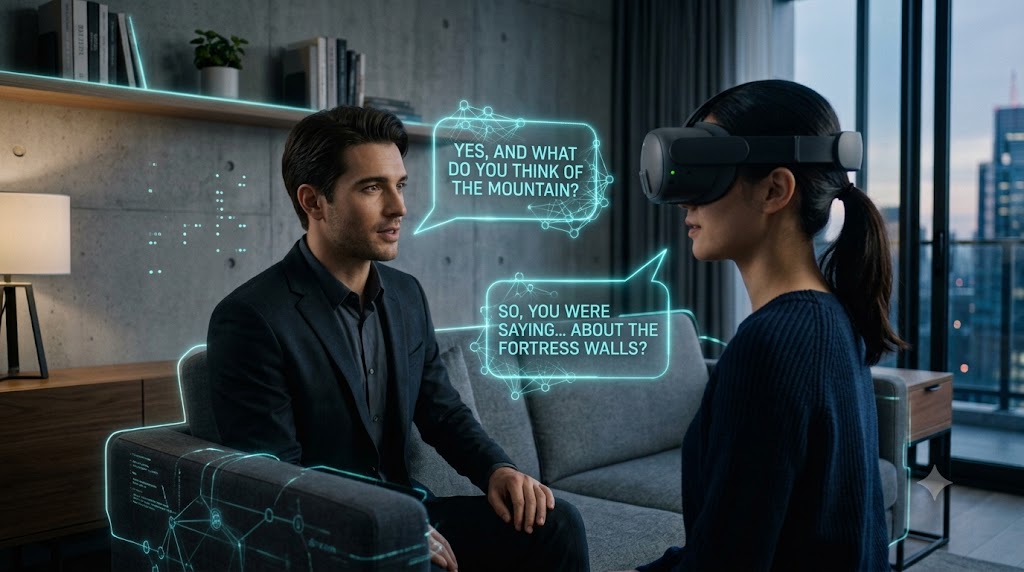
One genuinely interesting technical detail most coverage skips: how these NPCs avoid breaking character. A medieval tavern keeper NPC doesn’t randomly reference smartphones, not because a developer manually filtered every possible modern reference, but because of something called contextual persona locking, the character’s underlying prompt establishes a strict knowledge boundary the AI stays within. That’s the actual engineering trick that makes these characters feel coherent instead of obviously artificial.
For a much deeper dive specifically into gaming, including how these NPCs actually get their voice, which games already ship this, and the honest risks like players trying to jailbreak them, see our full breakdown of AI NPCs in VR games.
The practical difference this makes:
- A training simulation NPC can respond to genuinely unexpected questions instead of only the ones a script anticipated
- A game character can hold a different conversation with every player instead of the same fixed lines
- A tutoring or coaching avatar can adapt its explanation style based on how a specific person is struggling, in real time
The honest limitation: latency and consistency are still real problems. AI-generated responses take a moment to process, and characters can occasionally say something slightly off-tone or inconsistent with earlier dialogue. This is improving quickly, but it’s not flawless yet, and any article claiming otherwise isn’t being straight with you.
AI-Driven Personalization in Training Simulations
This is where AI and VR together are already proving genuine business value, not just novelty value.
Traditional VR training runs the same fixed scenario for every single user. AI-driven training adjusts the scenario based on how each person is actually performing. If a trainee is struggling with a specific step, the simulation can slow down, add guidance, or repeat that step in a different way.
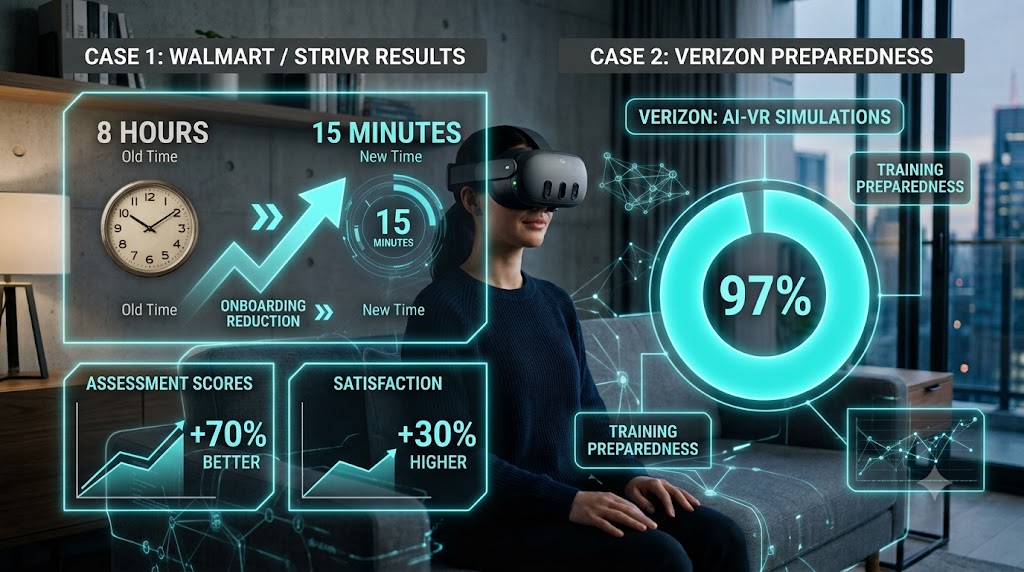
The best real-world proof of this comes from Walmart’s partnership with STRIVR, a training platform that grew out of Stanford’s Virtual Human Interaction Lab. Walmart has deployed more than 17,000 headsets across over 4,700 US stores, putting more than a million associates through VR training covering everything from operating Pickup Tower kiosks to handling the chaos of Black Friday, filmed using real 360-degree footage from an actual store on an actual Black Friday.
The results are hard to argue with. What used to take eight hours of in-person onboarding for Pickup Tower training now takes fifteen minutes in VR. Associates who trained in VR outperformed non-VR learners on post-training assessments 70% of the time, scored 10-15% higher on knowledge retention, and reported 30% higher satisfaction than trainees in traditional classroom sessions. Verizon, using the same platform for active shooter response training, reported associates scoring 97% more prepared afterward.
Here’s where it connects directly to AI: STRIVR’s newest product, Frontline Intelligence, moves beyond pre-job training into real-time, on-the-job AI assistance, built on custom visual language models and delivered through smart glasses rather than a full headset. Instead of only training someone before a shift, the system can now recognize what’s happening in front of an employee in the moment and offer contextual guidance live. That’s the genuine current frontier of AI and VR/AR convergence in enterprise training, not a future promise, but a product actively rolling out in 2026.
A few other concrete examples of where AI personalization specifically is already deployed:
| Use Case | What AI Adds |
| Medical and surgical training | AI-driven “patient” avatars that respond realistically to a trainee’s actions, adjusting vitals and behavior in real time |
| Teacher training | AI-controlled student avatars that simulate a classroom’s mood and behavior, shifting based on a trainee teacher’s choices |
| Job interview practice | AI interviewers that adjust question difficulty and follow-up style based on a candidate’s actual answers |
| Industrial and technical training | AI-guided scenarios for equipment repair and safety procedures that adapt pacing to the individual learner |
Notice the pattern: in every case, AI isn’t replacing the VR environment, it’s making the same environment respond differently to each individual person using it. That’s the actual innovation, not flashier graphics, but smarter responsiveness.
For a deeper look at how this applies specifically in medical settings, our guide to VR in healthcare covers surgical and clinical training use cases in more detail.
Where the Hype Outpaces the Reality
It’s worth being direct about this, since most content on this topic won’t be.
“Fully autonomous AI worlds” are still mostly marketing language.
Yes, AI can generate environments and character behavior, but human developers are still setting the rules, guardrails, and creative direction behind the scenes. No product today is genuinely building itself with zero human oversight, despite how some announcements are worded.
Real-time generation still has real latency. Complex AI-generated responses and environments can introduce a noticeable delay, which matters a lot in VR specifically, since any lag between your action and the world’s response can break immersion or even cause motion discomfort.
Most consumer VR apps still don’t use this technology yet.
The genuinely impressive AI-VR integration you read about mostly lives in enterprise training, research projects, and select flagship titles. The average VR game you’d download today is still running traditional, scripted content. That’s changing, but it’s not universal yet, and treating it as already-standard would be misleading.
Personalization requires data, and that raises real privacy questions.
For AI to adapt to you specifically, it needs to track your behavior, sometimes including biometric signals like eye movement or physiological responses. That’s powerful for training effectiveness, but it’s also a genuine privacy consideration worth being aware of as a user, not just a technical footnote.
What’s Actually Shipping in 2026
To ground all of this in something concrete, here’s what’s real and available right now, not concept demos.
- Convai and similar LLM-integration platforms are being used by developers to build conversational NPCs directly into Unreal Engine and Unity-based VR projects, the same technology behind the Frontiers journal study mentioned earlier.
- Enterprise training platforms across medical, aviation, and industrial sectors are increasingly shipping with AI-adaptive scenarios as a standard feature, not an add-on.
- Generative environment tools are being adopted by small VR studios specifically to compete with larger studios on content volume without matching their budgets.
- AI-driven job interview and public speaking simulators are one of the more surprisingly mature consumer-facing applications, since the use case (practice, low stakes, personalized feedback) maps naturally to what current AI-VR technology does well.
If you’re specifically interested in gaming applications, our comparison of the top VR headsets for gaming covers which current hardware handles these AI-driven titles best, and our dedicated piece on ChatGPT and virtual reality goes deeper into how conversational AI specifically is being used inside VR right now.
Frequently Asked Questions
How are AI and virtual reality merging in 2026?
AI is merging with VR in three main ways: generating 3D environments and content automatically, powering NPCs that hold real conversations instead of following scripts, and personalizing training simulations in real time based on individual user performance.
Are AI-powered VR characters actually intelligent?
They’re powered by large language models, the same technology behind tools like ChatGPT, which lets them understand natural language and generate contextual responses. They’re not “intelligent” in a general sense, but they are genuinely more responsive and less scripted than older rule-based NPCs.
Is AI-generated VR content as good as human-designed content?
It depends on the use case. AI excels at producing volume and variety quickly, which is valuable for training simulations and smaller studios. Human-designed content still generally leads on polish and narrative intentionality for premium, story-driven experiences.
Does AI in VR raise privacy concerns?
Yes, genuinely. Personalized AI experiences often rely on behavioral and sometimes biometric data to adapt in real time. This is a real consideration worth understanding, not just a hypothetical concern, particularly as this technology becomes more common in workplace training environments.
The Bottom Line
AI and VR aren’t just being marketed together, they’re genuinely solving different pieces of the same problem. AI handles the parts that used to require expensive manual work: building environments, writing character dialogue, and adjusting difficulty on the fly. VR provides the immersive space where all of that actually matters to the person experiencing it.
The real story in 2026 isn’t hype, it’s quiet, practical integration into training, education, and select games, with consumer gaming still catching up to what enterprise and research applications are already doing. That gap is worth watching closely over the next year.
For ongoing coverage as AI and VR continue converging, check our homepage for the latest updates.
Further Reading
- Generative AI NPCs in VR: TUMSphere Study | Frontiers in Computer Science
- Graduated Realism: AI-Powered Avatars in VR Teacher Training
- Generative AI Meets Virtual Reality: A Comprehensive Survey
- Virtual Reality Trends of 2026
- NVIDIA ACE for Games: Bringing AI NPCs to Life
- Strivr Helps Walmart Reduce Training Time by 96%
AUTHOR ABOUT
Aamir Khan is a content strategist & senior technology writer at Future of Virtual Reality with expertise in virtual reality, AI, emerging technologies, Spatial computing, digital transformation, and user experience. As a content specialist, he has developed and managed impactful content strategies for global audiences, which combine technical accuracy with practical insights. His work focuses on helping readers understand the real-world applications, innovations, and future impact of immersive technologies.
Pingback: AI NPCs in VR Games: The Next Generation (2026)
Pingback: AI Avatars in the Metaverse: Reality vs Hype (2026)