
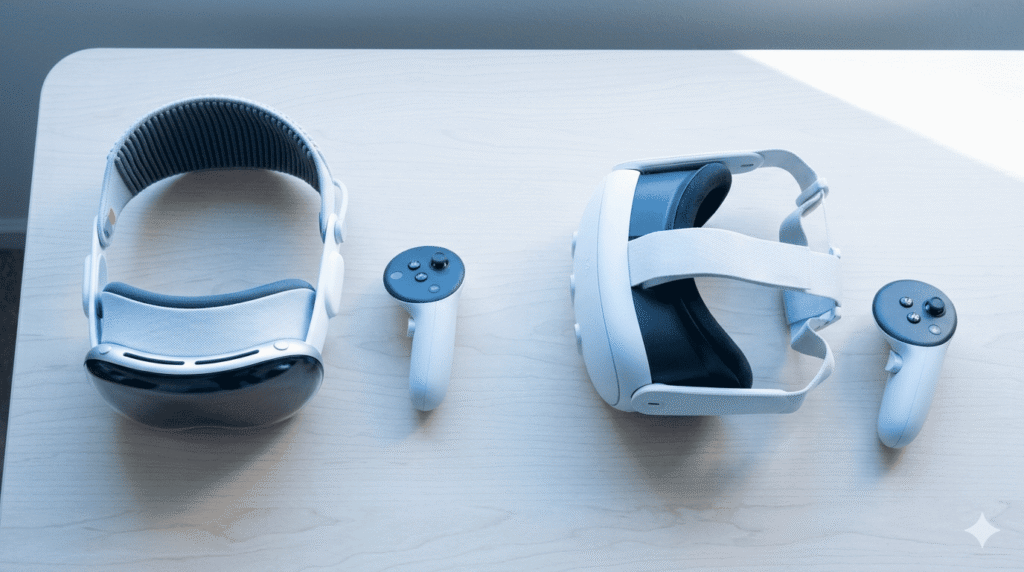
The Apple Vision Pro sold around 370,000 units in its first 12 months on the market, according to Wellsenn XR estimates published in early 2025. The Meta Quest 3 ships more units in a single strong quarter. Yet both companies still treat each other as the competitive benchmark.
That tells you something the spec sheets do not. The Apple Vision Pro vs Meta Quest 3 question is not really about which device has better hardware. It is about which one fits the work you actually want to do.
I have spent the last year using both devices for development work, enterprise demos, gaming, and the occasional movie night. The conclusions surprised me more than once.
Here is the short version. The Quest 3 wins on price, comfort, ecosystem, and games. The Vision Pro wins on display, productivity, and pass-through video clarity. Neither is the right answer for everyone, and most of the comparison guides online get the trade-offs wrong.
Let me walk you through what actually matters. If you want a foundational primer first, our beginner’s guide to virtual reality covers the basics in plain language.
Why This Comparison Matters Now
Meta captured 72.2% of the global XR market in 2025, per IDC’s Q4 shipment tracker. Quest 3 alone accounts for 27.58% of Steam VR headset usage as of early 2026, while the older Quest 2 still holds 24.84%. Combined, that is more than half of the active PC VR userbase running on Meta hardware.
Apple is a different story. Vision Pro shipped roughly 370,000 units in its first 12 months. That puts it behind even the PlayStation VR2 in raw volume.
Volume is not the whole picture though. Apple’s installed base spends more per user. Vision Pro draws professional users, enterprise pilots, and developers who already build for iOS. Quest 3 owns gaming, social, and consumer by a wide margin.
So the real comparison is this. If you want a productivity and content device that integrates with your iPhone and Mac, Vision Pro is built for you. If you want a VR device for games, fitness, social experiences, and a wide library, the Quest 3 is the obvious answer.
Pricing: The Gap Is Wider Than the Specs Suggest
Apple Vision Pro starts at $3,499 in the US, before AppleCare. Add prescription Zeiss inserts at $99 to $149 and a travel case at $199, and you are looking at $3,800 to $4,000 to walk out the door.
Meta Quest 3 starts at $499.99 for the 128GB model. The 512GB version runs $649.99. Even with an Elite Strap ($69.99) and a carrying case ($69.99), you are still under $800.
That is a five-to-seven times price difference. Not a slight premium. A different category entirely.
The Quest 3S, which Meta launched in October 2024 at $299.99 for 128GB, makes the spread even wider. For the price of one Vision Pro, you can equip an entire team of 11 people with Quest 3S headsets.
If you are deciding between them, start here. The price gap defines who each device is built for. Our full VR headsets buying guide breaks down the wider category if you are still narrowing options.

Display Quality: Where Apple Earns Its Premium
Vision Pro uses two micro-OLED panels with a combined 23 million pixels. That is roughly 4K per eye. Pixel density runs at 3,386 PPI. Color reproduction covers the full P3 wide color gamut.
Quest 3 uses two LCD panels at 2,064 by 2,208 per eye. That is about 4.5 million pixels per eye, less than half of what the Vision Pro pushes. Pixel density sits around 1,218 PPI.
In practice, this is the single biggest difference between the two. Text on the Vision Pro is sharp enough to read a Kindle book comfortably for an hour. Text on the Quest 3 is functional but tires the eyes faster.
Color and contrast follow the same pattern. Vision Pro’s OLED produces deeper blacks and richer color. Quest 3’s LCD is brighter overall but feels washed out in dark scenes.
If you plan to use the headset for movies, productivity, or reading, the Vision Pro display alone justifies a chunk of the price gap. If you mostly play games, the difference matters less. Most VR games are designed to forgive lower resolution. For a deeper component-by-component breakdown of how these displays actually work, see our VR headset technology explained article.
Comfort and Weight: Quest 3 Quietly Wins Here
Vision Pro weighs 600 to 650 grams without the external battery, depending on the strap. The battery adds 353 grams and sits in your pocket on a tethered cable.
Quest 3 weighs 515 grams with the battery built in. No cables, no pocket weight.
That extra 100 grams on your face matters more than the numbers suggest. After 45 minutes in the Vision Pro, I feel the weight on my cheekbones. Quest 3 sessions of two or three hours feel manageable with the Elite Strap.
The Solo Knit Band that ships with the Vision Pro pushes too much weight to the front. The Dual Loop Band fixes some of it but looks ridiculous. Most owners I know eventually buy a $169 BeloVR or Annapro strap to make the device wearable.
So even though the Vision Pro is the more advanced device, the Quest 3 is the one you will actually keep on your head.
App Ecosystem: Two Very Different Worlds
Meta Quest’s library includes more than 500 native VR apps and games on the official store, plus thousands more via App Lab and SideQuest. Beat Saber, Resident Evil 4, Asgard’s Wrath 2, Population: One, Supernatural. The catalogue is wide and deep.
Vision Pro launched with about 600 native apps in February 2024. By early 2026, that number is closer to 2,500. Plus the entire iPad app library runs in compatibility mode.
But the composition is different. Most Vision Pro native apps are productivity, content streaming, and 3D enterprise tools. The native gaming library is thin. Apple does not allow Meta’s apps on visionOS. Steam VR support requires a workaround through Mac mirroring.
If gaming is a primary use case, Quest 3 is not just the better choice. It is the only choice.

Pass-Through Video and Mixed Reality
Vision Pro’s color pass-through is the closest any consumer headset has come to genuine mixed reality. Cameras feed real-time video to the displays. The latency is around 12 milliseconds. You can read your phone screen through the device.
Quest 3’s pass-through is workable but visibly lower resolution. Edges blur. Color skews. It is good enough for room awareness and basic MR apps, but you would not read a book through it.
This is one of the few areas where Vision Pro’s $3,500 premium is genuinely earned. For broader context on where pass-through fits into the wider spatial shift, see our spatial computing in 2026 guide.
Productivity and the Mac Connection
Vision Pro pairs natively with Mac for an extended virtual display. Hand-eye coordination works through eye tracking and gesture recognition rather than controllers. For knowledge workers who already live in Apple’s ecosystem, the integration is seamless.
Quest 3 supports Microsoft 365 natively after Meta and Microsoft’s September 2025 partnership. You can run Word, Excel, PowerPoint, and Teams inside the headset. It works. It is also clunky compared to the Vision Pro’s native macOS mirroring.
For solo productivity, Vision Pro is clearly ahead. For team productivity inside Microsoft’s ecosystem, Quest 3 is now a viable option.
What Developers Are Actually Building For
This is where the long-term outlook gets interesting. Meta’s Reality Labs reported $2.2 billion in revenue for 2025 against a $19.19 billion operating loss, per Meta’s earnings disclosure. The company is essentially subsidizing the entire VR developer ecosystem.
Apple is monetizing developers through the App Store from day one, but the install base is small. Most developers I speak to are still hedging.
Looking at major 2025 and 2026 releases, Quest gets the early launch and the bigger version. Vision Pro gets a stripped-down port six to nine months later, if at all. Until the Vision Pro install base reaches 5 to 10 million units, that pattern will hold. The launch of Samsung’s Galaxy XR platform may shift this — read our analysis of why 2026 is the Android XR moment for VR for the full picture.
Should You Wait for Vision Pro 2 or Quest 4?
A cheaper Apple Vision (rumored at $1,500 to $2,000) is expected in late 2026 or early 2027 per Mark Gurman’s reporting at Bloomberg. Quest 4 is unconfirmed but Meta’s Connect 2026 announcements suggest a 2027 release.
If you are price sensitive and the use case is not urgent, waiting makes sense. If you need a device now, the Quest 3 at $499 is the safer bet because the resale value will not collapse the way the Vision Pro’s might once a cheaper Apple option ships.
The Honest Verdict
After 12 months with both:
Buy the Quest 3 if you want VR games, fitness apps, social experiences, or a low-cost enterprise training option. The library, the comfort, and the price make it the right answer for 80% of buyers.
Buy the Vision Pro if you live in Apple’s ecosystem, work from a Mac, want the best display available, and use VR primarily for productivity and content. The price is high, but the device delivers what it promises in those use cases.
Do not try to make either device be something it is not. The Vision Pro is not a gaming headset. The Quest 3 is not a productivity workstation. The companies designed them for different jobs, and the comparison only works once you accept that.
Frequently Asked Questions
Is Apple Vision Pro worth $3,499 in 2026?
For Apple ecosystem users who need a premium display and Mac integration, yes. For general VR use, no. The Quest 3 covers about 80% of common use cases at one-seventh the price.
Can you play Quest games on Vision Pro?
No. Apple does not allow Meta’s apps on visionOS, and the platforms use different software stacks. Native Quest games will not run on Vision Pro without significant developer porting.
Which headset is better for enterprise training?
Quest 3 wins on cost-per-seat and Meta’s enterprise tooling. Vision Pro suits high-end professional use like medical visualization or 3D design but is too expensive for mass deployment.
How long does each headset’s battery last?
Quest 3 averages 2 to 2.5 hours of mixed use. Vision Pro’s external battery lasts about 2 hours. Both can run plugged in indefinitely.
Will Vision Pro 2 be cheaper?
Bloomberg’s Mark Gurman reported in early 2026 that Apple is working on a more affordable variant priced around $1,500 to $2,000, possibly launching late 2026 or early 2027.