
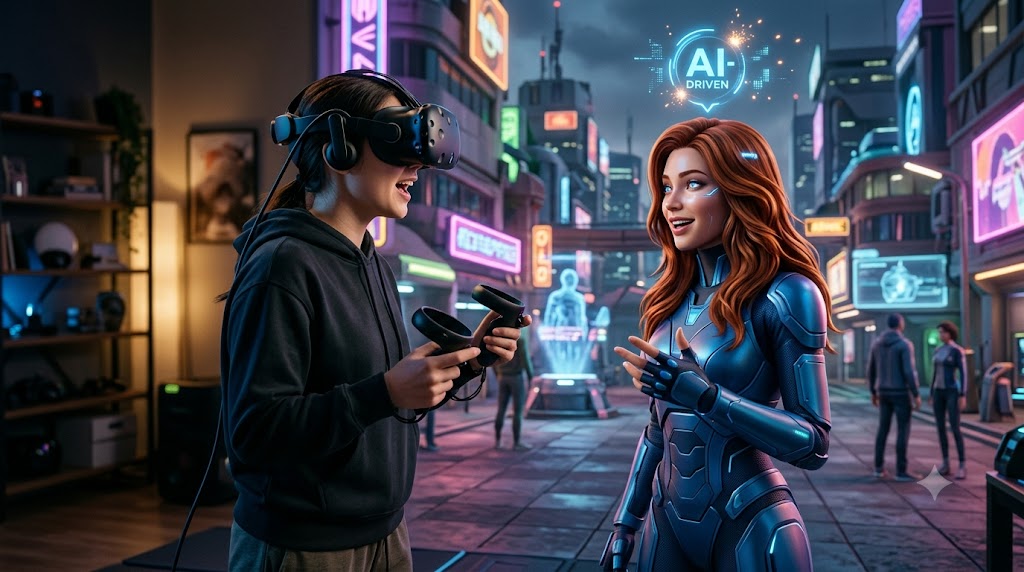
Imagine talking to a video game character, and instead of picking from three canned responses on a menu, you just say whatever’s actually on your mind out loud, and the character actually understands you and answers back in real time. That’s what an AI NPC is. No script. No menu. It’s built on the same kind of technology behind ChatGPT, except instead of typing to it, you’re standing next to it in a VR world, talking to it like a real person.
That’s the simple version. The more interesting part is how fast this went from “cool research demo” to “actual games you can buy today,” and how it really works under the hood, explained without the jargon most articles bury this in. Here’s everything, broken down plainly.
Here’s what we’ll cover:
- What actually separates an “AI NPC” from an old scripted character
- The real technology and companies behind this shift
- How these characters actually get a voice, not just words
- Which VR and console games already ship this today
- A real university study that tested it on actual people
- Where this is genuinely headed next
How AI NPCs in VR Games Actually Work
Think back to any old video game conversation. You’d get three or four dialogue options to pick from, the character would say one pre-written line back, and if you tried to ask something the writers never thought of, the conversation just hit a wall. It felt like talking to a vending machine wearing a costume.
AI NPCs work completely differently. Instead of picking from a menu, you can say anything, in your own words, and the character actually responds to what you said, because it’s not reading from a script; it’s generating a brand new answer on the spot. Here’s the simplest way to see the difference:
| Old Scripted NPCs | New AI NPCs | |
| How they talk | Pre-written lines only | Made up in real time, based on what you actually say |
| What you can ask | Only what the writers planned for | Basically anything |
| Do they remember you | No, or only fake “flags” | Yes, they can recall earlier parts of the conversation |
| How they sound | Pre-recorded voice lines | Voice generated live, on the spot |
| Cost to add more dialogue | Expensive, needs new writing and recording | Cheap, it just generates more |
| Risk | None, always exactly on-script | Can occasionally say something slightly odd |
The “do they remember you” row is the one that actually matters most. Some AI NPCs today can keep track of more than 50 back-and-forth exchanges, remembering your name, choices you made earlier, and things you’ve already done, instead of forgetting everything the moment the conversation ends. That’s the real difference between a character that feels alive and one that’s obviously just a menu in disguise.
For the bigger picture on how this fits into the wider AI and VR shift, our complete guide to AI and virtual reality in 2026 covers generative environments and AI-driven training simulations too, not just characters. And if you’re curious what current VR headsets can actually run this kind of live AI processing smoothly, our latest VR systems roundup breaks that down too.
Technology That’s Actually Making This Possible
Making an AI NPC feel real takes three separate jobs working together: understanding what you just said, figuring out how to respond, and then actually speaking that response out loud convincingly. Here’s who’s building each piece, explained simply.
NVIDIA ACE
This is basically a toolkit NVIDIA built so game developers don’t have to invent all of this from scratch. It handles the “listening” and “responding” parts together. The clearest example of it in action is a demo in which NVIDIA teamed up with a company called Convai to build Jin, a noodle-shop character in a game. Nothing Jin says was written by a human beforehand. Every single line is made up on the spot, based on whatever the player actually asks.
Convai
It is the company that connects the AI “brain” (the language model doing the thinking) to the actual game itself, whether that’s built in Unreal Engine or Unity. Think of Convai as the translator sitting between “this is what the AI wants to say” and “this is how the game engine actually makes that happen on screen.”
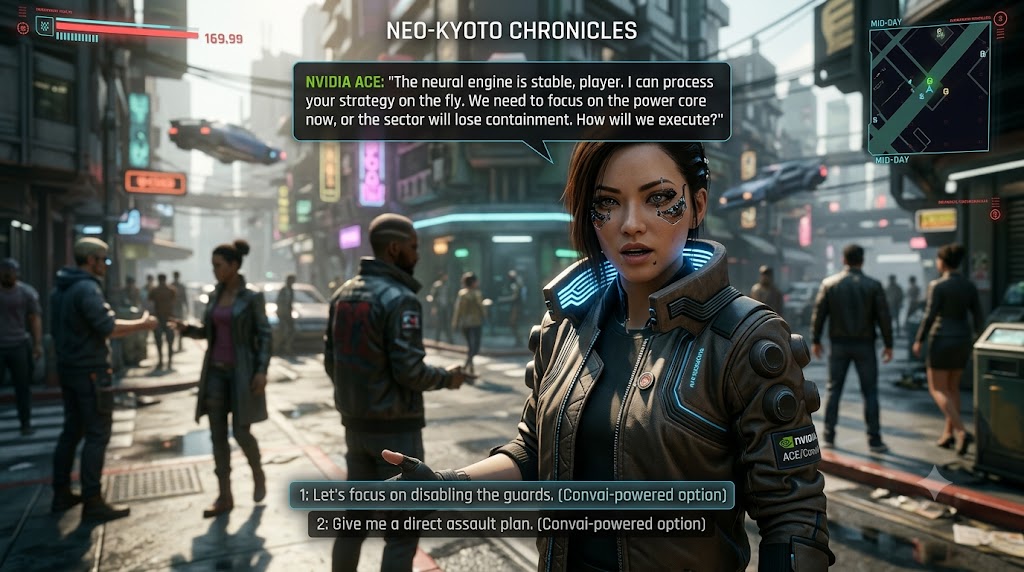
Here’s something worth understanding, because it explains why these characters don’t say weird, out-of-place things: developers use a trick sometimes called contextual persona locking. Before the AI ever starts talking as a character, it’s given a strict set of rules about who that character is and what they’d realistically know.
So a medieval blacksmith NPC won’t suddenly mention smartphones, not because someone manually blocked every possible modern word, but because the AI was told upfront “you are a blacksmith in a medieval world, stay in that world.” That one simple rule is the actual trick behind why these characters feel consistent instead of randomly breaking immersion.
Voice Behind the Dialogue
Coming up with smart things to say is only half the job. The character also has to actually sound like it’s speaking, right away, with no awkward pause, or the whole illusion breaks. That’s a separate problem, and a separate group of companies is solving it.
Inworld AI
This one is built specifically for speed. Its faster voice model responds in under 130 milliseconds, and its higher-quality version takes about 200 milliseconds, both fast enough that you genuinely don’t notice any delay before the character starts talking back. It can also add small human touches like a laugh, a sigh, or a throat-clear, tiny details that make a voice feel like a real person instead of a robot reading text.
ElevenLabs
It is probably the name you’ve actually heard of already. It offers thousands of voices in more than 70 languages, and it plugs directly into the same game engines developers already use.
This has genuinely changed what’s possible for small teams. A solo developer or a three-person indie studio can now give every single character in their game a real, distinct voice, something that used to require hiring actual voice actors and booking a recording studio, which most small teams simply couldn’t afford.
The honest way to think about the difference: Inworld is usually the better choice when a character needs to respond instantly to something unpredictable you just said, while ElevenLabs tends to win when a studio wants the highest possible voice quality for big, pre-written story moments.
Bigger studios often end up using both, one for scripted cutscenes, the other for live, reactive conversations during actual gameplay. If you’re curious how these voice technologies pair with actual VR hardware, our roundup of current VR experiences worth trying in 2026 covers several titles using this exact kind of tech.
Games That Already Ship This Today
This isn’t confined to tech demos anymore. Real, shipped titles are using this technology right now.
- PUBG has integrated AI teammates built on NVIDIA ACE, giving players squadmates that respond dynamically rather than following fixed bot logic.
- inZOI and NARAKA: BLADEPOINT have both adopted similar generative AI character systems.
- Major studios including Tencent, Ubisoft, NetEase, and miHoYo have publicly committed to ACE-style tooling for future titles.
- The modding community actually got here first: LLM-powered dialogue mods for Skyrim and Mount & Blade II: Bannerlord let players hold open-ended conversations with NPCs years before major studios shipped the same idea officially.
That last point is genuinely worth appreciating. Some of the most convincing early proof that AI NPCs could work in a full game, not just a tech demo, came from unpaid modders, not multi-million dollar studios.
If you want to see which current headsets actually handle this kind of real-time AI processing well, our comparison of the top VR headsets for gaming breaks down the hardware side in detail.
The Research Behind the Hype
Flashy demo videos are one thing. Actual research testing this on real people is another, and it does exist.
In 2026, a team published a study where they built a VR platform called TUMSphere to help international university students settle into a new campus and culture. Instead of static, scripted signposts, the platform used AI-powered NPCs, built on the same Convai technology mentioned above, that could actually guide students around and answer whatever questions they had, in normal spoken language, not a menu.
They tested it on 24 real students, not just watching a demo, but measuring whether it actually worked: how fast it responded, how easy it was to use, and whether it genuinely helped people learn what they needed to know. That’s a much higher bar than a cool trailer, and it’s exactly the kind of proof that separates real progress from hype.

Where This Is Actually Headed Next
Right now, AI NPCs can talk. The next step is teaching them to actually see and hear you too, not just process your words.
Researchers are already working on this. Newer AI systems can look at an image and understand what’s in it, the same way they can read text and understand it. The expectation is that this same ability gets built directly into game characters, letting them notice where you’re looking, read your body language, and react appropriately, not just to what you say, but to what you’re actually doing.
Picture this: an NPC notices you keep glancing at a locked door instead of paying attention to them, and they actually comment on it rather than ignore it. That’s not available yet, but based on where the underlying technology already is, it’s a realistic near-term step, not wishful thinking.
The Honest Limitations – AI NPCs VR Games
It’s only fair to be upfront about what still doesn’t work perfectly, since most articles on this topic conveniently skip it.
There’s still a small delay
Coming up with a smart response on the spot takes a tiny bit longer than just playing a pre-recorded line. In VR specifically, even a small delay between what you do and how a character reacts can feel off in a way it wouldn’t in a normal flat-screen game.
It’s not always perfectly consistent
Even with the “stay in character” rules developers put in place, an AI NPC can occasionally say something that feels slightly off or doesn’t quite match what it said a minute earlier. It’s getting better fast, but it’s not flawless.
Most games don’t actually use this yet
Everything above is real and genuinely impressive, but it’s still the exception, not the rule. The average game you’d pick up today still uses old-fashioned scripted dialogue. That’s changing quickly, but it would be misleading to suggest this is already everywhere.
Frequently Asked Questions
What makes an NPC “AI-powered” instead of scripted?
An AI-powered NPC generates its dialogue in real time using a large language model, rather than selecting from pre-written lines. It can respond to open-ended questions and, in more advanced systems, remember context from earlier in the conversation.
Which games currently use AI NPCs?
Several shipped titles already use this technology:
- PUBG – AI teammates built on NVIDIA ACE
- inZOI and NARAKA: BLADEPOINT – similar generative AI character systems
- Tencent, Ubisoft, NetEase, and miHoYo – major studios publicly committed to this technology for future releases
Is NVIDIA ACE available to all developers?
Yes. NVIDIA ACE is a toolkit developers can integrate into games built on engines like Unreal Engine and Unity, often paired with platforms like Convai that handle the conversational AI layer specifically.
Do AI NPCs actually improve the gaming experience, or is it a gimmick?
Peer-reviewed research, including a 2026 university study testing AI NPCs in a VR orientation platform with real users, found genuine usability and engagement benefits, not just novelty appeal. That said, the technology still has real limitations around latency and consistency worth knowing about.
Is this technology only for big studios with large budgets?
No. AI voice platforms have made fully voiced NPCs realistic for small teams too:
- Inworld AI and ElevenLabs cut voice production costs dramatically compared to hiring actors and booking studio time
- A three-person indie team can now voice hundreds of unique NPC lines for a fraction of the old cost
- No casting or recording budget is required to get started
What are the current limitations of AI NPCs?
Three real limitations are worth knowing before assuming this is flawless:
- A small delay still exists between your action and the character’s response, more noticeable in VR than flat-screen games
- Occasional inconsistency, where a character’s response doesn’t perfectly match something said earlier
- Limited adoption so far, since most games today still use traditional scripted dialogue rather than AI-driven NPCs
Bottom Line
AI NPCs represent the first genuine break from decades of dialogue-tree conversations in games, and 2026 is the year this moved from research paper to shipped title. NVIDIA ACE and ConvAI are the names behind the conversation side; Inworld AI and ElevenLabs handle the voice, and the studios adopting all of it- Tencent, Ubisoft, NetEase, miHoYo- aren’t small experimental teams; they’re the industry’s biggest players.
What’s coming next, NPCs that can see and interpret your gestures, not just hear your words, is the exciting part still ahead. For now, the honest state of things is real progress, real limitations, and a technology worth paying attention to rather than dismissing as a passing trend.
For more on how AI is reshaping virtual reality beyond just characters, check our homepage for ongoing coverage.
Further Reading
- NVIDIA ACE for Games: Bringing AI NPCs to Life
- Elevating Conversational NPCs: NVIDIA ACE Taps ConvAI
- Next-Gen Orientation: Generative AI NPCs in VR | Frontiers in Computer Science
- How LLMs Are Shaping the Future of Virtual Reality (arxiv review paper)
- Inworld AI vs ElevenLabs: Real-Time Voice for Gaming
- ElevenLabs for Game Dev: AI Voice Acting in 2026
Pingback: AI and Virtual Reality in 2026: How They're Merging