
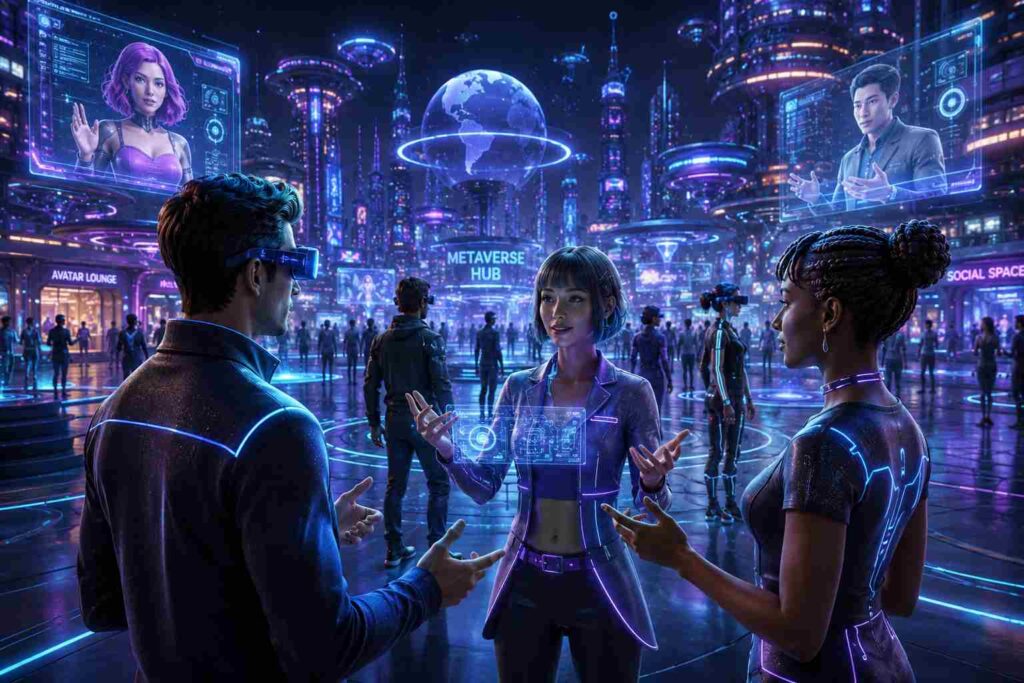
A virtual customer service representative answers questions naturally without following a rigid script. A digital teacher adapts explanations based on a student’s progress. A game character remembers previous conversations and responds differently each time you meet. These scenarios sound like science fiction, yet versions of them already exist in 2026.
The growing intersection of artificial intelligence and immersive technology has created a new category of digital experiences: AI avatars in the metaverse. Unlike traditional avatars that simply represent users in virtual worlds, these AI-powered digital characters can converse, respond, learn from interactions, and perform tasks autonomously.
At the same time, AI avatar technology is surrounded by hype. Headlines often suggest that digital humans are becoming indistinguishable from real people or that virtual companions are on the verge of replacing human interaction. The reality is more nuanced. While significant progress has been made, today’s AI avatars remain limited by technology, privacy concerns, and the challenge of creating genuinely human-like behavior.
As explored in our 2026 guide to AI and Virtual Reality, AI is transforming how users interact with immersive environments. AI avatars represent one of the most visible examples of that transformation.
This article examines how AI avatars work, which technologies make them possible, where they are already being deployed, and why the gap between today’s digital humans and future visions still remains significant.
Key Takeaways
- AI avatars are more advanced than traditional avatars.
- Most AI avatars combine multiple technologies rather than a single AI system.
- Gaming, healthcare, education, and customer service are leading adoption areas.
- Current systems remain limited by memory, latency, and accuracy issues.
- AI avatars are becoming increasingly important in virtual reality and spatial computing.
What Are AI Avatars in the Metaverse?
An avatar traditionally refers to a digital representation of a user within a virtual environment. For decades, avatars have existed in video games, social platforms, and online communities. Most of these avatars, however, have no intelligence of their own. They are simply visual representations controlled by human users.
AI avatars in the metaverse represent the next evolution of digital identity. Instead of acting solely as visual representations, these intelligent digital characters combine conversational AI, voice interaction, animation systems, and decision-making capabilities to create more interactive experiences.
Unlike traditional avatars, AI-powered avatars can communicate with users, answer questions, perform tasks, adapt to interactions, and in some cases maintain memory of previous conversations. They can exist within virtual worlds, gaming environments, educational platforms, customer service spaces, and other immersive digital experiences.
The evolution can be viewed as a progression:
Traditional Avatar
→ Static digital representation
Animated Avatar
→ Includes facial expressions and movement
Conversational Avatar
→ Can respond using AI-generated language
Context-Aware Avatar
→ Understands user intent and environment
Persistent AI Companion
→ Maintains long-term memory and personalized interactions
Many modern AI avatars occupy the middle stages of this progression. They can converse naturally and respond to context, but they are not yet truly autonomous digital beings.
| Capability | Traditional Avatar | AI Avatar |
| Visual Representation | Yes | Yes |
| Speech Interaction | No | Yes |
| Natural Conversation | No | Yes |
| Context Awareness | No | Yes |
| Memory | No | Sometimes |
| Task Execution | No | Limited |
| Autonomous Behavior | No | Partial |
The Technologies Behind Modern AI Avatars
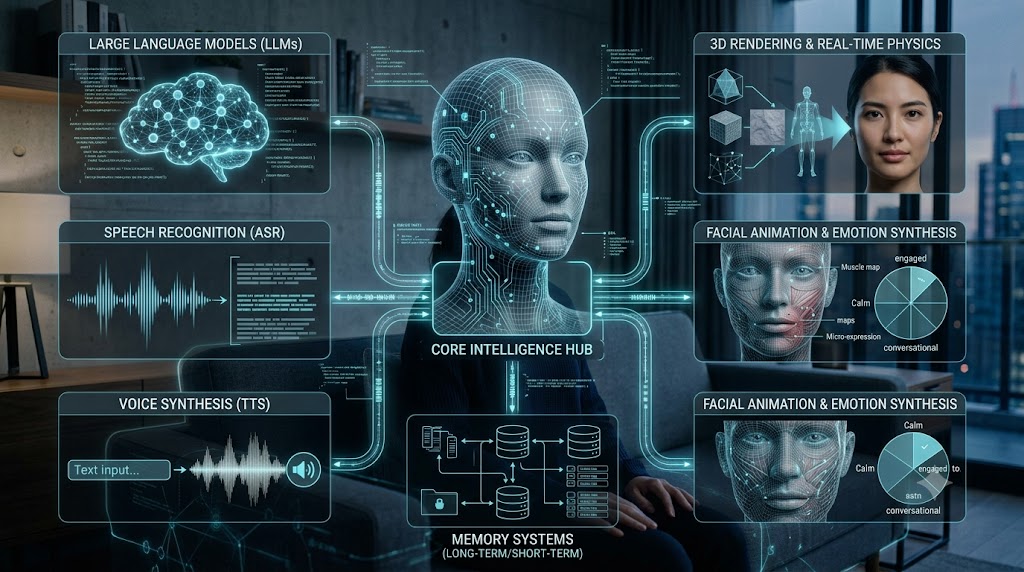
One of the biggest misconceptions surrounding AI avatars is the idea that they are powered by a single technology. In reality, modern AI avatars combine several advanced systems working together.
Large Language Models
The conversational abilities of AI avatars are typically powered by large language models (LLMs). These models generate responses, answer questions, and create natural conversations.
Without language models, AI avatars would behave much like traditional scripted NPCs with limited dialogue options. This shift represents a broader movement toward smarter immersive experiences where artificial intelligence enhances interaction inside virtual worlds.
Speech Recognition
Speech recognition systems convert spoken language into text that AI systems can process. This allows users to communicate naturally through voice rather than typing commands.
As speech recognition accuracy improves, interactions with AI avatars become more fluid and intuitive.
Text-to-Speech Systems
Once the AI generates a response, text-to-speech technology converts that response into spoken dialogue.
Modern systems can generate realistic voices with natural pacing, emotional tone, and expressive delivery.
Facial Animation
AI avatars rely heavily on facial animation systems to create believable communication.
Technologies such as NVIDIA Audio2Face analyze speech patterns and automatically generate synchronized facial expressions and lip movements. These developments are also connected with advances in spatial computing, where digital content can interact more naturally with the physical environment.
This capability dramatically improves immersion by making avatars appear more lifelike during conversations.
Avatar Rendering
The visual appearance of AI avatars comes from avatar creation and rendering platforms. Creating realistic digital humans also depends heavily on improvements in modern VR hardware and rendering capabilities.
Solutions such as Ready Player Me, Unreal Engine MetaHumans, and proprietary avatar systems allow developers to create highly detailed digital humans capable of operating across multiple virtual environments.
The combination of these technologies creates the illusion of a living digital character, even though each component serves a specialized function.
AI Avatars vs AI NPCs: Understanding the Difference
Many people use the terms AI avatar and AI NPC interchangeably, but they serve different purposes.
AI NPCs are designed primarily to support virtual environments, particularly games. Their role is to populate digital worlds and provide interactive experiences for players.
AI avatars, on the other hand, are often designed for direct interaction with users and may exist outside gaming environments.
| Feature | AI Avatar | AI NPC |
| Primary Purpose | Communication and assistance | Gameplay interaction |
| User Relationship | Ongoing and personalized | Contextual to game world |
| Memory | Often persistent | Usually limited |
| Environment | Multiple industries | Primarily gaming |
| Examples | Virtual tutors, assistants | Game companions, merchants |
This distinction is becoming increasingly important as developers create more sophisticated digital characters.
Readers interested in gaming-specific implementations should also explore our article on AI-Powered NPCs and Smart Environments, which examines how AI is reshaping interactive game worlds.
Where AI Avatars Are Being Used Today
AI avatars are no longer confined to research laboratories. Organizations across multiple industries are actively deploying them in real-world environments.
Education
Educational platforms are beginning to use AI avatars as virtual tutors and learning assistants.
Unlike static educational content, AI-powered tutors can answer questions, explain concepts differently depending on the student’s understanding, and provide personalized guidance.
Immersive educational environments may eventually combine virtual reality with AI avatars to create highly adaptive learning experiences.
Healthcare
Healthcare organizations are exploring AI avatars as digital assistants capable of guiding patients through administrative processes, answering routine questions, and supporting patient education. These applications are part of the wider adoption of immersive technology in healthcare, including medical training, therapy, and patient support.
Importantly, these systems are not replacing medical professionals. Instead, they serve as supplementary tools designed to improve efficiency and accessibility.
Customer Service
One of the fastest-growing use cases involves customer service.
AI avatars can greet customers, provide information, answer common questions, and guide users through processes without requiring human intervention for every interaction.
Unlike traditional chatbots, avatar-based systems create a more engaging and human-centered experience.
Enterprise Training
Organizations increasingly use AI avatars in training simulations. AI-driven simulations are becoming a key component of enterprise VR learning strategies.
Employees can practice communication skills, customer interactions, and decision-making scenarios with AI-driven virtual characters.
These simulations provide scalable training opportunities while reducing costs associated with traditional role-playing exercises. Studies on VR training effectiveness have shown measurable benefits in learner confidence, engagement, and knowledge retention..
Retail and Hospitality
Retailers and hospitality companies are experimenting with digital assistants capable of welcoming customers, recommending products, and answering questions.
As avatar realism improves, these systems may become increasingly common in customer-facing environments.
The Companies Building the Future of AI Avatars
Several companies are leading the development of AI avatar technology.
NVIDIA ACE
NVIDIA has emerged as one of the most influential players through its ACE (Avatar Cloud Engine) platform.
ACE combines speech recognition, language generation, animation, and rendering technologies to create interactive digital humans capable of real-time conversations.
The company’s work demonstrates how multiple AI technologies can be integrated into a single avatar system.
Inworld AI
Inworld AI specializes in creating intelligent virtual characters for games and immersive environments.
Its platform allows developers to build characters with unique personalities, goals, and conversational capabilities.
Ready Player Me
Ready Player Me focuses on avatar creation and interoperability.
Users can create avatars that function across multiple applications and virtual worlds, supporting the broader vision of interconnected digital identities.
Synthesia
Synthesia has become a major player in AI-generated video avatars.
Businesses use the platform to create digital presenters capable of delivering training content, marketing messages, and educational materials.
Character.AI
Character.AI demonstrates the growing public interest in conversational AI personalities.
Although not primarily focused on VR, it highlights how users increasingly engage with digital characters as companions, advisors, and entertainment experiences.
Meta
Meta reality labs research continues to invest heavily in avatar technology through research into realistic digital humans, expression tracking, and immersive communication.
The company’s long-term vision centers on making virtual interactions feel increasingly similar to face-to-face conversations.
Real-World Examples That Show What Is Actually Possible
To understand AI avatars realistically, it helps to examine actual deployments rather than marketing promises.
NVIDIA ACE Digital Humans
NVIDIA ACE demonstrates how conversational AI, speech systems, and avatar rendering can work together in real time.
Users can speak naturally, receive contextual responses, and observe synchronized facial expressions and voice output.
This represents one of the clearest examples of production-ready digital human technology.
AI Companions in Gaming
Several modern games are experimenting with AI-driven companions capable of responding dynamically to player actions.
Instead of repeating scripted dialogue trees, these companions can adapt conversations based on context and previous interactions.
This creates more immersive experiences and increases replayability.
Virtual Presenters
Businesses increasingly deploy AI-generated presenters for training and communication.
These digital humans deliver information consistently while reducing production costs associated with traditional video creation.
AI-Powered Learning Assistants
Educational organizations are testing virtual instructors capable of providing personalized support to students.
Although still early in development, these systems highlight the potential for scalable educational assistance.
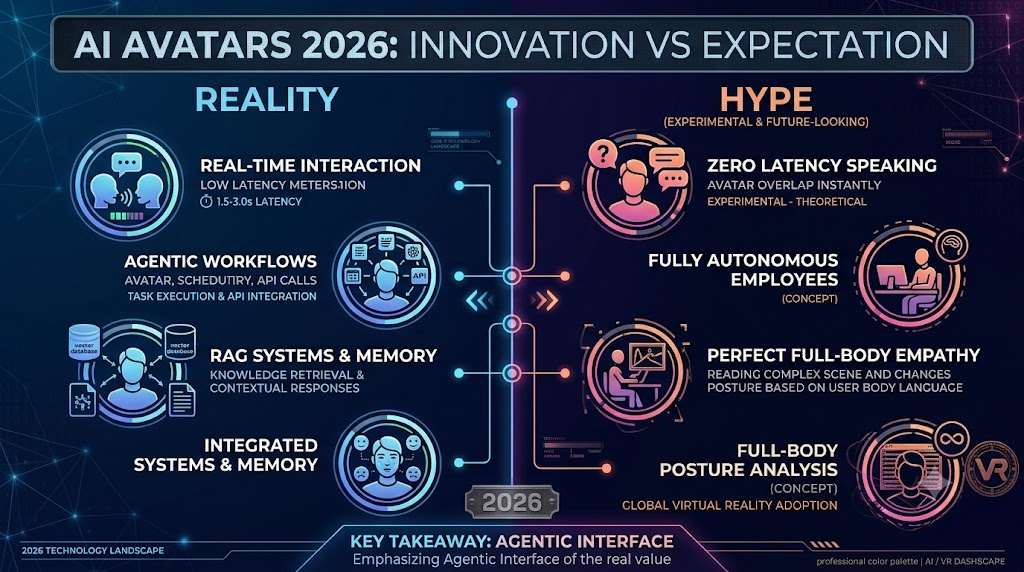
What’s Real Today?
Understanding this distinction is critical because many headlines blur the line between production-ready technologies and experimental research projects.
Available Now
- Conversational AI avatars capable of natural dialogue
- AI-powered tutors and learning assistants
- Digital customer service representatives
- AI-generated virtual presenters
- AI companions and game characters
- Real-time speech-to-avatar systems
- Emotionally expressive digital humans
Still Experimental
- Fully autonomous digital humans
- Human-level emotional intelligence
- Persistent lifelong memory across all interactions
- Self-aware AI characters
- Perfectly realistic digital humans
- AI avatars that can independently reason like humans
Where AI Avatars Still Fall Short
Despite impressive advances, AI avatars remain far from perfect.
Limited Memory
Many systems still struggle with maintaining long-term memory across conversations.
Users often discover that avatars forget important details or lose context after extended interactions.
Hallucinations
Language models can generate inaccurate information with high confidence. Language models can generate inaccurate information with high confidence. These challenges highlight broader AI model limitations and reliability challenges identified in ongoing AI research.
This creates challenges for applications involving healthcare, education, and professional decision-making.
Emotional Understanding
AI avatars can simulate emotions but do not genuinely experience them.
The distinction remains important when evaluating claims about digital empathy or companionship.
Latency
Real-time conversations require multiple systems to operate simultaneously.
Speech recognition, language generation, animation, and rendering all introduce delays that can affect realism.
Privacy Concerns
AI avatars often process voice data, behavioral information, and personal preferences.
Organizations must carefully manage data security and user privacy to maintain trust.
Biggest Myths About AI Avatars
Myth 1: AI Avatars Think Like Humans
Reality: AI avatars generate responses based on patterns in training data. They do not possess consciousness, self-awareness, or independent reasoning.
Myth 2: AI Avatars Have Genuine Emotions
Reality: They can simulate emotional responses but do not experience feelings.
Myth 3: Every Metaverse Avatar Is AI-Powered
Reality: Most avatars remain user-controlled digital representations without autonomous intelligence.
Myth 4: AI Avatars Will Replace Humans
Reality: Most successful implementations focus on assisting humans rather than replacing them entirely.
Myth 5: AI Avatars Are Already Perfectly Realistic
Reality: While visual quality has improved dramatically, behavioral realism remains a significant challenge.
Will AI Avatars Replace Human Interaction?
This question frequently appears in discussions about AI.
The evidence suggests that AI avatars will complement human interaction rather than eliminate it.
- In healthcare, digital assistants can handle routine inquiries while medical professionals focus on patient care.
- In education, AI tutors can provide additional support while teachers remain central to learning.
- In customer service, AI avatars can manage repetitive questions while human agents address complex situations.
The most effective implementations typically combine automation with human expertise rather than choosing one over the other.
What Comes Next?
The future of AI avatars will likely be shaped by several emerging trends.
Persistent Memory
Future systems will maintain richer long-term memories, creating more personalized interactions.
Spatial Computing
As discussed in our article on Spatial Computing in 2026, digital assistants may become integrated directly into mixed reality environments.
Real-Time Translation
AI avatars could eventually enable seamless communication across languages.
Digital Twins
Organizations may create AI-powered digital representations of products, environments, and even professional expertise.
Agentic AI
Future avatars may move beyond conversation and perform tasks autonomously on behalf of users.
Multimodal Intelligence
The combination of voice, vision, gestures, and environmental awareness could significantly expand avatar capabilities.
Expert Perspective
The biggest misconception about AI avatars is that visual realism equals intelligence.
In reality, the most important advances are happening behind the scenes through:
- Large language models
- Voice technologies
- Memory systems
- Real-time personalization
A realistic face may attract attention, but intelligence determines whether users continue interacting with the avatar.
Conclusion
AI avatars represent one of the most fascinating intersections of artificial intelligence and immersive technology. They are no longer theoretical concepts confined to research laboratories. Real products already exist across gaming, education, enterprise training, customer service, and virtual communication.
At the same time, today’s AI avatars remain far less advanced than many marketing claims suggest. Most systems rely on a combination of language models, speech technologies, animation tools, and rendering platforms rather than possessing true human-like intelligence.
The most important question is no longer whether AI avatars are real. They are.
The more meaningful question is how effectively they can augment human experiences while addressing challenges involving privacy, accuracy, trust, and emotional authenticity.
As AI continues to converge with virtual reality, spatial computing, and digital identity systems, AI-powered avatars and digital humans are likely to become increasingly common.
For more interesting articles, visit the Future of Virtual Reality Homepage.
Frequently Asked Questions
What Is an AI Avatar?
An AI avatar is a digital character powered by artificial intelligence that can communicate, answer questions, and interact with users through text, voice, or virtual environments. Unlike traditional avatars, AI avatars can respond independently rather than relying entirely on human control.
Are AI Avatars Real in 2026?
Yes. AI avatars are already being used across multiple industries, although they remain far from fully autonomous digital humans.
Examples include:
- NVIDIA ACE digital humans
- Synthesia AI presenters
- Inworld AI game characters
- Character.AI personalities
- Meta’s realistic avatars
Most current AI avatars are designed to assist, communicate, and engage users, but they still have limitations in memory, reasoning, and emotional intelligence.
Can AI Avatars Hold Natural Conversations?
Modern AI avatars can hold surprisingly natural conversations by combining large language models, speech recognition, and voice synthesis technologies. While they can answer questions and maintain context, they may still make mistakes or lose track of longer discussions.
What Is the Difference Between an AI Avatar and an AI NPC?
Both use artificial intelligence, but they serve different roles. AI avatars are designed to assist and communicate with users, while AI NPCs are built to enhance gameplay and virtual environments.
Key differences:
- AI avatars focus on communication.
- AI NPCs focus on gameplay.
- AI avatars are used across industries.
- AI NPCs are primarily used in games.
Simply put, AI avatars assist users, while AI NPCs bring virtual worlds to life.
Can AI Avatars Replace Human Interaction?
Not entirely. AI avatars work best as assistants rather than replacements.
Current applications include:
- AI tutoring and coaching
- Virtual customer support
- Workplace training scenarios
- Healthcare information assistance
- Conversational game characters