
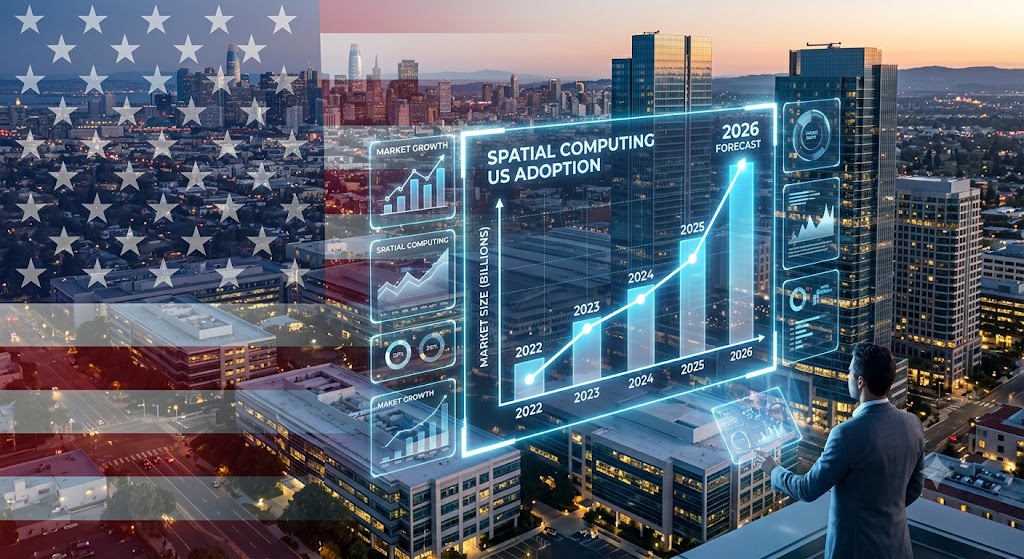
The United States is the largest spatial computing market in the world, and it isn’t particularly close. Depending on which research firm you ask, the US controls somewhere between 25% and 75% of the global market, and while those numbers disagree wildly on scope, they agree completely on one thing: no other country comes close to America’s combination of hardware makers, enterprise buyers, and defense spending in this space.
If you’re trying to understand what’s actually happening in this market rather than just seeing a headline number, this guide breaks down the real size, the sectors actually spending money, and the companies genuinely leading it. Specifically, here’s what’s covered:
- Why market-size estimates vary so wildly, and which numbers you can actually trust
- Who leads the market, and how Apple, Microsoft, and Meta are each playing a different game
- Which industries are actually spending money right now, not just experimenting
- The real data behind the boom, in plain numbers
- Where the startup and investment activity is concentrated, including exact funding figures
- Which US cities are driving innovation, and why
- The honest risks most market reports leave out
Why the Market Size Numbers Are All Over the Place
Before diving into the data, it’s worth addressing something most articles on this topic don’t: the estimates for the US spatial computing market vary by more than 15x depending on the source, and pretending otherwise would be dishonest.
Here’s what different research firms are actually reporting:
| Source | Figure | Scope |
|---|---|---|
| Grand View Research | $35.9B (2023), 17.7% CAGR through 2030 | Full US spatial computing market |
| DataM Intelligence | $627.53B by 2033 | US spatial computing market, broader definition |
| SNS Insider | $68.3B (2025) to $457.52B by 2035 | US spatial computing platform market specifically |
| North America regional data (DataM) | $260.84B by 2032, US holds 75% share | North America, US-weighted |

The gap exists because “spatial computing” gets defined differently by each firm. Some count only hardware and software platforms. Others fold in the entire XR ecosystem, AI infrastructure, and every downstream service built on top of it. Neither approach is wrong, but neither is the whole picture on its own.
What’s consistent across every single one of these reports, regardless of methodology, is the growth trajectory: double-digit CAGR, US dominance, and enterprise spending outpacing consumer spending by a wide margin.
If you want the bigger-picture view of how spatial computing works globally before diving into the US specifically, our complete spatial computing guide covers the full technology stack and international market data.
Who Actually Leads the US Spatial Computing Market
Three companies account for the overwhelming majority of US spatial computing revenue and influence, and each is playing a genuinely different game.
- Apple, ~25% share: built almost entirely around Vision Pro and visionOS. The February 2026 visionOS 3.0 update pushed further into medical simulation and productivity use cases, reinforcing its position as the premium, enterprise-leaning option rather than a mass-market play.
- Microsoft, ~20% share: strength concentrated almost entirely in enterprise. HoloLens and Azure Spatial Anchors remain the backbone of manufacturing digital twins and defense training programs, with Azure’s spatial tooling driving reported 15% year-over-year growth in healthcare and training deployments specifically.
- Meta, dominant device volume: leads through the Quest ecosystem, with Reality Labs having poured more than $100 billion into the category to date. In a signal of where the real money is moving, Meta committed $100 million to Anduril in 2025 specifically for US defense XR deployments, a clear indicator that even the most consumer-focused player in this space sees enterprise and government contracts as the near-term growth engine.
For a closer look at how these three platforms compare on actual hardware, our latest VR systems roundup breaks down specs and pricing in detail.
The Sectors Actually Spending Money
Gaming gets the headlines, but it isn’t where US enterprise dollars are going. Here’s where adoption is genuinely concentrated.
- Healthcare, fastest-growing vertical (CAGR above 30% by some estimates): spatial computing lets surgeons rehearse complex procedures on a 3D model of a real patient’s anatomy before ever picking up a scalpel, and hospitals report measurably fewer errors in AR-guided procedures compared to traditional methods. For more on this specific application, see our guide to VR in healthcare.
- Defense, one of the clearest growth signals in the market: beyond Meta’s Anduril investment, government and defense adoption is expanding specifically around simulation, mission planning, and remote training, sectors where the cost of a headset is trivial compared to the cost of physical training exercises.
- Manufacturing, the leader on raw adoption numbers: more than 40% of Global 2000 manufacturers now run at least one production digital twin. Companies like Boeing and Siemens use spatial computing to mirror entire factory floors in real time, letting engineers spot problems and test fixes before touching physical equipment. Reported results include 10-15% reductions in downtime and up to 30% faster product iteration cycles.
- Retail, smaller but growing fast: primarily through virtual try-ons and AR-assisted store navigation, both increasingly common in mainstream US retail apps rather than experimental pilots.

US Spatial Computing by the Numbers
A few data points worth knowing if you’re evaluating this market seriously, rather than going off a single vague headline figure.
- The US accounted for over 25% of the global spatial computing market as of 2023, according to Grand View Research, with North America overall holding between 33.5% and 39.45% of global revenue depending on the source.
- Hardware still dominates revenue, accounting for roughly 55-65% of total market spend, though services are growing at the fastest rate of any segment as enterprises need integration and ongoing support, not just devices.
- Digital twin technology specifically is projected to become a market worth more than $73 billion by 2027, and manufacturing is the primary driver.
- Enterprise adoption is projected to surpass 75% among large organizations by 2030, according to multiple industry trackers, a signal that spatial computing is moving from pilot programs into standard operating procedure.

For the full breakdown of how this compares internationally, our regional coverage of Europe, Asia, and Dubai and the UAE shows exactly how adoption patterns differ by region.
The US Spatial Computing Startup and Investment Landscape
Big platform players get most of the headlines, but the startup layer underneath them tells its own story, and it’s a genuinely US-dominated one.
The United States has attracted $32.1 billion in total funding for spatial computing companies, more than any other country by a wide margin, according to startup data tracker Tracxn. The US is also home to more spatial computing companies than anywhere else in the world, with over 4,500 firms in the sector, well ahead of the UK and India in second and third place.
A few specifics worth knowing:
- Epic Games is the single highest-funded company in the entire global spatial computing sector, having raised over $8 billion, a reflection of how central its Unreal Engine has become to spatial and mixed reality development well beyond gaming.
- The sector has produced dozens of unicorns and seen hundreds of acquisitions, a sign of a maturing market rather than a purely speculative one.
- Founder pedigree skews heavily academic: Stanford, MIT, and Harvard alumni have founded more spatial computing companies, and raised more capital collectively, than graduates of any other universities over the past decade.
This funding concentration matters practically, not just as a trivia point. It means the deepest bench of spatial computing engineering talent, tooling, and specialized investors is still overwhelmingly based in the US, which reinforces why enterprise buyers elsewhere in the world often still look to American vendors and platforms first.
Where US Spatial Computing Innovation Is Actually Concentrated
Market share numbers describe the whole country, but the real work is heavily clustered in a handful of specific places.
Silicon Valley remains the center of gravity by sheer weight of headquarters alone. Apple (Cupertino) and Meta (Menlo Park) both develop their spatial computing platforms a short drive from each other, and the region’s existing venture capital density means most new spatial computing startups still raise their earliest rounds from Bay Area funds.
Seattle has quietly become a serious secondary hub, and its strength comes from a different angle than Silicon Valley’s consumer-platform focus. Microsoft’s HoloLens and Azure spatial tooling are developed here, and the city’s gaming heritage, anchored by Valve, Bungie, and Xbox Game Studios, has produced a dense pool of engineers experienced in the exact real-time 3D rendering skills spatial computing depends on.
Washington DC and Northern Virginia function as the country’s de facto spatial computing defense corridor, where the growing wave of military and government contracts (including Meta’s Anduril partnership) tends to concentrate, given the sector’s proximity to defense procurement decision-makers.
If you’re evaluating where to build a career, launch a startup, or simply understand who’s actually behind the headlines in this market, these three regions explain far more than any single national statistic can.
The Real Risks in the US Market Specifically
Every market report paints a growth picture, but a few genuine friction points are worth naming honestly.
Talent shortages. Spatial computing development requires a genuinely different skill set than traditional software, and demand for experienced XR developers currently outpaces supply, particularly for smaller companies competing against Apple, Meta, and Microsoft for the same limited talent pool.
Data privacy exposure. These devices collect biometric data, eye movement, hand geometry, even physiological signals, that current security frameworks weren’t built to handle. No comprehensive regulatory standard yet matches something like PCI-DSS for payment data, leaving compliance largely improvised on a company-by-company basis.
High enterprise deployment costs. Even as consumer hardware prices ease, enterprise-grade deployments involving custom software, integration, and training still represent a serious upfront investment that smaller organizations struggle to justify without proven ROI data specific to their industry.

Frequently Asked Questions
How big is the US spatial computing market in 2026?
Estimates vary significantly by scope, ranging from roughly $35.9 billion (Grand View Research’s core market definition) to figures well over $100 billion when broader ecosystem spending is included. What’s consistent across every estimate is double-digit annual growth and clear US dominance globally.
Which US companies lead the spatial computing market?
Apple, Microsoft, and Meta control the large majority of the market. Apple leads in premium hardware and enterprise productivity, Microsoft dominates enterprise deployment through HoloLens and Azure, and Meta leads on consumer device volume while increasingly investing in defense contracts.
What industries use spatial computing most in the US?
Manufacturing, healthcare, and defense are the three largest adopters. Manufacturing leads on raw deployment numbers through digital twins, healthcare is the fastest-growing vertical by CAGR, and defense spending has become one of the clearest growth signals in the entire market.
Is North America still the largest spatial computing region?
Yes. North America consistently holds the largest regional share globally across every major research report, typically cited between 33% and 39% of total market revenue, driven primarily by US enterprise and defense spending.
Bottom Line
The US spatial computing market doesn’t need an inflated single number to make its case. Whether the real figure is closer to $36 billion or well over $100 billion depends entirely on how you draw the boundary, but the underlying story is the same either way: American enterprises are the world’s biggest buyers of this technology, defense spending is accelerating faster than almost anyone predicted a year ago, and the three companies actually building the hardware, Apple, Microsoft, and Meta, are each betting on a different piece of the same growing pie.
For ongoing coverage as this market develops, check our homepage for the latest spatial computing news.
Pingback: Spatial Computing 2026: The Real Numbers Behind the Hype