
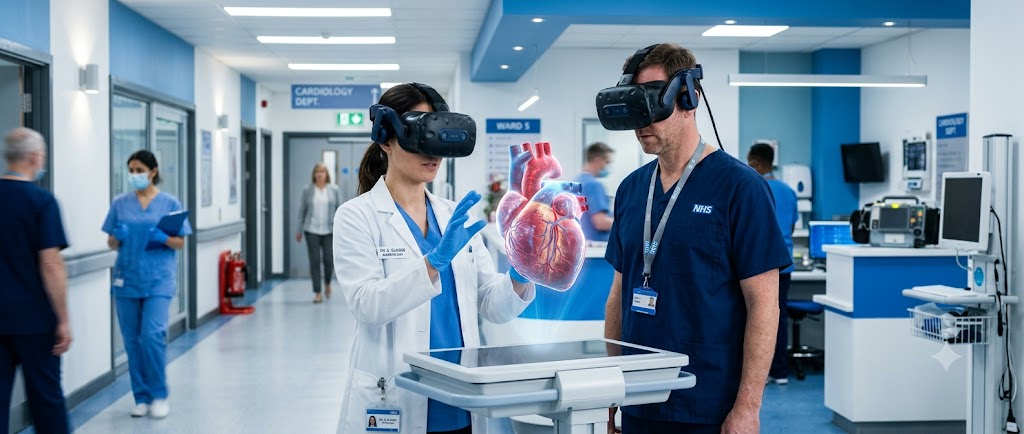
When people talk about the NHS and technology, the conversation often defaults to two well-worn positions: either cautious admiration for what Britain’s health service is trying to do with limited resources, or frustrated criticism of how slowly institutional change moves inside a system serving 68 million people. Virtual reality does not escape that tension. But what has happened in British and European healthcare VR over the past 18 months represents something more than incremental progress.
In February 2026, NHS Supply Chain published a pipeline notice for a new national framework agreement covering medical simulation devices and immersive technologies, with an estimated value of £210 million. The scope explicitly includes VR simulation systems, AR trainers, and mixed reality platforms, alongside immersive projection rooms and simulated electronic patient records. The contract period runs from May 2027 through May 2029, with a possible extension to 2031. A £210 million national procurement framework is not a pilot. It is an infrastructure commitment, and it signals that VR healthcare in Europe, starting with the NHS, has passed the experimental phase.
For a broader picture of how VR technology applies across health, wellness, and therapeutics globally, the Future of Virtual Reality team covers the full landscape, and our VR health and wellness section goes specifically into the clinical and therapeutic dimensions we touch on throughout this article.
What the NHS Has Been Building on the Ground
Long before the Supply Chain framework announcement, individual NHS trusts had been building practical VR programs. NHS England Pharmacy London, in partnership with Frimley Health NHS Trust, developed a digital-twin pharmacy environment that recreates an actual NHS dispensary as a precise virtual replica, accessible anywhere in the world through Quest headsets. Pharmacists in different locations train together inside the same virtual room, practicing procedures on a simulation of the real equipment they use on shift. The project’s stated philosophy, “sending headsets not people,” reflects a genuinely practical calculation for a health service with 1.3 million staff across hundreds of facilities.

NHS England’s East of England team, working with Immersive Medical Ltd, developed a VR training scenario following an 83-year-old patient named Peter through his healthcare journey. Learners make decisions about his treatment using clues in his home environment to inform their clinical reasoning. The scenario specifically targets multi-morbidity management, where patients have several overlapping conditions simultaneously, a challenge traditional classroom instruction struggles to convey with the same experiential force.
Gloucestershire Hospitals introduced VR simulation to their Healthcare Support Worker training programme, using a locally developed visual impairment simulation that puts trainees in a first-person experience of significant sight loss. Staff feedback noted that inhabiting a patient’s perspective changed how workers approached care interactions with an immediacy that reading about the condition simply could not produce.
Great Ormond Street Hospital’s VR work sits in a different category entirely. GOSH and UCL’s clinical cardiovascular engineering group co-developed VheaRts, a platform that generates 3D models of a child’s specific heart anatomy from their own MRI and CT data, viewable in VR before surgery. For complex congenital heart conditions where every patient’s anatomy is different and the stakes of decision-making are extremely high, the ability for a surgical team to walk through a patient’s actual cardiac geometry in three dimensions before making the first incision is not a convenience. It changes what surgeons can know before they operate.
Scaling VR Training Across the NHS
Beyond individual trust programs, ExR Education’s NHS-specific VR platform hosts a library of NHS-co-created training content, available 24 hours a day to healthcare professionals across trusts. The platform covers anesthetics and intensive care, nursing consultation skills, knee and shoulder replacement surgical scrub training, and air ambulance pre-hospital procedures, among many others. For NHS organizations that want to implement VR training without building content from scratch, this kind of ready-made institutional library is a more realistic near-term deployment model than custom-built scenarios.
NHS Highland used VR to provide career inspiration to school students in remote areas of Scotland. Pupils in Inverness, Caithness, and Fort William reported that being able to virtually inhabit an NHS professional’s role gave them a clearer sense of what the work actually involves. Nine out of ten students across the first ten schools said the sessions were effective in helping them picture themselves in NHS settings.
It is also worth noting that UK schools in the London borough of Sutton are running a VR mental health pilot with tech firm Phase Space, backed by the CAMHS team at South West London and St George’s NHS Trust. Nine out of ten pupils reported an immediate reduction in stress after using the headsets during the program, raising the question of whether school-based VR mental health tools could help ease pressure on overstretched NHS child mental health services.
VR Healthcare in Europe Beyond the NHS
The NHS dominates English-language coverage of European healthcare VR, but the story on the continent is equally substantive. Germany’s medical schools and simulation centers have integrated VR into surgical and procedural training programs, with the country’s university hospital network providing strong institutional infrastructure for adoption. The same cultural emphasis on precision and documented skill development that makes German manufacturing receptive to VR training, as we have explored in our coverage of the latest VR and spatial computing developments, makes its medical education system a natural environment for immersive simulation.
The Netherlands has a strong digital health research base, and Dutch healthcare institutions have been active in VR rehabilitation research specifically. Several Dutch university hospitals have run clinical trials on VR-based rehabilitation for stroke patients and chronic pain conditions, contributing to the peer-reviewed evidence base that is gradually moving VR from pilot to standard-of-care consideration in rehabilitation medicine.
France’s involvement in healthcare VR is influenced partly by its strength in digital health policy and partly by its medical simulation industry, historically strong in laparoscopic training. French teaching hospitals have been deploying VR simulation for minimally invasive surgical training, building on established relationships with medical simulation vendors.
You can also read our other interesting article about the Usage of VR to reduce anxiety.

The Regulatory Landscape Across the EU
In the EU, the Medical Device Regulation framework governs immersive healthcare tools, and the distinction between a regulated medical device and a training or wellness tool remains an active area of regulatory interpretation. The EU’s General Data Protection Regulation adds a further layer of consideration for any VR application that collects biometric, eye-tracking, or physiological data from patients. European healthcare institutions tend to work through data governance requirements before scaling a clinical VR program. This slows initial rollout timelines but typically produces deployments structured more carefully around patient data rights from the start.
EU reimbursement frameworks for VR therapy are less developed than in the US. Most European national health systems do not yet reimburse VR-specific therapeutic applications as a distinct billing category, which means hospitals absorb VR therapy costs as operating expenses. This creates a structural incentive to prioritize training applications over patient-facing therapeutics in the near term, at least until reimbursement pathways catch up.
What the £210M Framework Actually Means for the Future
National framework agreements in the NHS work by pre-qualifying vendors and establishing pricing structures that individual trusts can access without running full procurement processes from scratch. Once the framework is live, any NHS trust wanting to deploy VR simulation tools can do so through a simplified purchasing process against a validated vendor list. That structural change is what typically converts individual pilot projects into system-wide deployment.
If the framework proceeds on its published timeline (full tender notice expected July 2026, contracts from May 2027), the period from 2027 to 2029 could represent the moment when VR training and simulation transitions from a notable initiative at a minority of NHS trusts to standard infrastructure across the system. The NHS has used similar framework models to scale other digital health tools, and the combination of reduced procurement friction and pre-negotiated pricing substantially lowers the barrier for smaller trusts.
Key Takeaways
- NHS Supply Chain’s £210 million framework for VR, AR, and MR medical simulation (February 2026) is the largest structural VR healthcare commitment in Europe to date.
- Individual NHS trusts have been building practical programs for several years, including digital-twin pharmacy training, multi-morbidity simulation, cardiac anatomy VR at GOSH, and career inspiration for students in remote Scotland.
- Germany, the Netherlands, and France each have growing healthcare VR programs shaped by their distinct medical education and research cultures.
- EU Medical Device Regulation complexity and underdeveloped reimbursement structures are the primary barriers to faster pan-European scaling.
Frequently Asked Questions
Is the NHS using VR in hospitals?
Yes. Multiple NHS trusts run active VR training and patient care programs. GOSH operates the VheaRts cardiac visualization platform. Gloucestershire Hospitals and NHS England’s East of England team have both developed immersive training scenarios. NHS Supply Chain announced a £210 million VR and simulation procurement framework in February 2026.
How much is the NHS investing in VR medical simulation?
NHS Supply Chain published a pipeline notice in February 2026 for a national framework valued at an estimated £210 million, covering VR simulation systems, AR trainers, mixed reality platforms, and related immersive healthcare technologies, with contracts anticipated from May 2027.
Which European countries use VR in healthcare?
The UK leads in documented NHS deployment at scale, with Germany, the Netherlands, and France running active VR medical training and rehabilitation programs through university hospitals and simulation centers.
Further Reading
- https://www.auganix.org/xr-news-nhs-supply-chain-medical-simulation-xr-contract/
- https://www.england.nhs.uk/east-of-england/2024/05/22/immersive-vr-training-for-nhs-staff-developed-in-the-east-of-england/
- https://www.gosh.nhs.uk/learning/gosh-learning-academy/education-and-training/clinical-simulation-centre/virtual-reality-at-gosh/
- https://exr.education/uses/nhs/