
Key takeaways
- German carmakers use VR mostly to plan new lines and to train people before the real line runs.
- Augmented reality handles much of the hands-on work, such as maintenance and assembly guidance.
- Studies suggest VR assembly training can carry over to real tasks, but skills fade without refreshers.
- In Germany, a headset that could monitor workers usually needs works council approval. GDPR applies too, and the EU AI Act limits emotion tracking.
- Start with the works council, not the headset.
BMW Is Training People for a Line That Does Not Exist Yet
BMW is teaching staff to work on an assembly line that has not been built yet. That is the clearest picture of virtual reality in manufacturing in 2026.
Virtual reality in manufacturing means using headsets to plan, practice and troubleshoot production before anyone touches the real line. In Germany, the big carmakers mostly use it for factory planning and worker training. And German labor law decides how it can be rolled out.
This guide follows VR through a factory’s life, from the first layout to the daily fix. It covers what research says about training transfer, and the German rules most English guides skip. It is part of our enterprise series, alongside VR safety training and VR haptic suits. For cost numbers, see our enterprise VR training ROI guide.
What Is Virtual Reality in Manufacturing?
Virtual reality in manufacturing is the use of immersive headsets to design, plan, train for and support physical production in a simulated space. It has two close relatives:
- Augmented reality (AR) puts instructions on top of the real machine.
- A digital twin is a live virtual model of a plant or process. A headset is often the window into it.
A simple rule helps. VR is for places and situations you cannot or should not use yet, like a future line or a dangerous fault. AR is for the real line, in the moment. German makers use both.
For how VR works under the hood, see our overview of how virtual reality works. The wider German push for connected, data-driven factories goes by the name Industrie 4.0.
Why Is Germany a Special Case?
Three things set Germany apart: large manufacturers, a deep base of mid-sized suppliers known as the Mittelstand, and strong worker co-determination law.
At the 21st Digitale Fabrik congress, BMW, Volkswagen and Schaeffler showed work on digital twins, AI-supported planning and physical AI, according to Automotive Manufacturing Solutions. The first two points explain why VR gets used. The third explains how.
How Do German Factories Use VR From Planning to Daily Work?
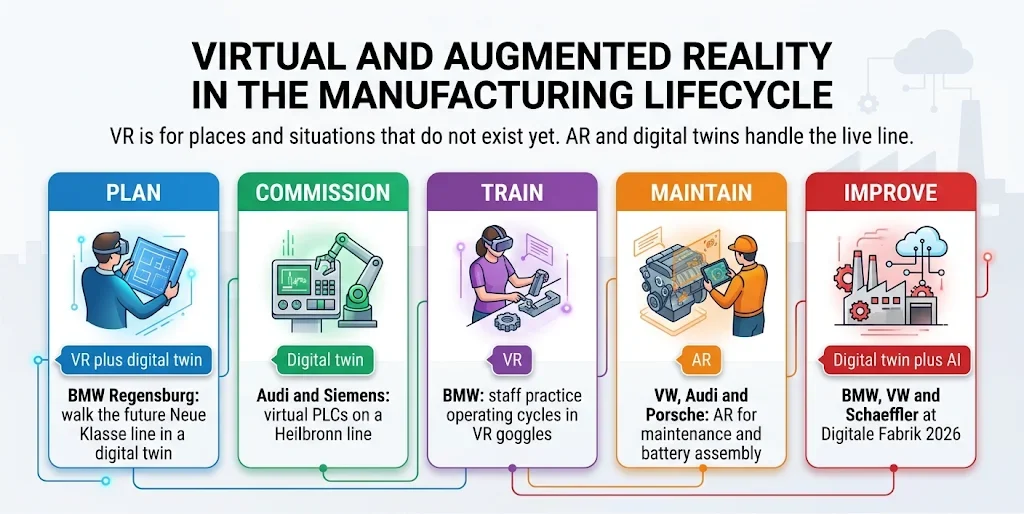
Think of five stages.
Stage 1: Plan, Before the Line Exists
At Plant Regensburg, BMW is planning production lines for its Neue Klasse models inside a digital twin built on NVIDIA Omniverse Enterprise. The plant is using 3D human simulation in vehicle assembly, so planners can model the line and the people who will work on it, according to EMobility+.
BMW also brings plant-wide digital twins into VR to cut layout conflicts and shorten planning cycles, Automotive Manufacturing Solutions reports. A 2022 industry account, cited in a digital twin review, put the planning gain at 30%. Treat that as a company-reported figure.
Stage 2: Commission, When the Twin Takes Control
Audi, with Siemens, ran virtual PLCs (software controllers) on an assembly line at its Böllinger Höfe plant in Heilbronn and planned a rollout in the Neckarsulm body shop, per RCR Wireless. This is digital twin and software control, not VR. It still matters, because the twin is what a headset looks into.
Stage 3: Train, Before the Real Line Runs
BMW production expert Dominik Wottke said video from the twin lets staff preview their future workplace. Employees can wear VR goggles to explore the future assembly line, practice specific operating cycles and shorten the learning phase on the real line. For hazard training, see our guide to VR safety training.
Stage 4: Maintain, Where AR Takes Over
Volkswagen, Audi and Porsche use AR for maintenance, battery assembly and worker training. Battery module assembly needs precise orientation and strict safety checks. BMW uses AR for variant-specific guidance: scan the vehicle number and the system highlights the right part, fastening point or cable route.
Stage 5: Improve, Where Digital Meets Reality
At the Digitale Fabrik congress, digital models were described as tools that do more than show plans. They help prepare decisions, compare variants and control real systems. BMW’s Tobias Delago also noted that using AI in production planning comes with special conditions. In plain words: the digital model has to stand up to the real factory.
Does VR Assembly Training Carry Over to the Real Line?
Mostly yes for procedures, with caveats. Here is the evidence:
- Early lab studies. Studies on two-handed assembly (3D puzzles) found no significant difference in times and success rates between virtual and physical training, as summarized in Shen et al., 2021.
- Skills fade. The same team tested levels of immersion and reported a significant performance drop in a retention test two weeks after training. Plan refreshers.
- Fewer errors. A 2019 study in the International Journal of Advanced Manufacturing Technology found VR-trained participants made fewer errors and took less time in real product assembly than a baseline group.
- Touch helps. A study of haptic-enabled virtual assembly reported up to 80% better real assembly performance for people who trained virtually first, compared with conventional training. It was a lab study. We explain how touch cues work in our guide to VR haptic suits.
- The wider picture. A 2024 systematic review of VR for assembly and disassembly training collects more of the evidence.
Most of these studies used puzzles, small models or student volunteers, not production lines. Treat them as signals, not guarantees.
What Do German Rules Mean for Factory VR?
Here is what most English guides skip. In Germany a headset is not only a training tool. Legally, it can be a monitoring device.
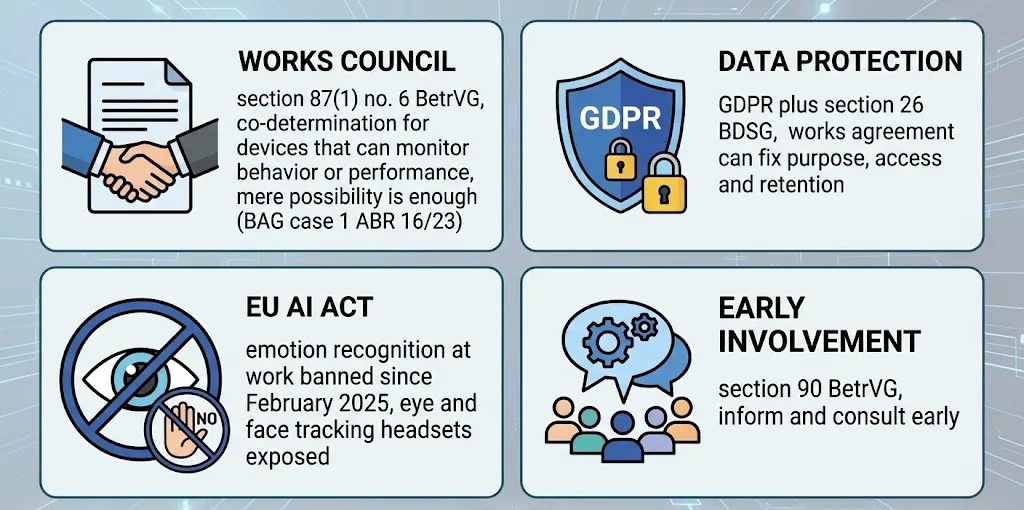
- Works council approval:Under section 87(1) no. 6 of the Works Constitution Act (BetrVG), a works council has a say on technical devices that can monitor behavior or performance. In case 1 ABR 16/23, the Federal Labour Court held that a headset system with a listen-in option needed co-determination, and the mere possibility of live monitoring was enough, as Eversheds Sutherland reported. Law firm Taylor Wessing says the same reasoning carries over to VR and AR headsets, which can capture gaze direction, speaking time and reactions.
- Data protection: GDPR and section 26 of the German Federal Data Protection Act (BDSG) cover employee data. Law firm Buse notes that where a company has a works council, introducing VR or AR solutions is subject to co-determination. A works agreement (Betriebsvereinbarung) can set purposes, access and retention.
- EU AI Act: Since February 2025, AI emotion recognition at work has been banned (Article 5(1)(f)). Headsets with eye or face tracking are especially exposed, says Taylor Wessing.
- Early involvement: Section 90 BetrVG asks employers to inform and consult the works council early about planned technical installations and work processes, as Mayer Brown summarizes.
- The worker view: In an IG Metall interview, a works council member at ZF Wabco said performance and behavior monitoring must be ruled out from the start, and described a works agreement covering systems that process employee data.
What does this mean in practice? Use VR for training. Switch off gaze and behavior analytics unless you agree otherwise. Keep only the data you need. And sign a works agreement. This is general information, not legal advice. Ask German employment counsel.
What Does Factory VR Cost, and Where Does It Pay Off?
I found no public German-wide ROI dataset, so I will not invent one. What I can say is where VR tends to pay first:
- Lines that do not exist yet, such as new model launches.
- Work with many variants, where mistakes are easy.
- Costly or dangerous errors.
- Rare events you cannot stage safely.
Volume matters too. For break-even logic, see our enterprise VR training ROI guide and our overview of VR for business.
How Can a Mid-Sized Manufacturer Start?
- Talk to the works council first. Agree on scope and data rules before you buy anything.
- Pick one use case with clear pain. A new line launch, a hazardous task or a costly error.
- Decide VR or AR. VR for places that do not exist yet, AR for the live line.
- Set data rules. No gaze or behavior analytics by default. Define how long you keep data.
- Pilot small and measure real outcomes. Track errors and time to competence on the real line, not course completions. For hardware, see our VR headsets guide.
- Add refreshers. Skills fade, so schedule short repeat sessions.
Schools and training centers face similar choices. See our guide to VR in education.
What Is the Outlook for EU Industrial VR?
Industry coverage this year points to digital twins and AI as the center of gravity. VR is the human window into those models. Consumer headset sales have fallen, with IDC expecting a 42.8% drop in 2025, The Register reported. But factory VR depends on use cases, not consumer demand. That is my read, not a forecast. For the bigger picture, see spatial computing in 2026.
German Terms You Will See
| German | English | Why it matters |
| Betriebsrat | Works council | Must be involved in monitoring-capable systems |
| Betriebsvereinbarung | Works agreement | Sets rules for data and use |
| Mitbestimmung | Co-determination | The council’s right to a say |
| DSGVO | GDPR | Covers employee data |
| Digitale Fabrik | Digital factory | Planning with digital models |
| Industrie 4.0 | Industry 4.0 | The connected factory push |
| Mittelstand | Mid-sized firms | The typical supplier base |
To Conclude
Virtual reality in manufacturing is strongest before the real line exists: planning layouts, rehearsing launches and training people early. AR takes over on the live line. In Germany, the law adds one more step that every plan must include.
Start with the works council, not the headset. Teams that agree on data rules first move faster later.
Frequently Asked Questions
Is VR training allowed in Germany if there is no works council?
Yes, but data protection law still applies. Co-determination under section 87 applies at companies with a works council. Without one, GDPR and the employee data rules in the BDSG still govern what you collect.
Do German factories use VR or AR more?
Both. VR is used for planning and training, such as BMW’s virtual line walkthroughs. AR is used on the live line for maintenance and assembly guidance at Volkswagen, Audi, Porsche and BMW.
Does eye tracking create extra legal risk?
Yes. Gaze data can monitor behavior, which can trigger works council rights. The EU AI Act also bans emotion recognition at work, which puts eye and face tracking headsets under close watch.
Can VR replace physical prototypes and trials?
Not fully. BMW’s own researchers say digital models must stand up to reality. Use VR to catch problems earlier, then confirm on the real line.
Which German companies lead in factory VR?
- BMW, Volkswagen, Audi, Porsche, Siemens and Schaeffler all appear in 2026 coverage.
- This is a list of examples, not a ranking.
- Mid-sized suppliers often follow through their large customers.
How We Researched This Article
I read court-ruling summaries and law firm briefings on German workplace monitoring, an IG Metall interview with a works council member, trade coverage of BMW, Audi and Volkswagen, and peer-reviewed assembly training studies. I treat company figures as claims. I have not visited these factories or tested any system.
About the Author
Aamir Khan is a content strategist and senior editor. He founded Future of Virtual Reality, a site about VR and spatial computing, and he researches and edits each guide against primary sources where possible.
Editorial Note
Companies named here are examples from public sources, not endorsements. This article is general information, not legal advice. Found a mistake? Tell us on our contact page and we will fix it and note the change.