
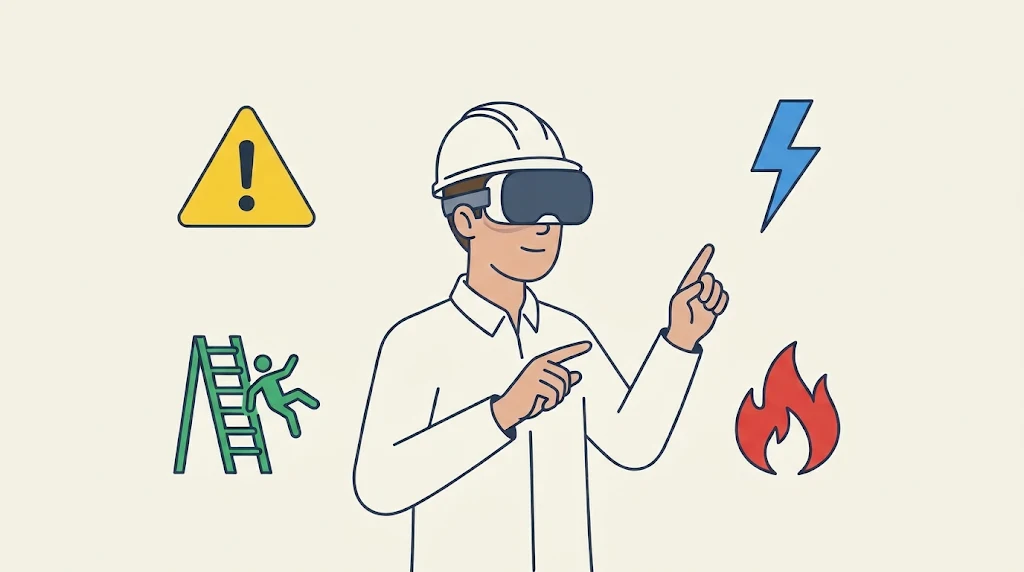
VR safety training is worth using for two jobs. It helps workers spot hazards, and it lets them rehearse dangerous or rare events with no real risk. It is not a replacement for the hands-on checks that safety rules often expect. Get that split right and the results can be strong. Get it wrong and you have an expensive video.
Here is the proof it can work. Wincanton, a UK logistics firm, reported 58% fewer dropped trailer incidents and 71% fewer red light incidents within 12 months of rolling out immersive training.
Here is the catch. That result came from a vendor case study. The training targeted three specific problems, and it ran on phones and desktops as well as headsets. The headset was not the magic.
This guide covers what the research says, what OSHA has said, where VR fits and how to start. For the wider business case, read our guide to VR for business. For ROI numbers, see our enterprise VR training ROI breakdown. If you work in a plant, our guide to virtual reality in manufacturing shows how German factories use VR.
Key takeaways
- VR safety training works best for spotting hazards and practicing rare, dangerous events.
- It does not replace the hands-on checks that regulators expect. OSHA says adequacy is decided case by case.
- Studies show good short-term gains. Long-term results on real job sites are less proven.
- One logistics firm reported 58% to 71% fewer incidents in three target areas, but that is a vendor case study.
- Start with your own incident data, not a course catalog.
What Is VR Safety Training?
VR safety training puts workers inside a simulated hazard so they can practice the right response with no real risk. Some programs are fully 3D, so you move and act. Others use 360 degree video of real sites, so you look around and make decisions.
Common topics include hazard recognition, fire and emergency response, working at height, confined spaces and lockout/tagout. A systematic review and meta-analysis in Safety Science found 14 main application areas. Construction and fire safety were the most studied.
Think of it as a flight simulator for the workplace. Pilots do not learn engine failure by waiting for one. Same idea. It is one use of virtual reality that has moved well beyond games.
What Does the Research Say About VR Safety Training?
The evidence is positive, with limits. Here is what the main studies found:
- Knowledge and retention. The Safety Science meta-analysis found VR beat traditional methods on knowledge gain and knowledge retention. The most common outcomes measured were hazard recognition, safety actions and correct use of equipment.
- Motivation and behavior. A randomized trial in Finland, published in the Journal of Safety Research in 2020, found VR training had a stronger effect than lecture-based training on safety motivation and self-efficacy. VR trainees also reported a bigger rise in safety performance one month later. That last result was self-reported.
- Engagement is not learning. A 2025 study of 221 construction workers from the University of Colorado Boulder found that VR can make training more engaging. But higher engagement did not automatically mean better learning. The same research found that VR added to video training can improve hazard recognition.
- Field results are thin. A 2026 review in Frontiers in Virtual Reality found solid short-term learning and hazard recognition gains. But long-term retention and transfer to real sites are under-reported, and real-world hazard detection often lags what people achieve in VR.
What does this mean for you? Design beats hardware. VR works when the scenario matches a real hazard, gives feedback, and is measured against real behavior, not just course completion.
What Does OSHA Say About VR Safety Training?
Short answer: OSHA has not banned VR training and has not blessed it. In an August 2020 letter of interpretation, OSHA said whether online or VR training is adequate can only be decided case by case. Employers must check that the tool helps workers understand the hazards they face.
The same letter makes three points worth remembering:
- Hands-on practice matters. Effective training should include hands-on instruction, such as practice with protective equipment, so workers learn by doing and the employer can check competence.
- Some standards need live interaction. The bloodborne pathogens standard requires a chance for interactive questions and answers with the trainer. VR alone may not provide that.
- Some standards need site-specific training. HAZWOPER (29 CFR 1910.120) and electric power work (29 CFR 1910.269) are the examples OSHA gave. Relying only on VR may not deliver that.
Interpretation letters are not law, and this one covers the United States. Outside the US, check your own regulator before relying on VR for compliance. OSHA’s training requirements guide lists what each standard asks for.
Which Safety Skills Fit VR Best?
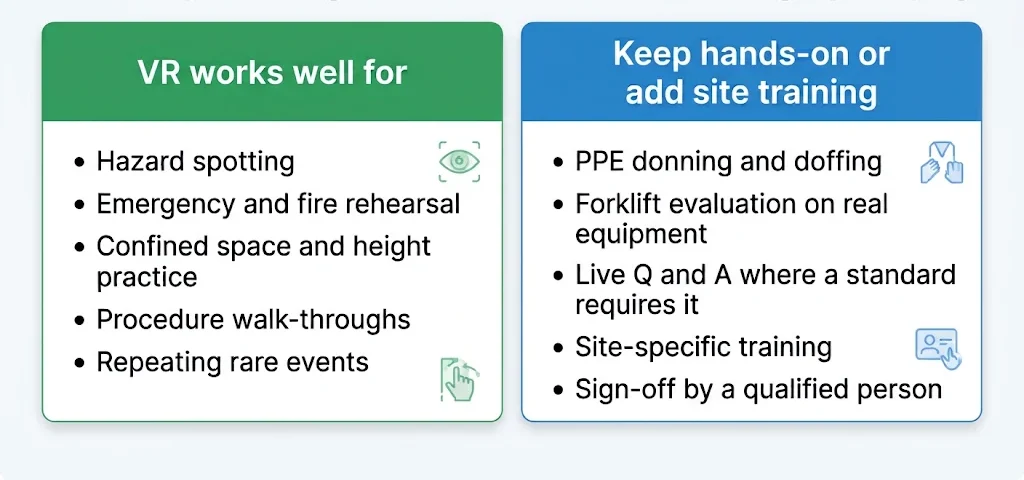
VR is strongest where the real thing is dangerous, rare or costly to repeat.
- Hazard spotting. Workers scan a scene, find what is wrong and get instant feedback. A randomized study published through ASCE measured better hazard recognition in VR groups than in paper-based training.
- Fire and emergency drills. Real drills are disruptive and risky. In VR you can rerun them as often as you like.
- Confined spaces and working at height. These are risky to practice for real. A 2008 study in Presence tested small vibrating motors worn on the arms in a virtual confined space. Arm feedback improved navigation compared with visual cues alone. That is why trainers watch touch technology. We cover it in our guides to VR haptic suits and haptic gloves.
- Lockout/tagout steps. VR is good for rehearsing the order: find energy sources, lock, tag, verify. Purdue published a VR lockout/tagout simulation built on OSHA’s 1910.147 standard. But handling real locks and equipment still belongs on the shop floor.
Keep these real: putting on protective gear, forklift operator evaluation (OSHA’s powered industrial truck rules require practical evaluation) and any site-specific training.
What Did One Company Report?
Wincanton is a UK supply chain firm with more than 20,000 employees at 160 sites. It found that 60% of its accidents came from three recurring types: dropped trailers, cage falls and red light pull-offs. It built one course for each, filmed on location with real colleagues in 360 degree scenes, then added hazard-spotting tasks, quizzes and decision exercises.
After 12 months, the published case study reports 58% fewer dropped trailer incidents, 71% fewer red light incidents and 58% fewer cage falls. It also says 80% of surveyed learners rated their hazard spotting as better than before.
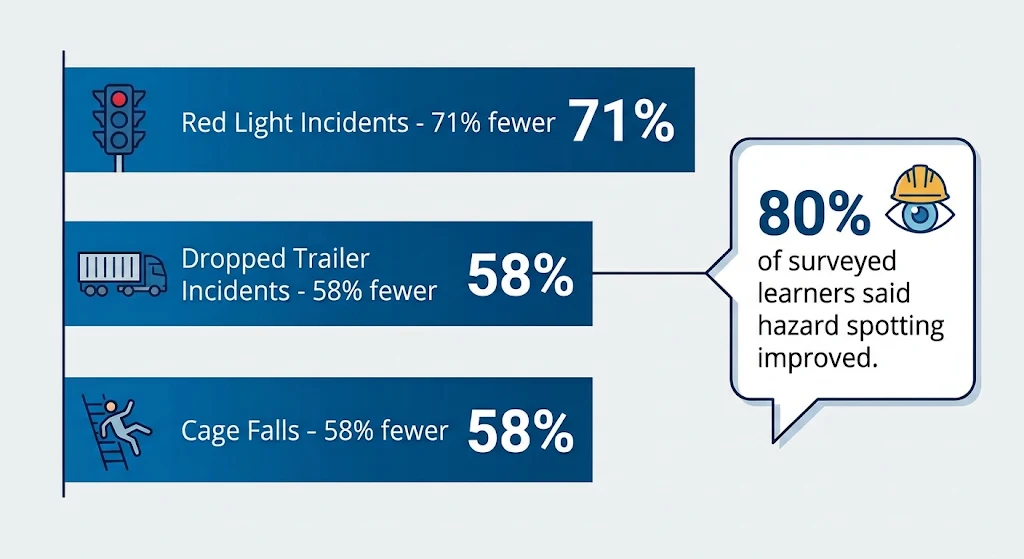
Read this with care. It is a vendor case study. The training was required for staff tied to the three risks, and it ran on mobile, desktop and tablets as well as headsets. Other changes may have happened at the same time. The lesson still holds: start with your own incident data.
For a smaller example, an electrical utility ran a three-day pilot with 20 on-site participants and reported a 40% rise in compliance and a 20% drop in task time. It also warned that realism matters, because a weak simulation can lead you to false conclusions.
How Much Does VR Safety Training Cost?
It depends on volume. These are the main cost drivers:
- Content: ready-made modules or custom scenarios.
- Hardware: headsets, charging, cleaning and device management.
- Updates: every change to a site or procedure needs new content.
- People time: facilitators, sign-off sessions and measurement.
Public research suggests VR pays off at scale. In a PwC study of soft skills training, VR matched classroom cost at 375 learners and was 52% more cost-effective at 3,000. That was soft skills, not safety, but the volume logic carries over. We break the numbers down in our enterprise VR training ROI guide.
How Do You Roll Out VR Safety Training?
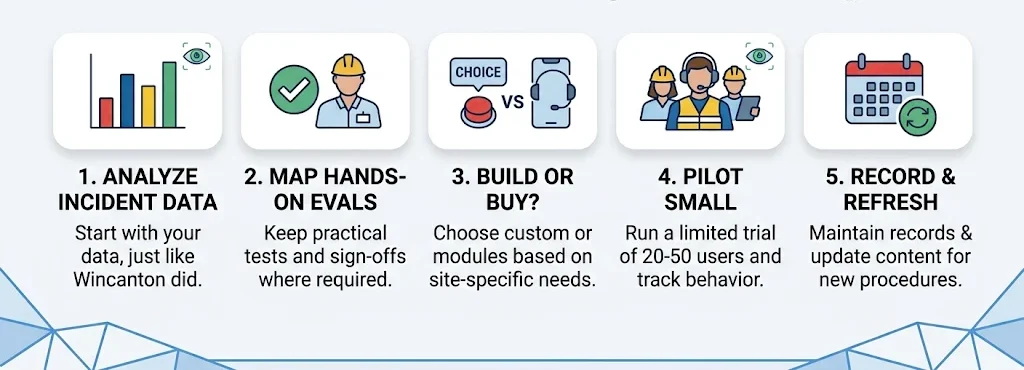
Keep it simple. Five steps:
- Start with your incident data. Pick the two or three incident types that hurt most, as Wincanton did.
- Map what needs hands-on sign-off. Check your standards and regulator, and keep live evaluation where it is required.
- Choose build or buy. Ready-made libraries cover common topics like lockout/tagout. Vendors such as PIXO VR sell them, and tools like ELB Learning’s CenarioVR let you build from your own site footage. These are examples, not endorsements.
- Pilot small and measure behavior. Try 20 to 50 workers and track observed behavior and near-misses, not just completion rates.
- Keep records and refresh. Update content when procedures change, and keep the training records your regulator expects.
For headset choices, see our VR headsets guide.
What Are the Limits of VR Safety Training?
- Realism: a weak simulation can teach the wrong lesson.
- Transfer: real-world detection often lags VR performance.
- Sign-off: VR cannot replace qualified evaluation where rules demand it.
- Comfort: some people feel sick in VR. Our guide to virtual reality experiences explains why and what helps.
- Site specifics: generic content rarely covers your exact hazards.
Bottom Line
Use VR safety training for what it does best: hazard recognition and safe rehearsal of dangerous or rare events. Keep hands-on evaluation and site-specific training where OSHA or your regulator expects them. Judge every vendor claim by the same standard you would use on your own incident data.
My take: the companies seeing real gains picked specific problems first and bought technology second. Do that and VR becomes a tool. Skip it and VR becomes a demo.
Frequently Asked Questions
Does VR safety training count toward certification?
It depends on the standard and your regulator. OSHA says adequacy is decided case by case. Ask your regulator or an accredited training provider before you replace any required session.
Is 360 degree video as good as a full 3D simulation?
I found no head-to-head study in the research I reviewed. 360 degree video suits spotting hazards in real sites. Full 3D suits practicing actions and procedures. Many programs use both.
What headset do you need?
- Standalone headsets are the common route because they need no PC.
- Plan for charging, cleaning and device management.
- Compare options in our VR headsets guide.
Can small businesses afford VR safety training?
- Start with ready-made modules for common topics.
- Pilot with a small group before you scale.
- Remember the volume rule: cost per learner falls as numbers grow.
How long should a VR safety module be?
There is no official number. A sensible start is 10 to 20 minutes, with breaks between sessions. Let workers stop at the first sign of dizziness or discomfort. For healthcare and school uses of the same ideas, see our guides to VR in healthcare and VR in education.
How We Researched This Article
I read the OSHA letter of interpretation directly, along with the Safety Science meta-analysis, the 2026 Frontiers review, the University of Colorado Boulder studies, the Finnish randomized trial and the Wincanton case study. I treat company-published results as claims, not proof. I did not test any VR product for this article, and I have not visited the sites mentioned.
About the Author
Aamir Khan is a content strategist and senior editor. He founded Future of Virtual Reality, a site about VR and spatial computing, and he researches and edits each guide against primary sources where possible.
Editorial Note
Companies and products named here are examples from public sources, not endorsements. This article is general information, not legal advice. Found a mistake? Tell us on our contact page and we will fix it and note the change.
Further Reading
- OSHA: Training Requirements in OSHA Standards (publication 2254)
- J.J. Keller: Virtual reality safety training and OSHA standards
- Journal of Safety Research: randomized trial of VR safety training
- Frontiers in Virtual Reality: 2026 review of VR for safety training