
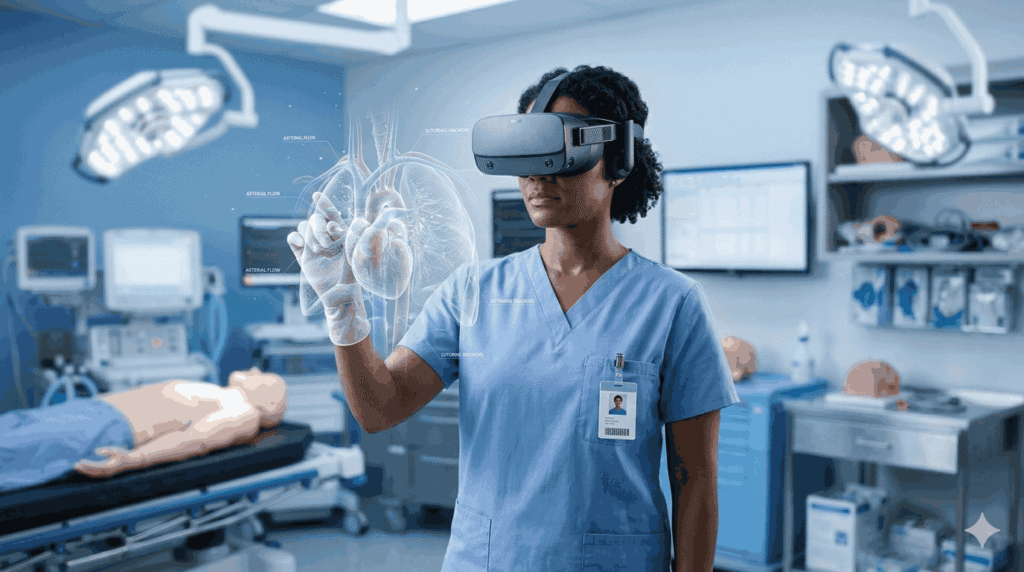
Virtual reality got dismissed as a gaming toy for a long time. The dismissal made sense in 2015. By 2021, surgeons were rehearsing operations inside it. By 2023, the FDA had authorized a VR programme as a medical device. By 2025, half of Fortune 500 companies had VR embedded in their training infrastructure.
This is not a technology still proving itself. The question now is more specific: which applications have strong clinical or performance evidence, and where are the claims getting ahead of the data? This guide covers both — with sources, not speculation.
The distinction matters. VR has genuine, measurable advantages in specific contexts. It also has genuine limitations. An honest guide to the benefits of virtual reality acknowledges both. Here is what the research actually shows.
Does VR Training Actually Work? Yes — and Here Are the Numbers
The short answer is yes. The evidence base is strong, and it has been replicated across industries and contexts ranging from retail onboarding to surgical preparation.
PwC’s landmark study on VR soft skills training found four specific advantages. VR-trained employees completed learning 4× faster than classroom counterparts. They showed 3.75× greater emotional connection to material than classroom learners and 2.3× greater emotional connection than e-learning peers. Additionally, 40% more felt confident applying newly learned skills than e-learning peers (PwC, 2020). Those are not marginal improvements. They are category differences.
The mechanism behind these results is well understood. VR creates the conditions for embodied learning — the learner is not watching a scenario unfold on a screen, they are inside it. The brain processes the experience with the same neural pathways it uses for real events. Retention improves because encoding is deeper. Confidence improves because the experience felt real.
VR Training Benefits by Industry: Data Table (2020–2025)
| Industry | VR Application | Key Metric | Source | Year |
| Corporate Training | Soft skills, safety, onboarding | 4× faster learning vs classroom | PwC | 2020 |
| Retail (Walmart) | Associate onboarding (200 stores) | 10–15% confidence score gain | Walmart / Strivr | 2022 |
| Healthcare (Cedars-Sinai) | Inpatient pain management | 24% lower pain scores vs TV | Cedars-Sinai | 2023 |
| Surgical Training (Osso VR) | Procedure rehearsal | 230% technique improvement | Osso VR | 2023 |
| Medical Education | Anatomy, procedure retention | 40% better recall vs video | Stanford University | 2021 |
| Mental Health | Phobia exposure therapy | Equivalent outcomes to in-person CBT | J. Anxiety Disorders | 2024 |
| Defence | Combat & emergency training | 40% reduction in training time | US Army / Various | 2023 |
Walmart’s deployment stands out because of its scale. VR training rolled out across 200 stores for Black Friday preparation scenarios. Employees who trained in VR showed measurably higher confidence scores and faster situational response times. More importantly, the programme scaled across thousands of employees without proportional increases in instructor time or logistics cost — a fundamental shift in the economics of workforce training.
VR training ROI is strongest where real-world training is expensive, dangerous, or physically constrained. The upfront content development cost is offset by near-zero marginal cost per additional trained employee.
What Are the Benefits of Virtual Reality in Healthcare?
VR delivers real, measurable results in three healthcare areas: surgical training, pain management, and mental health therapy. For a deeper look at clinical deployment, see our full guide to VR in healthcare. The evidence quality varies between these areas, so being specific matters.
Surgical Training
Patient-specific VR simulations allow surgeons to rehearse a specific upcoming procedure inside a virtual replica of their actual patient’s anatomy — built from MRI or CT scan data. The surgeon performs the exact motion sequence before making a single incision. Procedural memory is established before any real risk is involved.
Osso VR’s training data is among the most cited in the field: a 230% improvement in surgical technique scores compared to trainees who did not use the platform (Osso VR Research). For perspective, conventional surgical training improvements are typically measured in single-digit percentage points. The magnitude of this difference is not subtle.

Pain Management
Cedars-Sinai Medical Center deployed VR across hospitalized patients from 2019 through 2023. Patients using VR reported pain scores 24% lower than those watching standard hospital television (Cedars-Sinai, 2023). This is not a placebo story. The mechanism is attentional: VR immersion occupies enough cognitive processing bandwidth that pain signal amplification is reduced at the perceptual level.
The FDA’s De Novo authorization of AppliedVR’s RelieVRx for chronic lower back pain in 2021 marked the first time a VR programme received regulatory approval as a medical device. That distinction matters — it separates clinically validated applications from the wellness marketing that surrounds much of the consumer VR health space.
“There is only so much attention to go around. When you are inside a compelling VR world, your brain simply has less processing capacity left over to amplify pain signals. That is the core mechanism, and it holds up under repeated clinical testing.” — Dr. Hunter Hoffman | Director, Human Interface Technology Lab, University of Washington
Mental Health Therapy
VR exposure therapy for phobias has the strongest mental health evidence base. Systematic reviews published in the Journal of Anxiety Disorders confirm outcomes comparable to traditional in-person exposure therapy for heights, flight anxiety, social phobia, and spider phobia. The APA clinical guidelines on VR exposure therapy reflect this evidence base directly.
VA hospitals began integrating VR therapy for PTSD in 2022, following strong clinical results from USC’s Institute for Creative Technologies. By 2025, multiple VA sites were running active programmes. The practical advantage VR offers over traditional exposure therapy goes beyond outcomes: therapists can adjust virtual stimulus intensity mid-session, something impossible in the real world. The full clinical picture is covered in our guide to how VR is transforming mental health therapy.
How Does VR Improve Education Outcomes?
The clearest way to understand VR’s educational advantage is through what it changes: passive learning becomes active experience.
Stanford University tested retention six weeks after two content types: video and VR. The VR group retained significantly more information and showed greater motivation to engage further with the topic (Stanford HCI Group). The immersion is not decorative — it changes how the brain encodes the information.
By 2026, approximately 50% of universities worldwide offer VR-based courses, according to the Information Technology and Innovation Foundation (ITIF, 2025). Medical schools lead institutional adoption because VR solves the three core constraints of traditional medical education: limited specimen access, ethical restrictions on practice with real patients, and the non-repeatable nature of live procedures. Our guide to VR in education covers institutional deployment patterns in detail.

VR’s educational edge is strongest where real-world access is limited: expensive field sites, dangerous environments, rare clinical scenarios, and historical or geographic locations students cannot physically reach.
Virtual Reality in Business: Architecture, Product Design, and Remote Work
In product design and construction, VR saves real money before anything physical exists. Design changes identified in a VR walkthrough before construction cost essentially nothing. Post-construction changes cost an estimated 10× more, according to industry benchmarks cited by the American Institute of Architects. Ford has reported reducing prototype iterations by 25% following VR integration. Physical automotive prototypes cost $10,000 to $500,000 each. The ROI calculation is straightforward once you understand that figure. BMW and Volkswagen run similar programmes. For large-scale manufacturing, VR prototyping is now standard practice. This connects to broader trends in enterprise use of the metaverse — where persistent shared virtual environments are replacing flat-screen collaboration for complex spatial work.
What VR Cannot Yet Do: The Honest Limitations
No honest guide to the benefits of virtual reality skips the limitations. Motion sickness affects 25 to 40% of first-time users (NIH/PMC review). Most adapt with repeated exposure, but a subset does not. For deployments where every employee must complete VR training, this creates a genuine accommodation requirement that needs to be planned for.
Content quality is inconsistent. Generic off-the-shelf VR training modules frequently fail to produce the learning outcomes seen in research-backed programmes. The technology is a delivery mechanism. The design quality of the content determines whether it works. Buyers who evaluate VR by hardware specs alone miss the variable that matters most.
Hardware costs remain a barrier for organisations in regions with constrained budgets. A basic enterprise-grade headset starts at $499 to $699 per unit. For large-scale simultaneous deployment, the upfront capital cost is real. For more on where the technology is heading — and when costs are projected to fall — see our analysis of the future of virtual reality.
FREQUENTLY ASKED QUESTIONS
Q1. What are the main benefits of virtual reality in healthcare?
Three areas have strong clinical evidence: surgical training (Osso VR: 230% technique improvement), pain management (Cedars-Sinai: 24% lower pain scores), and phobia/PTSD therapy (APA-recognized modality, active in VA hospital systems). Each has peer-reviewed data behind it.
Q2. How does VR improve employee training outcomes?
PwC data shows 4× faster completion, 2.3× greater emotional engagement vs e-learning, and 40% more confidence applying skills. The core mechanism is risk-free repetition at scale: one VR module can train unlimited employees at near-zero marginal cost after initial development.
Q3. Are there proven advantages of VR in children’s education?
Yes. Stanford retention research and Google Expeditions deployment data support VR’s learning advantages. Age recommendation is 13 or older for regular use. Short supervised sessions are generally acceptable for children 10 and older. Consult a paediatrician for children with any vision concerns.
Q4. Which industries get the strongest ROI from virtual reality?
Healthcare, defence, manufacturing, architecture, and corporate training show the strongest documented ROI. The pattern is consistent: VR returns most where real-world training is expensive, dangerous, logistically constrained, or where errors carry serious consequences.
Q5. Does VR genuinely help with anxiety and phobias?
Yes, for specific phobias. Multiple systematic reviews confirm VR exposure therapy outcomes match traditional in-person CBT for heights, flight anxiety, social phobia, and others. The VA hospital system’s active PTSD programmes reflect the strength of the evidence base in trauma therapy.