
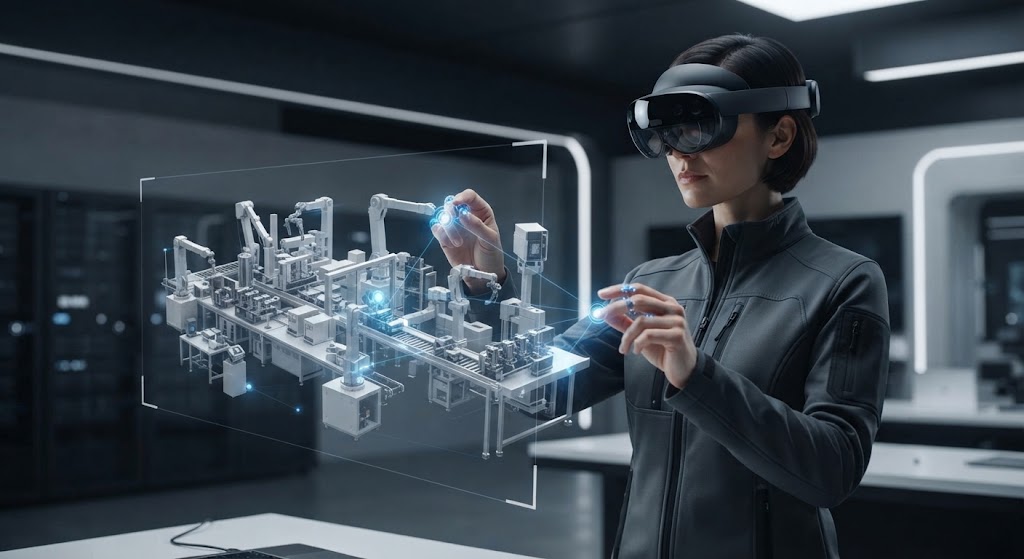
Virtual reality is no longer something businesses experiment with simply because it looks futuristic. Companies are using VR to train employees, simulate dangerous environments, visualize products and facilities, improve technical skills, support property sales, and create experiences that would be difficult or expensive to reproduce in the physical world.
The strongest business case usually appears when VR can replace costly physical training, reduce risk, shorten the time it takes someone to become competent, or let a company repeatedly simulate something that cannot be easily recreated in the physical world. Enterprise VR training is a particularly mature example. A 2025 Forrester Total Economic Impact study commissioned by Meta found that a composite enterprise using Meta Quest for learning and development could achieve a 219% return on investment, with benefits including improved training productivity and reduced costs associated with traditional training. Forrester’s Total Economic Impact study of Meta Quest
But training is only part of the story.
VR for business now covers industrial simulation, manufacturing, design, real estate, collaboration, customer experiences, healthcare, safety and increasingly sophisticated haptic technologies. The important question for a company is therefore not whether VR is impressive. It is whether a particular VR application solves a sufficiently expensive or difficult problem to justify the investment.
What you will learn in This Detailed Guide
- What VR for business actually means
- How companies are using VR for training and simulation
- Where VR delivers measurable business ROI
- How haptic gloves are changing enterprise VR
- How manufacturers use VR and digital twins
- How VR is transforming real estate sales
- What VR implementation actually costs
- How to choose the right VR solution for your business
- Where VR makes sense, and where it does not
- What the future of enterprise VR looks like
What Is VR for Business?
VR for business refers to the use of immersive virtual reality systems to perform, simulate, teach, visualize or improve commercial activities.
Unlike consumer VR, where entertainment and personal experiences dominate, business VR is usually tied to a measurable operational goal. A company may use a headset to let an employee practice a hazardous procedure without exposure to real-world danger. An engineering team may walk through a digital factory before construction begins. A property agent may allow an overseas buyer to explore an apartment without physically visiting it.
The hardware can be similar to what consumers use at home, but the surrounding system is different.
A business deployment may include VR headsets, specialized controllers or haptic devices, custom software, digital twins, learning management system integration, analytics, device management and support. In other words, the headset is often just the visible part of a much larger business solution.
If you are still getting familiar with the underlying hardware, our guide to VR headset technology and what is actually inside modern headsets provides a useful technical foundation.
That distinction matters when evaluating the economics.
Buying a few headsets and showing employees a generic VR experience is not the same as deploying a scalable enterprise VR program. The latter requires content, infrastructure, training, maintenance and a clear measurement strategy.
Why Are Businesses Investing in VR?
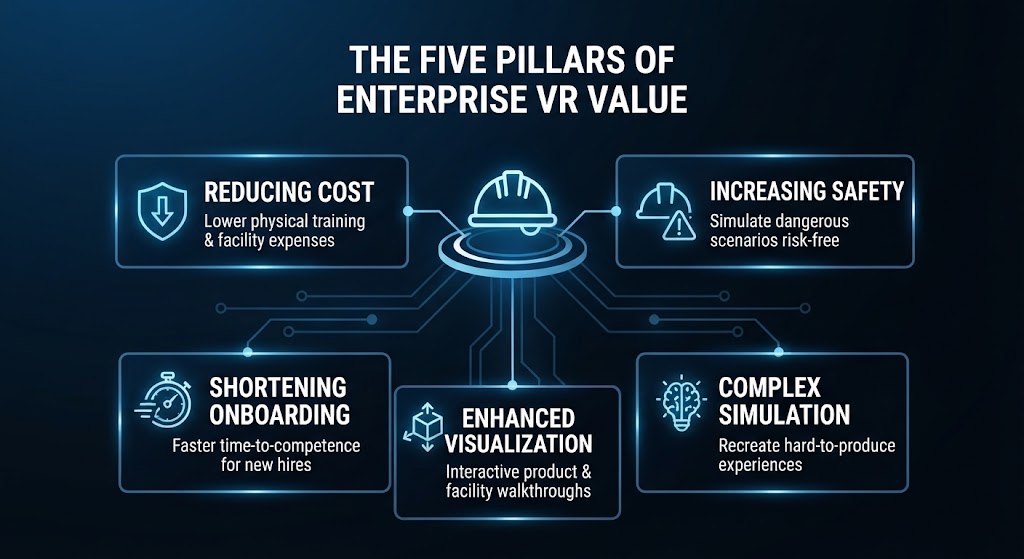
The business case generally comes from five areas:
- Reducing the cost of physical training
- Making dangerous or expensive scenarios safer to practice
- Shortening training and onboarding time
- Improving visualization and decision-making
- Creating experiences that are difficult to reproduce physically
The strongest applications tend to combine several of these advantages.
Consider industrial maintenance. A technician could learn a procedure by reading a manual, watching a video, observing an experienced worker or practicing on real equipment. VR adds another option: the technician can repeatedly perform the procedure inside a simulated environment before touching the actual machine.
That does not automatically make VR the best solution. If the procedure is simple and inexpensive to practice physically, VR may add unnecessary cost. But if the equipment is expensive, unavailable, dangerous or located thousands of miles away, the calculation changes dramatically.
This is the central principle behind successful VR for business.
Do not start with the headset. Start with the problem.
How Businesses Are Actually Using Virtual Reality
The most useful way to understand enterprise VR is to look at the tasks companies are putting inside virtual environments.
Training remains one of the largest applications, particularly where employees need to practice procedures rather than simply absorb information. Manufacturing and energy companies can simulate equipment failures, safety procedures and maintenance tasks. Retailers can rehearse customer interactions. Corporate teams can practice communication and leadership scenarios.
Beyond training, VR is increasingly used for visualization.
An architect can walk through a building before it exists. An engineer can inspect a virtual representation of a facility. A manufacturer can examine a production layout and identify potential problems before machinery is installed. A property developer can show a prospective buyer an apartment or development from another country.
The technology becomes particularly valuable when seeing and experiencing something in three dimensions provides information that a conventional screen cannot communicate as effectively.
That is why enterprise VR is gradually moving beyond the traditional “virtual reality training” label.
It is becoming a broader tool for simulation, visualization, decision-making and interaction.
For a wider look at how VR is evolving into spatial computing and how VR, AR, MR and AI increasingly overlap, see our guide to spatial computing in 2026.
Enterprise VR Training Is Where the Business Case Gets Serious
If there is one area where VR has accumulated substantial enterprise evidence, it is training.
Traditional corporate training can involve instructors, classrooms, travel, physical equipment, dedicated facilities and employee downtime. Those costs become especially significant when workers are distributed across multiple locations or need to repeat training regularly.
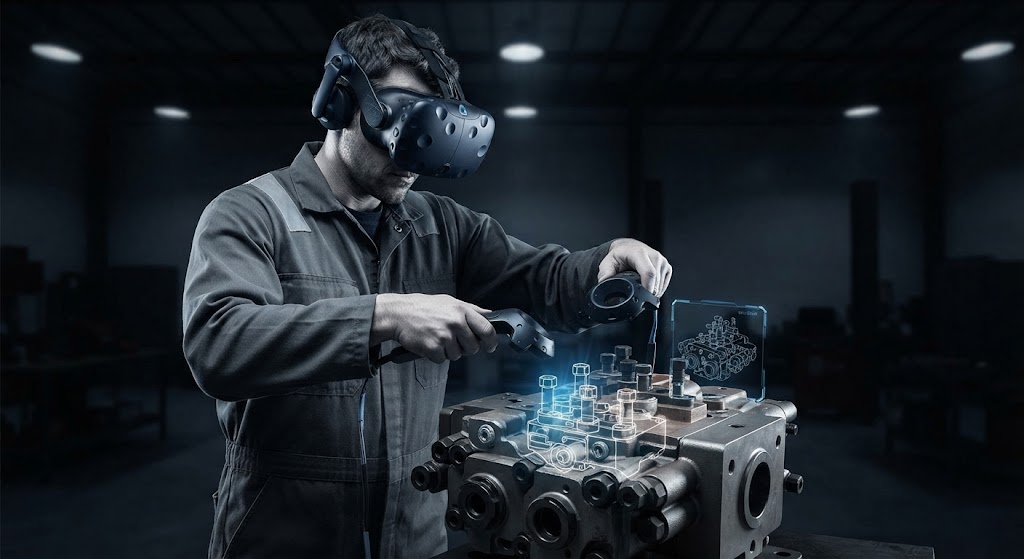
VR can move part of that process into a reusable digital environment.
A worker can enter the same simulated environment repeatedly, make mistakes without damaging equipment, receive immediate feedback and repeat the procedure until it becomes familiar. Managers can also standardize the experience so employees in different locations are practicing the same procedure.
PwC’s research into VR soft-skills training compared classroom, e-learning and VR-based learning among managers. The study found that VR can become more cost-effective at scale, reaching cost parity with classroom learning at approximately 375 learners and with e-learning at approximately 1,950 learners in the scenario examined. At 3,000 learners, PwC estimated VR training was 52% more cost-effective than classroom training. PwC’s VR training research
The figures are not universal benchmarks for every company. They come from PwC’s specific study and assumptions.
The broader lesson is more important: scale can fundamentally change the economics of enterprise VR training.
Where VR Training Delivers the Most Value
VR training tends to make the strongest financial sense when the alternative is expensive, risky, difficult to schedule or difficult to reproduce consistently.
Think about an electrical technician learning how to respond to a dangerous fault.
Putting someone directly into a real hazardous environment simply to let them practice is obviously problematic. A video can explain the procedure, but it cannot fully reproduce the pressure of identifying the correct equipment, locating the relevant components and carrying out a sequence of actions.
A VR simulation can create that environment without exposing the trainee to the physical consequences of failure.
Intel provides a real example. The company used VR for electrical safety recertification after experiencing electrical incidents and near-misses that had generated more than $1 million in costs. Intel and HTC VIVE reported an estimated 300% five-year ROI for the VR course. Intel VR electrical safety case study
That is a much stronger business case than simply saying employees enjoyed the VR experience.
VR Can Also Change the Economics of Repeated Training
The economics become particularly interesting when the same training needs to be delivered to hundreds or thousands of employees.
Once the digital training environment exists, the company can reuse it across locations and cohorts. That does not mean additional learners are free. Headsets require management, content needs maintenance and employees still need support. However, the marginal cost of delivering the same digital scenario can be substantially lower than repeatedly recreating a physical training environment.
Forrester’s 2025 Meta Quest study similarly found that enterprise XR training can improve training productivity and reduce expenses associated with traditional hands-on learning. The study’s composite organization had 10,000 employees, with 33% using Quest for training. Forrester’s Meta Quest enterprise ROI study
This is one reason scale matters so much.
A company training 30 employees once a year may struggle to justify a custom VR program.
A company training several thousand employees across multiple locations on a recurring basis has a very different calculation.
Real Enterprise Case Studies Matter More Than VR Hype
The difference between a promising technology and a useful business tool becomes clearer when you examine actual deployments.
Avangrid has been among the organizations using VR for technical and safety training, with examples involving utility and maintenance scenarios. Industry training providers working with Avangrid, Enel and other enterprises increasingly emphasize the same implementation principle: build the ROI case around the cost of the existing process, not around the novelty of VR. VR Vision Group’s enterprise VR training framework and case studies
Intel is another useful example because its program was tied to a specific operational problem rather than a broad innovation initiative.
This is important because it demonstrates what enterprise VR looks like beyond a demonstration.
The goal is not simply to put an employee inside a virtual world. The VR environment becomes part of an existing operational training system.
That distinction will become increasingly important as businesses move from pilots to larger deployments.
Haptic Gloves VR: Giving Business Applications a Sense of Touch
Visual immersion is only one part of the VR experience.
A worker can see a virtual machine, pick up a virtual component and interact with a digital environment, but conventional VR still struggles to reproduce one of the most important senses involved in physical work: touch.
That is where haptic technology enters the picture.
Haptic gloves VR systems use sensors, vibration, force feedback or combinations of these technologies to give users tactile information while they interact with virtual objects. Depending on the system, users may receive sensations that indicate contact, pressure, texture or resistance.
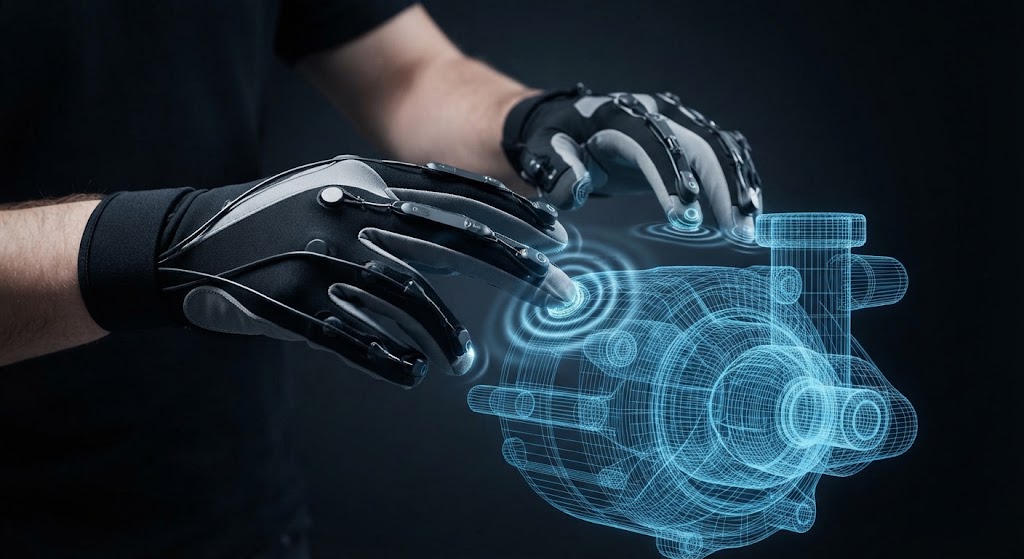
For businesses, this matters because many professional tasks are inherently physical.
A technician does not simply look at a machine. They grip components, feel resistance, manipulate tools and recognize physical feedback. A surgeon relies heavily on tactile information. An assembly worker learns partly through the sensation of handling a component.
VR without haptics can simulate the visual environment.
Haptics aims to simulate more of the physical interaction.
Research is moving quickly in this area. A study published in Sensors and Actuators A: Physical in August 2026 described an untethered lightweight haptic glove using soft thin-film motors and reported more than 98% recognition accuracy for the tested vibrotactile cues. 2026 haptic glove research published by Elsevier
The technology is still developing, but the direction is significant.
Why Haptics Could Matter to Enterprise VR
Imagine an apprentice learning how to assemble a component.
A standard VR system can show whether the component is positioned correctly. A haptic glove could potentially provide additional feedback when the worker grips, touches or manipulates the virtual object.
Now imagine a maintenance technician practicing a procedure in which force matters.
Visual information tells the trainee where the component is. Haptic feedback could eventually help communicate how that interaction should feel.
This is particularly interesting for:
- Manufacturing and assembly
- Equipment maintenance
- Medical and surgical simulation
- Rehabilitation
- Technical skills training
- Product design
- Remote operation
- High-risk industrial procedures
However, businesses should resist treating haptics as a magic upgrade.
The technology remains more complex and expensive than conventional VR controllers, and reproducing convincing force, texture and resistance is difficult. Haptic systems also need to balance accuracy, comfort, durability and ease of deployment.
The right question is therefore not “Can we add haptics?”
It is:
“Does tactile feedback improve the specific task enough to justify the additional hardware and deployment complexity?”
That question will become increasingly important as enterprise VR moves toward more sophisticated simulations.
The Business Case for VR Is Bigger Than Training
Training gets most of the attention because its ROI can be relatively easy to measure.
But companies can also use VR before an employee ever enters a training session.
Consider product development.
A physical prototype can be expensive and time-consuming to modify. A virtual prototype can be changed rapidly, allowing teams to inspect proportions, layouts and interactions before committing to physical production.
The same principle applies to buildings and industrial facilities.
Instead of waiting for construction to finish, teams can explore a digital representation and identify issues earlier. A manager can examine a production line. An engineer can review equipment placement. A safety team can simulate movement through a facility.
VR therefore becomes less about creating a “virtual world” and more about creating a decision environment.
That is an important shift.
When VR helps a company make a better decision before spending millions on physical construction, equipment or inventory, its value is no longer tied to how entertaining the headset experience is.
It is tied to the cost of the decision being improved.
From Training Rooms to Digital Twins
This is where VR begins to overlap with another major enterprise technology: the digital twin.
A digital twin is a digital representation of a physical asset, system or environment that can be used to understand, monitor or simulate its real-world counterpart.
VR can provide an immersive way to interact with that digital representation.
For a factory, that could mean exploring the layout of a production line.
For an energy company, it could mean practicing maintenance procedures around virtual equipment.
For a property developer, it could mean walking through a building before construction is complete.
The underlying business value is similar: move more of the decision-making process into a controlled digital environment before making an expensive physical decision.
NVIDIA describes digital twins in Omniverse as physically accurate virtual replicas that can incorporate real-world data, with enterprise examples including BMW, Siemens Energy, Ericsson and Lockheed Martin. NVIDIA’s Digital Twins overview
This is one reason enterprise VR is increasingly connected to industrial simulation, manufacturing and spatial computing rather than existing as an isolated headset category.
VR Manufacturing Is Turning the Factory Into a Simulation
Manufacturing may ultimately prove to be one of the most important long-term applications of VR for business because the physical cost of getting something wrong can be enormous.
A factory is not just a building filled with machines. It is a tightly connected system in which equipment placement, worker movement, production sequences, robotics, logistics and safety procedures all influence one another.
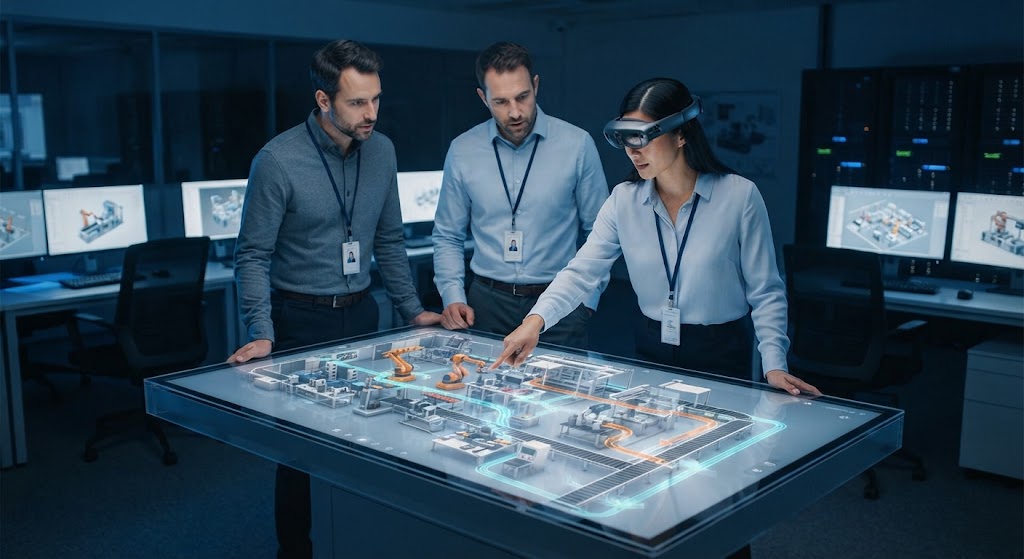
Changing that system after construction can be expensive.
Changing it inside a digital environment is considerably easier.
BMW is one of the clearest examples. The company uses virtual planning environments and digital twins to simulate complex production systems before changes are implemented in the physical world. BMW says its iFACTORY strategy uses 3D scans and digital twins of production sites so planning can be carried out virtually and teams can collaborate across locations. BMW’s iFACTORY production strategy
BMW’s work with NVIDIA goes even further. Its virtual factory ecosystem uses Omniverse and OpenUSD to support factory planning, simulation, collaboration and AI-enabled workflows. NVIDIA’s 2025 presentation describes an environment involving hundreds of planners and factories represented as large-scale 3D models. NVIDIA’s BMW virtual factory presentation
That is a more sophisticated use of VR manufacturing than simply putting factory workers into headsets.
The virtual environment becomes a planning layer.
Engineers can examine whether equipment will fit. Designers can evaluate how workers move through a space. Robotics teams can simulate systems before deployment. Production planners can identify potential collisions or workflow problems before they become physical problems.
NVIDIA also reports that BMW’s factory simulation work has been designed to deliver expected efficiency gains of up to 30% in the relevant manufacturing-planning use case. That figure is a vendor-reported expected gain, not a universal result for every factory. NVIDIA’s BMW manufacturing case study
Why Germany Matters for Industrial VR
Germany is particularly important because of the country’s concentration of automotive, machinery, chemicals, engineering and advanced manufacturing companies.
The industrial use case is also unusually strong because many German manufacturers operate complex facilities where production changes have significant downstream consequences.
A company does not need to completely replace physical testing with VR.
It can use VR to identify problems earlier.
That distinction matters.
If a virtual simulation prevents one expensive redesign, avoids a production interruption or helps engineers optimize a factory layout before construction, the value of the technology can exceed the cost of the VR system by a considerable margin.
For European manufacturers, the opportunity therefore extends beyond employee training. Industrial VR training, factory simulation and digital twins can become part of the same connected workflow.
That is why manufacturing deserves a dedicated deep dive in this cluster.
VR Real Estate Is Changing How Properties Are Presented
Real estate presents a very different business case.
A factory simulation is primarily about reducing operational risk and improving planning. A property tour is about helping someone make a purchasing or leasing decision.
The basic concept is simple.
Instead of relying entirely on photographs, floor plans and physical viewings, an agent or developer can create an interactive digital representation that allows prospective buyers or tenants to explore a property remotely.
Dubai is particularly well suited to this model because of its international property market and large luxury and off-plan segments.
Emaar, for example, currently offers 360-degree virtual tours for selected apartments, villas and communities across developments including Dubai Creek Harbour, Downtown Dubai, Dubai Marina, Arabian Ranches and others. Emaar Properties 360 VR Tours
The value is obvious for an international buyer.
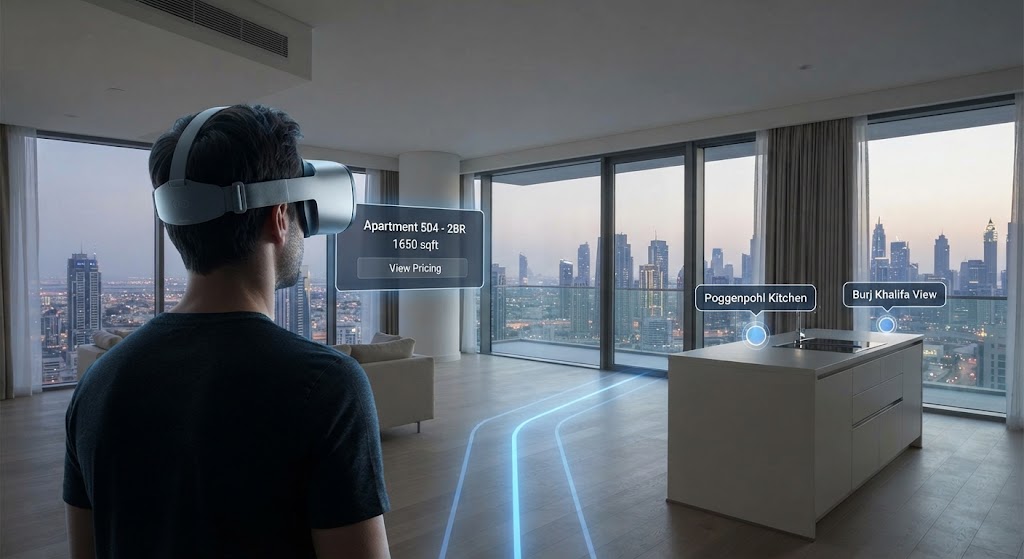
Someone sitting thousands of miles away can explore a property before deciding whether a physical visit is worthwhile.
For developers selling properties that are not yet complete, immersive visualization can go even further. A buyer can experience the proposed layout, finishes and surroundings before the physical property exists.
That does not remove the need for due diligence or physical inspections. It simply moves part of the sales journey into a digital environment.
London Shows a Different Side of the Same Opportunity
London’s property market demonstrates another important use of virtual tours: reducing unnecessary physical visits.
Matterport’s case study of London real estate group Atkinson McLeod reports a 50% reduction in physical property visits after the company adopted digital-twin-based virtual tours. The company also reported twice as many click-throughs on marketing emails containing virtual tours and found that 56% of surveyed tenants considered the tours useful. Matterport’s Atkinson McLeod case study
This is a useful example because the value is not simply “buyers like VR.”
The technology helped agents filter demand.
Someone could explore a property remotely and decide that it was not suitable before an agent spent time arranging a physical viewing. At the same time, a genuinely interested buyer could arrive at the physical viewing with a better understanding of the space.
For more detail on the economics and limitations of immersive property marketing, see our dedicated guide to VR in real estate and virtual property tours.
The lesson for businesses is broader than real estate.
Immersive technology can be valuable when it removes unnecessary physical steps from a commercial process.
What Does VR for Business Cost?
There is no single price for VR for business because the hardware is only one part of the investment.
A small company experimenting with an off-the-shelf headset and existing software might spend relatively little.
A multinational manufacturer creating a custom simulation of a production facility can spend dramatically more.
The main cost categories usually include:
- VR headsets and accessories
- Haptic devices where required
- Enterprise software and device management
- Custom VR content
- 3D modeling and environment development
- Integration with existing business systems
- IT infrastructure and support
- Employee onboarding
- Maintenance and hardware replacement
- Analytics and reporting
This is why comparing enterprise VR costs with the retail price of a headset can be misleading.
A headset might be affordable, but a realistic industrial simulation can require extensive 3D assets, software development, testing and subject-matter expertise.
The opposite is also true.
A business does not necessarily need a custom-built virtual world.
For some training applications, an existing enterprise platform or configurable simulation may be enough.
The right approach is to match the sophistication of the solution to the value of the problem.
How to Calculate the ROI of VR for Business
A convincing VR business case should begin with the current process. Suppose a company currently sends employees to a central training facility.
Calculate the annual cost of:
- Employee travel
- Trainer travel
- Accommodation
- Facility rental
- Physical equipment
- Employee time away from normal duties
- Equipment downtime
- Repeat training
- Accidents or errors associated with inadequate practice
Then compare that baseline with the proposed VR program. The calculation becomes particularly interesting at scale.
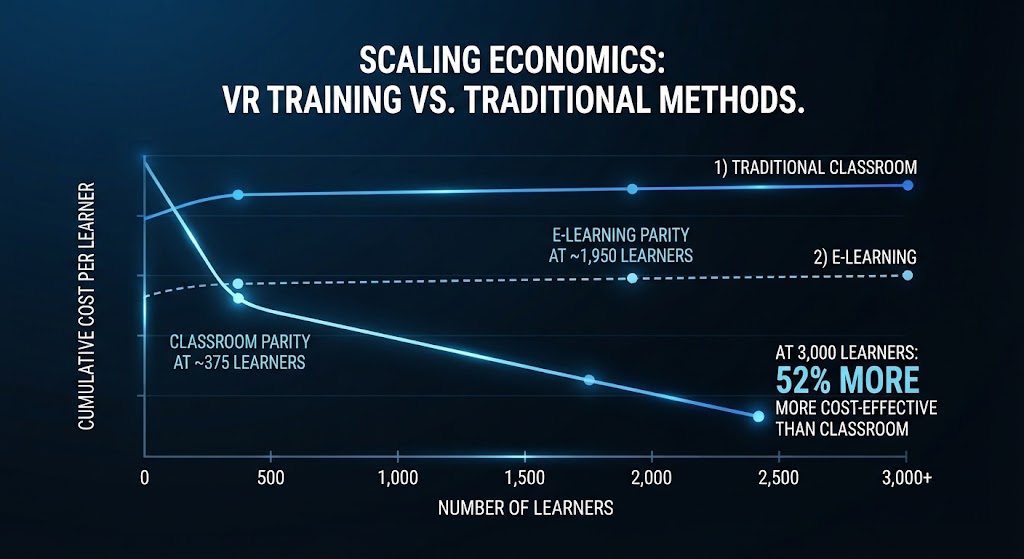
PwC’s research found that VR training could reach cost parity with classroom training at approximately 375 learners and with e-learning at approximately 1,950 learners in the specific scenario it studied. At 3,000 learners, the study estimated VR training could be 52% less expensive than classroom training. PwC’s enterprise VR training study
These figures should not be treated as universal benchmarks. They belong to PwC’s specific study and assumptions.
But they demonstrate an important principle: scale can fundamentally change the economics of enterprise VR.
A 20-person pilot and a 20,000-person training program should never be evaluated using the same financial model.
The Metrics That Matter
Businesses should measure outcomes rather than headset usage.
Training time: How long does it take employees to reach the required level of competence?
Training cost per employee: What does each completed training cycle actually cost?
Retention: Do employees remember and correctly apply what they learned?
Error rates: Are mistakes decreasing after VR training?
Safety incidents: Does simulation reduce exposure to dangerous situations or improve procedural compliance?
Travel: Can some instructor or employee travel be eliminated?
Downtime: Can employees train without taking critical equipment offline?
Sales conversion: In real estate or product visualization, does immersive content improve qualified leads or conversions?
Design changes: In manufacturing or construction, does simulation identify expensive issues before physical implementation?
These metrics transform VR from a technology experiment into a business project.
Enterprise VR Platforms and Hardware
The enterprise VR market is no longer built around one type of headset.
Standalone devices are attractive because they reduce the complexity of deployment. They can be easier to distribute across a workforce and do not necessarily require a high-end computer for every user.
PC-connected systems can still make sense for applications requiring substantial graphical performance or highly detailed simulations.
Then there are specialized devices.
Haptic gloves can provide tactile information. Eye tracking can provide additional interaction and analytics capabilities. Hand tracking can reduce dependence on physical controllers. Spatial scanners and LiDAR systems can help create detailed digital representations of real environments.
The best hardware therefore depends on the task.
A company training sales employees in communication skills probably does not need the same equipment as an aerospace manufacturer simulating a complex maintenance procedure.
This sounds obvious, but it is an easy mistake to make.
Choose the workflow first. Choose the hardware second.
For a current overview of the wider headset landscape, our latest VR systems guide covers the major hardware categories and what separates them in 2026.
What Businesses Need Before Investing in VR
A successful VR deployment requires more than enthusiastic executives and a box of headsets.
The first requirement is a clearly defined use case.
If nobody can explain what business problem the VR project is solving, the project is probably not ready.
The second requirement is appropriate content.
A generic VR demonstration may impress employees during a presentation, but enterprise users need content connected to actual tasks, policies, equipment and outcomes.
The third is operational support.
Who manages the devices?
Who updates the software?
Who cleans and stores the headsets?
Who handles technical problems?
Who creates or updates the simulations when the company’s procedures change?
These questions become increasingly important as deployment scales.
Integration Matters More Than Most Companies Expect
Enterprise VR should not exist as a disconnected island.
Training applications may need to connect with learning management systems. Manufacturing simulations may need access to engineering or operational data. Digital twins may need data from sensors and enterprise systems.
This is one reason modern industrial XR is moving toward connected platforms rather than isolated VR experiences.
BMW’s factory-planning work is a good example. Its virtual environments connect multiple engineering and production workflows, while NVIDIA describes the use of real-world data, simulation and digital twins to maintain a closer connection between physical and virtual factories. NVIDIA’s BMW virtual factory resources
The more closely the virtual environment reflects the actual business process, the more useful it becomes.
But that also increases the importance of cybersecurity, data governance and access controls.
Security, Privacy and Employee Acceptance
VR systems can collect more information than many employees realize.
Depending on the hardware and application, an enterprise deployment may involve account information, movement data, interaction patterns, voice information, eye tracking or other behavioral signals.
Businesses therefore need clear policies about what is collected, why it is collected, where it is stored and who can access it.
Employee acceptance also matters.
Some people immediately adapt to VR. Others may feel uncomfortable, experience motion sickness or simply dislike wearing a headset for extended periods.
A strong enterprise program should accommodate those differences.
VR should be an effective tool, not a forced novelty.
Where possible, companies should provide alternative learning paths and use VR where immersion provides a genuine advantage.
How to Start a VR for Business Program
The safest way to begin is with a focused pilot.
Do not attempt to transform the entire organization at once.
Choose one problem where the potential value is measurable.
For example, a manufacturer might choose one safety procedure. A retailer might choose onboarding. A property developer might create an immersive tour for one development.
Establish the baseline first.
How long does the existing process take?
What does it cost?
What problems occur?
Then run the VR pilot and compare the results.
If the pilot improves measurable outcomes, expand it.
If it does not, find out why before spending more.
This approach also makes it easier to secure internal support. Executives are much more likely to approve expansion when the project can demonstrate measurable results rather than relying on statements about innovation.
Where VR for Business Is Heading Next
The next stage of enterprise VR will probably be less about standalone virtual reality and more about the convergence of several technologies.
AI can make virtual environments more responsive. Intelligent characters can act as simulated customers, patients, managers or coworkers. Digital twins can connect virtual environments with physical assets. Haptic devices can make interactions more physical. Spatial computing can allow digital information to remain connected to real-world environments.
This could change what business simulation looks like.
Instead of completing the same scripted training exercise every time, an employee might interact with an AI-driven virtual customer who responds differently based on what the employee says.
A technician might practice maintenance against a digital twin that reflects the configuration of a real machine.
A factory planner might change a production layout and immediately simulate how robots, workers and logistics would respond.
A property buyer might explore a development and ask an AI assistant questions about individual spaces.
The common thread is not the headset.
It is the ability to simulate, visualize and interact with complex situations before, instead of, or alongside physical activity.
For the broader evolution behind this shift, see our complete history of VR from 1838 to 2026 and our analysis of spatial computing in 2026.
Is VR Worth It for Your Business?
VR is worth considering when the physical or traditional process has a meaningful cost, risk or limitation that immersive technology can address.
It becomes especially compelling when the same experience needs to be repeated across many employees or locations, when mistakes are expensive, when physical equipment is difficult to access, or when visualization can improve an important commercial decision.
It is less compelling when the task is simple, inexpensive and easy to reproduce without specialized technology.
That is why the strongest enterprise VR strategies are rarely built around the question, “How can we use VR?”
They start with:
“Where are we losing time, money, safety or information, and can immersive technology change that?”
That shift in thinking separates a useful enterprise deployment from an expensive technology demonstration.
Bottom Line
VR for business has moved beyond futuristic demonstrations. Companies are using it for training, manufacturing, digital twins, property marketing, simulation and other workflows where immersive visualization or repeated practice can create measurable value. The strongest deployments are connected to a specific operational or commercial problem rather than being adopted simply because VR is innovative.
The opportunity is also becoming broader. Haptic gloves, AI, digital twins and spatial computing are expanding what businesses can simulate and experience. But companies should remain selective. Start with a measurable problem, establish the existing cost, test VR against that baseline and scale only when the results justify the investment.
Frequently Asked Questions
What industries benefit most from VR for business?
VR tends to be particularly valuable in industries where training, simulation, visualization or physical risk are significant.
- Manufacturing and engineering
- Healthcare and medical training
- Energy and utilities
- Construction and architecture
- Real estate
- Retail and customer service
- Aviation and transportation
Can small businesses use VR without building custom software?
Yes. Small businesses can begin with commercially available headsets, existing training platforms, 360-degree content or configurable applications instead of commissioning a fully custom VR environment.
The important question is whether an existing solution addresses the business problem well enough to justify adoption.
What should a company measure during a VR pilot?
A useful pilot should measure business outcomes rather than simply counting headset sessions.
- Training time per employee
- Cost per training session
- Knowledge or skills retention
- Error rates
- Employee confidence
- Travel and facility costs
- Completion rates
- Sales or conversion metrics where applicable
Is VR going to replace traditional corporate training?
Probably not across the board.
The evidence so far points more strongly toward VR becoming one component of blended learning. PwC’s enterprise research specifically argues that VR should complement rather than completely replace classroom and e-learning approaches. PwC’s research on VR learning in the enterprise
What is the difference between VR and a digital twin?
VR is an immersive way of experiencing a computer-generated environment. A digital twin is a digital representation of a physical object, system or environment that can be connected to real-world data and used for analysis or simulation.
They can work together, but they are not the same technology.
Further Reading
- PwC: How virtual reality is redefining soft-skills training
Research on VR training effectiveness, learner engagement and cost at scale. - Forrester: Total Economic Impact of Meta Quest
Enterprise ROI analysis based on organizations using Meta Quest for learning and development. - BMW Group: iFACTORY production strategy
BMW’s approach to virtual production planning, 3D scanning and digital twins. - Matterport: Atkinson McLeod virtual property tours case study
Real-world evidence on virtual property tours and their effect on physical visits and agent productivity.