
Key takeaways
- In Dubai, off-plan homes are roughly two thirds to 71% of sales, so VR and 3D walkthroughs mostly show homes that are not built yet.
- In London, tours mostly filter or replace first viewings of existing homes.
- Studies show VR tours raise emotion and a sense of presence. Proof that they raise purchase intent is mixed.
- Dubai ads need a Trakheesi permit number. UK listings fall under the DMCC Act 2024 rules on misleading actions and omissions.
- Treat a tour as a first filter, not a replacement for checking the property and the paperwork.
One Technology, Two Very Different Jobs
A VR real estate tour lets you walk through a property in a headset, or on a phone, before you visit. In Dubai it often shows a home that does not exist yet. In London it usually shows one that does. Same technology, different job.
That difference shapes who uses tours, what the evidence says and which rules apply. This guide compares the two markets side by side, using sales data based on Dubai Land Department records, peer-reviewed studies and the rules that matter. It builds on our city guides to VR experiences in Dubai and VR experiences in London, which cover arcades and attractions. This one is about buying and selling property.
What Are VR Real Estate Tours?
VR real estate tours are digital walkthroughs of a property. They come in four common forms:
- 360 degree photo tours. Fixed viewpoints you click between.
- 3D scanned tours. A scanned copy of a real home you can walk through, from companies like Matterport.
- CGI walkthroughs. Computer-made models of homes that are not built yet.
- Live guided tours. An agent leads you through by video or in VR.
Most open in a web browser. A headset adds a sense of scale. For how headsets create that sense, see our VR headsets guide. Tours are also a cousin of augmented reality apps that place furniture in a real room.
How Big Is Dubai’s Off-Plan Market?
Off-plan means buying from a developer before the building is finished. In Dubai it is now most of the market, but the exact share depends on who counts and what they count:
- January 1 to July 11, 2026: 46,138 of 69,626 home sales, or 66%, according to dataHabibi, using Dubai Land Department (DLD) records.
- First half of 2026: about 71% of transactions, per an analysis of DLD data cited by Dubai Housing.
- October 2026: 6,219 of 9,504 residential sales, or 65.4%, according to Direct Deal UAE, also using DLD data.
So the honest range is roughly two thirds to 71%. If you quote one number, say where it came from.

Why Do VR Tours Fit Dubai’s Off-Plan Sales?
When a building is not finished, there is nothing to visit. A walkthrough is the only way to “see” the unit. Developers also tend to offer staged payment plans, such as 60/40 or 70/30, which lets buyers commit early. That is why developers and render studios push 3D and VR walkthroughs.
But a render is a promise, not a home. Broker guides point buyers to the Dubai Land Department’s REST app to check project registration and progress, as Grovy explains. Confirm what the app shows for your project.
What Job Do VR Tours Do in London?
London is mostly resale and lettings. The home exists, so a tour is used to filter viewings.
During the 2020 lockdowns, agents rushed to offer video tours and virtual viewings, and Which? reported that Rightmove added an online viewing label. Rightmove later let agents tick a box for listings that include a virtual tour or video.
Headset tours go back further. In 2016, Rightmove tested a VR viewing platform, and a north London agency let buyers try VR tours in branch, according to Property Industry Eye. In my reading, portal tools today are built around tours and videos anyone can open on a phone or laptop, and headsets stay an add-on.
Agents say tours help overseas and time-poor buyers most. Much of the data behind that claim comes from tour sellers, so treat it as a pitch, not proof.
Dubai vs London at a Glance
| Dubai | London | |
| Job of the tour | Shows a home that is not built yet | Filters first viewings of existing homes |
| Typical property | Off-plan: about two thirds to 71% of sales | Resale and lettings |
| Who it helps most | Buyers who cannot visit a site that is still a plot | Overseas and time-poor buyers, as agents report |
| Key rule | Trakheesi permit number on every advert (RERA, DLD) | DMCC Act 2024: no misleading actions or omissions |
| Biggest risk | The render looks better than the finished building | The tour hides flaws or leaves out key information |
Do VR Property Tours Actually Help Sell?
The evidence is mixed:
- Emotion and presence. A 2024 experiment in Computers in Human Behavior gave 40 would-be buyers either photos or a headset tour. The headset group showed more positive emotion on EEG, stronger arousal, and higher presence and user-experience scores. But self-reported purchase intent did not differ, except for willingness to visit the real house.
- Not better than the real thing. Research by Azmi and colleagues with 65 potential homebuyers found the virtual setting scored lower on atmosphere than the real home (5.51 versus 6.06 in one review of the work). Purchase intention differed between the two settings.
- Some buyers prefer video. A 2025 study of 312 people in Vietnam found they preferred traditional video to VR when exploring homes.
- 3D tours and sales speed. Texas Tech researchers reported that sellers offering interactive 3D tours sold faster and for higher prices than sellers with photos or video only. The research was partly funded by Matterport, a tour provider, so read it with that in mind.
What should you take from this? Tours raise engagement and willingness to visit. The proof that they raise sales is mixed. I left out the big percentage claims from tour sellers because I could not trace them to a study.
What Rules Apply in Dubai and the UK?
Dubai: the Trakheesi permit
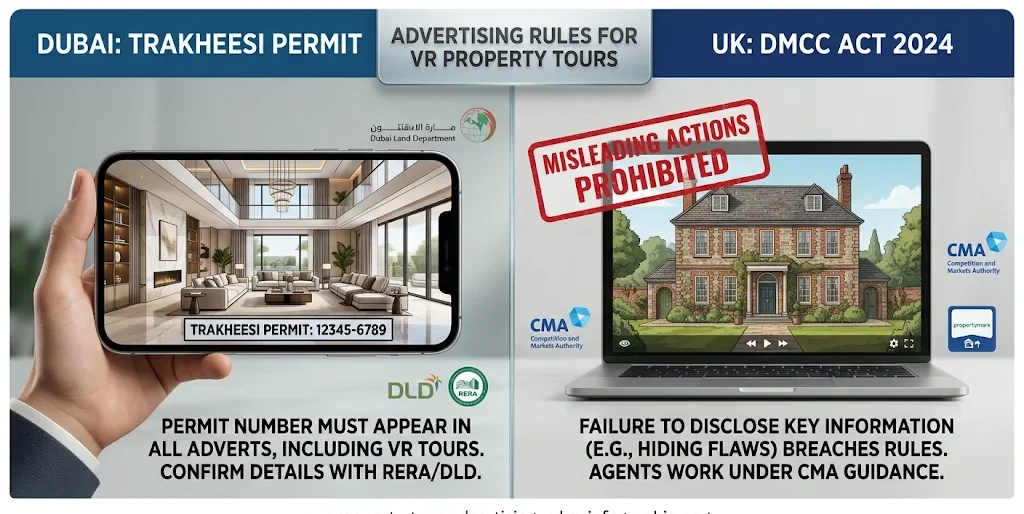
In Dubai, every property advert needs a permit number from the Dubai Land Department’s Trakheesi system, which RERA regulates. Bayut’s agent guide lists electronic adverts among the media it covers, and says the permit number must appear in the advert. If you use a VR tour to advertise a Dubai property, treat it as an advert, show the permit number and confirm the details with RERA or DLD.
UK: the DMCC Act 2024
The Digital Markets, Competition and Consumers Act 2024 replaced the older consumer rules on 6 April 2025. The old National Trading Standards material information guidance was withdrawn, and agents now work under the Act and CMA guidance, according to Propertymark. A misleading action can cover photos, plans, models and websites, as Bromley Council explains, so a tour that hides a flaw is a risk. The Property Ombudsman’s interim head said an agent can breach the rules by failing to give key information that matters to a decision on a property.
Some tour sellers pitch tours as a safeguard because they capture a property in full. That is a sales pitch, not a legal shield.
What Are the Limits and Risks of VR Property Tours?
- Render versus reality. A CGI walkthrough can look better than the finished building.
- What the camera hides. Wide lenses, staging and angles can mislead.
- Comfort. Some people feel sick in headsets. Our virtual reality experiences guide explains why.
- Access. Most buyers use a phone or laptop, not a headset.
- Privacy. Scans of lived-in homes can show personal items. Remove them first.
How Should Agents and Buyers Use VR Tours?
If you are an agent:
- Label renders clearly and show real finishes where you can.
- Show the permit number (Dubai) or all material information (UK) next to the tour.
- Clear personal items before scanning an occupied home.
- Offer a normal viewing to serious buyers. Use the tour as a first filter.
If you are a buyer:
- Check the permit number and the agent’s registration.
- For off-plan, check the project registration, developer, escrow and progress through official DLD channels.
- In the UK, check the energy rating, tenure, costs and the listing’s key information.
- Visit if you can, or send someone you trust.
Where Do Metaverse Properties Fit?
A VR tour shows a real property. A metaverse property is virtual land or a virtual building you buy inside a digital world. They are different products. Search interest in metaverse real estate for Dubai is tiny, about 10 searches a month in my keyword data, so this guide does not cover it. For the digital worlds side, see our guide to the metaverse and our look at spatial computing in 2026.
Conclusion
In Dubai, VR tours often stand in for a building that does not exist yet. In London, they filter viewings of homes that do. Research shows tours lift engagement and willingness to visit, but proof that they raise sales is mixed.
My take: treat a tour like a trailer, not the film. It should help you decide whether to look closer. Always check the property and the paperwork.
Frequently Asked Questions
Do I need a headset to take a VR property tour?
- No. Most tours open in a web browser on a phone or laptop.
- A headset adds a sense of scale and depth.
- If you get dizzy in a headset, use the browser version.
Can a VR tour replace a viewing?
For a first look, yes. For a purchase, no. Studies show tours raise willingness to visit the real home, which suggests they work as a filter. Visit in person, or send someone you trust, before you commit.
What should a buyer check besides the tour?
- The permit number and agent registration (Dubai) or the listing’s key information (UK).
- The developer, project registration and escrow for off-plan homes.
- Costs, tenure and the energy rating for UK homes.
Are VR tours only for expensive homes?
I found no independent research showing tours work only for luxury property. Some tour sellers say the effect is stronger at the top end, but that is a vendor claim. Cost per listing matters more for lower-priced homes.
Do VR tours work for rentals?
Yes. In the UK, Rightmove lets agents mark listings that include a virtual tour or video, and Which? reported in 2020 that agents were offering virtual viewings to renters. Tours save time for both sides when renters live far away.
How We Researched This Article
I read three Dubai sales analyses based on DLD records, Bayut’s guide on Trakheesi permits, Propertymark, Bromley Council and trade coverage on the UK rules, and four studies on VR and property buying. Sales-data sites are brokers and analytics firms, and their figures differ because they count differently. I did not visit properties or test any tour product.
About the Author
Aamir Khan is a content strategist and senior editor. He founded Future of Virtual Reality, a site about VR and spatial computing, and he researches and edits each guide against primary sources where possible.
Editorial Note
Companies named here are examples from public sources, not endorsements. This article is general information, not legal or investment advice. Check with a licensed professional before you buy or sell. Found a mistake? Tell us on our contact page and we will fix it and note the change.