
VR headsets have solved sight. The Apple Vision Pro hits 23 million pixels. The Quest 3’s pass-through reproduces real-world color in real time. Spatial audio handles hearing well enough that most users forget about it. For a full breakdown of how these components work, see our VR headset technology explained article.
Touch is the problem nobody fixed.
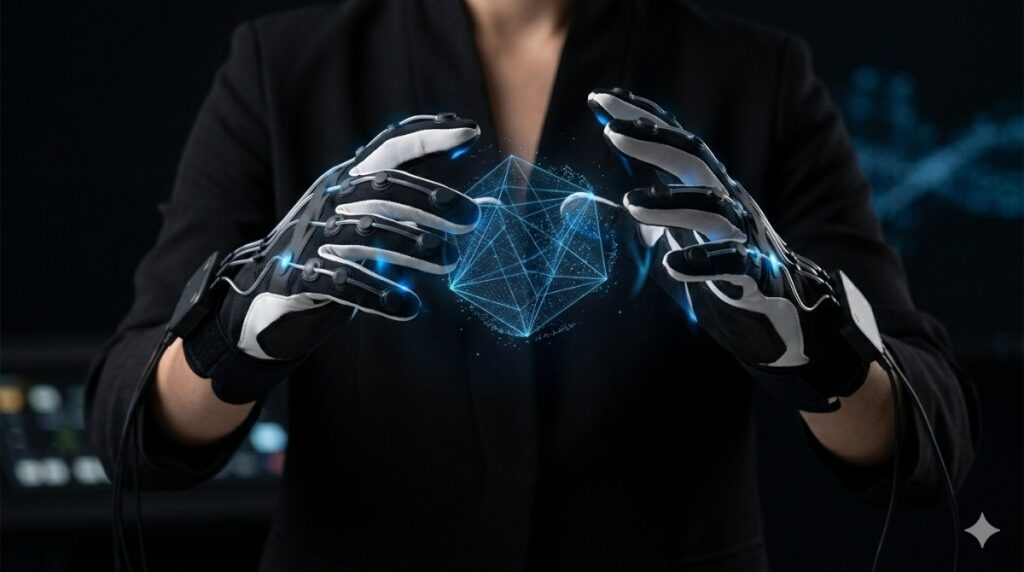
That is why haptic gloves in vr are quietly becoming the most important category in VR hardware. Not the most popular. Not the most hyped. The most important, because they are the layer that turns VR from a screen on your face into something closer to actual presence.
The category is small, fragmented, and expensive. HaptX gloves start at $5,495 per pair. bHaptics TactGlove runs $299. Manus and SenseGlove sit between them. Most consumer VR users will never touch a haptic glove. But every serious enterprise VR program eventually evaluates them.
Here is what they actually do, who is using them, and whether the technology is ready for real work in 2026.
Why Touch Matters More Than People Think
Pick up a coffee mug. Close your eyes. You still know exactly how heavy it is, how warm the ceramic feels, whether the handle is wide or narrow. Your hand processes about 17,000 mechanoreceptor inputs per second when you grip an object.
Now strap on a VR headset and pick up a virtual mug. You see it. You feel nothing. Your hand passes through it because there is no physical resistance. The illusion breaks immediately.
This is the core limitation of standard VR. Visual presence is solved. Tactile presence is missing. Without haptic feedback, certain training tasks, certain design workflows, and certain therapy applications just do not work.
Haptic gloves close that gap. Not perfectly, but enough that they change what VR can deliver. For the broader picture on what VR is solving across industries, see our benefits of VR data breakdown.
How Haptic Gloves Actually Work
There are three core technologies in the haptic glove category:
Vibrotactile feedback (low cost). Small motors vibrate against specific parts of your hand to simulate contact. This is what bHaptics TactGlove, the Quest’s optional haptic accessories, and most sub-$500 gloves use. Good for simulating contact and texture, weak at simulating resistance.
Force feedback exoskeletons (mid cost). Mechanical structures that resist your finger movement when you grip a virtual object. SenseGlove Nova and Manus Prime use this. Better at simulating shape and resistance, but bulkier and more expensive.
Microfluidic force feedback (high end). HaptX uses tiny inflatable air pockets across the palm and fingers to deliver true tactile and resistive feedback. Closest to real touch. Also the most expensive and least practical for mobile use.
Most enterprise programs use a mix. Vibrotactile gloves for general training, exoskeleton gloves for design and assembly work, microfluidic only for high-fidelity surgical or aerospace simulations.

The Five Major Players in 2026
HaptX Gloves G1: $5,495+ per pair. Microfluidic feedback with 133 tactile actuators per hand. The benchmark for realistic touch. Used by NASA, Sandia National Labs, and several Fortune 500 design teams. Tethered to a backpack compressor unit, so not mobile.
bHaptics TactGlove: $299 per pair. Vibrotactile only. Compatible with Quest 2, Quest 3, Pico, and Vive. The mass-market option. Best for general VR experiences and consumer use.
SenseGlove Nova 2: $5,200 per pair. Lightweight force feedback exoskeleton with palm haptics. Used by Volkswagen, Airbus, and Procter & Gamble for industrial training and product design.
Manus Quantum Metagloves: $3,490 to $9,890 depending on configuration. Best-in-class finger tracking with optional force feedback. Used in motion capture studios and high-end VR production.
Plexus Immersive Gloves: $1,500 per pair. Mid-range option with combined finger tracking and force feedback. Growing fast in the indie game developer market.
Where Haptic Gloves Are Actually Being Used
This is the part most coverage gets wrong. Haptic gloves are not a consumer product. The market is almost entirely enterprise, and the use cases are specific.
Surgical and medical training
Osso VR and FundamentalVR partner with HaptX and SenseGlove for surgical residency programs. The Mayo Clinic uses haptic-enabled VR for laparoscopic training. Studies show 230% better skill retention than traditional methods. For the wider clinical applications, see our VR in healthcare overview.
Aerospace and aviation
Boeing, Lockheed Martin, and Airbus use haptic gloves for aircraft assembly training and ergonomic design review. The cost per program runs $200,000 to $2 million but replaces physical prototype testing.
Automotive design
BMW, Volkswagen, and Ford use SenseGlove and Manus for digital prototype review. Designers evaluate switch placement, ergonomics, and interior layout in VR before building physical prototypes.
Military and defense training
US Army, USAF, and Royal Air Force use haptic VR for weapons handling, equipment maintenance, and explosive ordnance disposal training. Specific deployment numbers are classified but program budgets run in the tens of millions per year.
Remote inspection and telerobotics
Energy companies including BP and Shell use haptic gloves to remotely operate inspection robots on offshore platforms. The operator feels what the robot grips.

Consumer Gaming: Still a Gap
Despite the obvious appeal, haptic gloves have not broken into consumer gaming. A few reasons:
Price. $300 to $9,000 per pair is too high for a single-game purchase.
Compatibility. Most games do not support haptic glove APIs natively. Developers have to integrate specifically.
Comfort. After 20 minutes, even the best gloves get sweaty and uncomfortable.
Battery life. Wireless gloves need their own battery management on top of the headset.
There are a few exceptions. Beat Saber owners with bHaptics gloves report better immersion. Boxing and combat games gain some authenticity. But the consumer haptic glove market is still essentially a hobbyist niche.
Meta’s hand tracking team has been working on a sensorless glove for several years, with research published in 2024 showing promising results. If Meta ships a consumer-priced haptic glove in 2026 or 2027, the category could open. Until then, it stays enterprise.
The Hidden Layer: Body Suits and Tactile Vests
Worth mentioning because they overlap with gloves. The bHaptics TactSuit X40 at $499 is the most popular full-body haptic vest. Teslasuit at $14,500+ is the high-end enterprise option, including body temperature simulation and biometric tracking.
For training applications involving full-body movement (military, sports, emergency response), the vest plus glove combination delivers more authentic feedback than either alone.
Honest Limitations of Today’s Haptic Technology
A few things current haptic gloves cannot do:
True weight simulation. Even HaptX cannot make a virtual mug feel heavier than empty air. You feel pressure on contact, not gravity.
Temperature. No consumer or enterprise glove reproduces hot or cold. Teslasuit can do this for the torso, not the hands.
Sustained grip resistance. After about 30 seconds of holding a virtual object, the illusion degrades. Your brain notices the inconsistency.
Lightweight wearability. The best feedback comes from the bulkiest hardware. The lightest gloves give the weakest sensations.
Anyone selling you on haptic feedback that solves these problems in 2026 is overpromising. The technology is useful within its limits. It is not yet a complete touch replacement.
Where the Technology Is Heading
Three trends to watch over the next 24 months:
Soft robotics integration. New materials that combine sensors and actuators in flexible fabric. Reduces weight while maintaining feedback fidelity. Several startups in this space, with prototypes expected in late 2026.
AI-driven haptic rendering. Generative AI that interprets what you are touching and creates appropriate feedback dynamically, rather than requiring per-app integration. Reduces developer friction significantly. Our piece on AI and VR working together covers how this convergence is reshaping the entire stack.
Consumer-priced force feedback. Plexus and bHaptics both have under-$500 force feedback gloves in development. Once these ship, the consumer market opens.
Should You Buy Haptic Gloves in 2026?
For consumer VR users: probably not. The bHaptics TactGlove at $299 is the only consumer-realistic option, and the experience is limited to a small handful of compatible apps. Wait one or two product cycles.
For enterprise VR programs: it depends on the use case. Surgical training, industrial design, aerospace assembly, and any program where touch fidelity affects training outcomes will pay back the investment. General corporate training programs do not need them.
For VR developers: probably yes. Integrating haptic glove support into your app is a clear differentiator in a crowded market. The development cost is modest if you build for bHaptics’ SDK. To see where haptics fits in the wider shift, our spatial computing in 2026 guide covers the full ecosystem.
Frequently Asked Questions
How much do haptic gloves cost in 2026?
Consumer haptic gloves like the bHaptics TactGlove start at $299. Enterprise options like HaptX G1 start at $5,495. Most serious enterprise programs spend $5,000 to $20,000 per user including software integration.
Do haptic gloves work with Meta Quest 3?
Yes. The bHaptics TactGlove is the most popular Quest-compatible option. Manus and SenseGlove also support Quest 3 with their respective SDKs and tracking software.
Can haptic gloves simulate weight?
No. Current haptic technology can simulate contact, texture, and resistance but cannot reproduce gravitational weight. Lifting a virtual object feels lighter than the real object would feel.
Are haptic gloves used in real surgery training?
Yes. Osso VR, FundamentalVR, and partner programs at the Mayo Clinic and Cleveland Clinic use haptic-enabled VR for surgical residency. Published studies show measurable skill retention gains.
Will Meta release a consumer haptic glove?
Meta has published research on lightweight haptic gloves since 2021, with notable updates in 2024. No consumer product has been confirmed for 2026, but the company is publicly working in this space.
Pingback: Best VR Experiences in Singapore 2026: Top VR Arcades Guide