
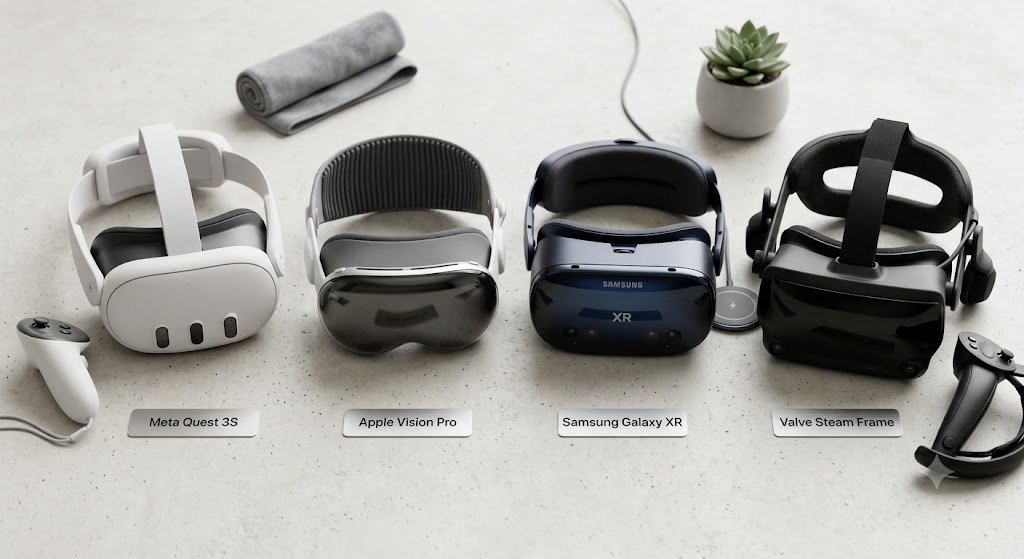
If you just want the short answer: the Meta Quest 3S is still the smartest first VR system for most people, the Samsung Galaxy XR is the best value premium pick, and the Apple Vision Pro remains the most capable but hardest to justify on price. Valve’s Steam Frame is the one to watch, but it isn’t shipping yet.
That’s the quick version. If you’ve been putting off buying a headset because the market feels like it’s changing every month, you’re not wrong. 2026 has already brought three genuinely new devices, a couple of price shocks nobody saw coming, and a shift in what “VR” even means.
Let’s walk through it properly.
Why 2026 Actually Feels Different
VR headsets used to mean one thing: Meta Quest, maybe with an Apple or Sony option on the side. That’s no longer true.
This year alone has brought the Samsung Galaxy XR, the first flagship Android XR headset, an M5-chip refresh of the Apple Vision Pro, and the ultralight Bigscreen Beyond 2 for PC VR enthusiasts. Valve’s long-rumored Steam Frame finally has a confirmed launch window too.
At the same time, a global memory shortage pushed prices up across the board. Meta raised the Quest 3 from $499 to $599 and the Quest 3S from $299 to $349 in April, and Apple followed by lifting the Vision Pro from $3,499 to $3,699 in June, both citing the same DRAM and storage supply crunch.
So if prices feel higher than you remember, that’s not your imagination. It’s an industry-wide problem, not a single company being greedy.
If you’re still getting familiar with the basics of how these devices work, our guide on how virtual reality actually works is a good place to start before diving into specific models.
The 2026 VR Systems Landscape at a Glance
Here’s the fastest way to understand where things stand right now.
| Headset | Price | Best For | Standout Feature |
| Meta Quest 3S | $349 | First-time buyers | No PC needed, huge app library |
| Meta Quest 3 | $599 | Value-conscious gamers | Pancake lenses, sharper display |
| Samsung Galaxy XR | $1,799 | Premium on a budget | Micro-OLED display, Gemini AI |
| Apple Vision Pro (M5) | $3,699 | Professionals, power users | Desktop-class performance |
| PlayStation VR2 | ~$350 | PS5 owners | Best console VR experience |
| Valve Steam Frame | TBA | PC VR enthusiasts | Full Steam library, standalone + PC |
This table alone answers most of the “which VR system should I buy” searches we see. But the reasoning behind each pick matters just as much as the price tag, so let’s break it down properly.
Meta Quest 3S and Quest 3: Still the Default Buy
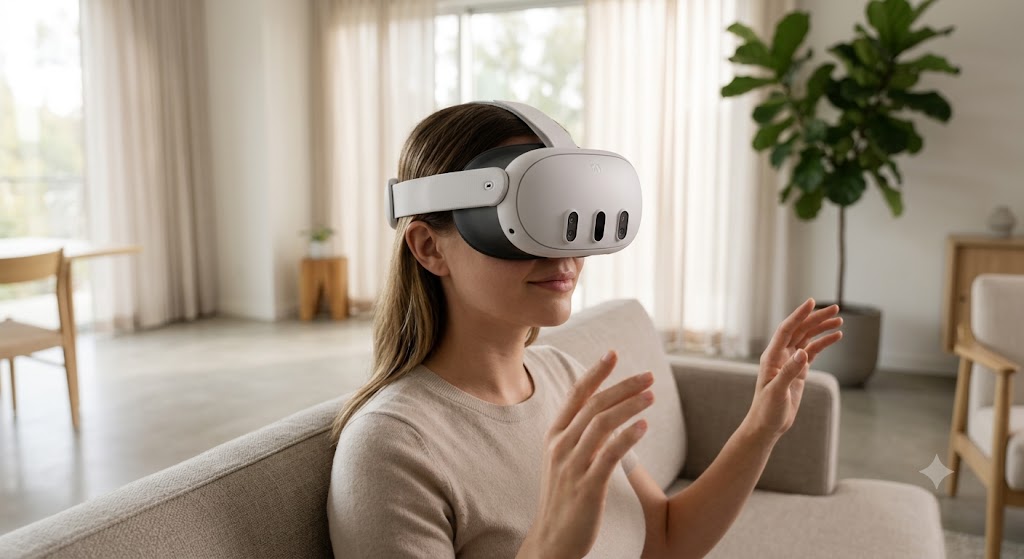
If you’ve never owned a VR headset, the Quest 3S is still the easiest recommendation on the market. It needs no PC, no external sensors, and no complicated setup. You charge it, put it on, and you’re playing within minutes.
It runs on the same Snapdragon XR2 Gen 2 chip as the pricier Quest 3, so performance is close. The trade-offs are a slightly lower-resolution display and Fresnel lenses instead of pancake optics, which most beginners genuinely won’t notice.
If you can stretch your budget, the Quest 3 at $599 is the better long-term investment. It has:
- Sharper pancake lenses for a clearer image
- Full-color mixed reality passthrough
- Access to the largest VR content library of any platform
- Meta AI integration for object recognition and hands-free assistance
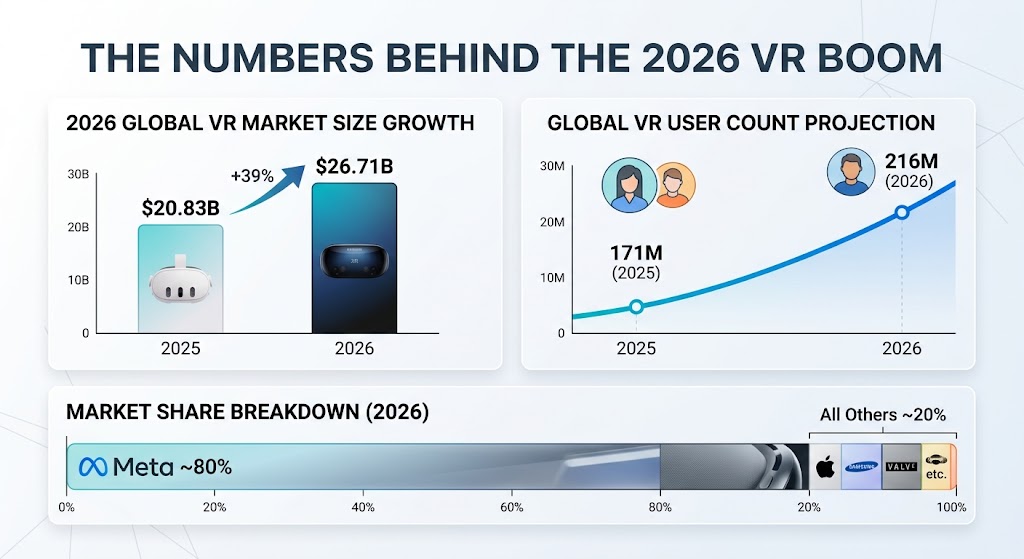
Meta still dominates the category, holding roughly 80% of all dedicated VR headset sales worldwide. That’s not a marketing claim; it’s what independent tracking from IDC’s shipment data shows.
For a deeper breakdown of Quest-specific features, our post on Meta Quest Pro for gaming and beyond is worth a look, and if you’re weighing it directly against Apple’s headset, we’ve already done that comparison in detail.
Apple Vision Pro vs Samsung Galaxy XR: The Premium Fight Nobody Expected
For years, “premium VR” basically meant Apple Vision Pro, full stop. That changed in October 2025 when Samsung’s Galaxy XR launched as the first Android XR headset, and it genuinely gave Apple something to worry about.
Here’s how they actually compare:
| Spec | Apple Vision Pro (M5) | Samsung Galaxy XR |
| Price | $3,699 | $1,799 |
| Display | Micro-OLED, highest resolution available | Micro-OLED, close second |
| Chip | Apple M5 | Snapdragon XR2+ Gen 2 |
| Weight | Heavier, luxury materials | 19 oz, lighter build |
| AI Assistant | Limited (no Visual Intelligence yet) | Gemini Live, full integration |
| Ecosystem | visionOS, exclusive Immersive Video | Android XR, mobile app ports |
The performance gap is real. Independent benchmark testing found Apple’s M5 chip runs more than seven times faster than Samsung’s Snapdragon XR2+ Gen 2 in multicore tasks, which is why the Vision Pro can handle desktop-grade multitasking that the Galaxy XR simply can’t.
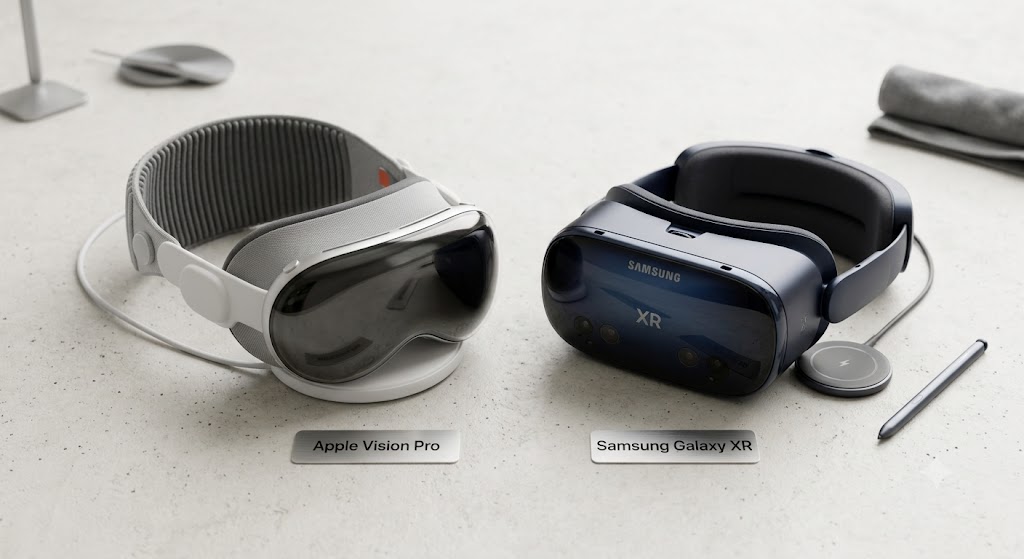
But Samsung wins on almost everything else that matters to a normal buyer: it’s roughly half the price, noticeably lighter to wear for long sessions, and comes with genuinely useful AI features built in through Gemini.
So who should buy which? If you need serious productivity power and don’t blink at the price, the Vision Pro still has no real competition. If you want a taste of true mixed reality spatial computing without remortgaging your house, the Galaxy XR is the smarter buy for most people.
This ties directly into the broader shift toward spatial computing in 2026, which both of these devices represent far more than traditional gaming-focused VR.
Valve Steam Frame: The Headset Everyone’s Actually Waiting For
If you follow PC gaming at all, you’ve probably heard Steam Frame mentioned more than any headset that’s actually shipping right now. That hype is earned.
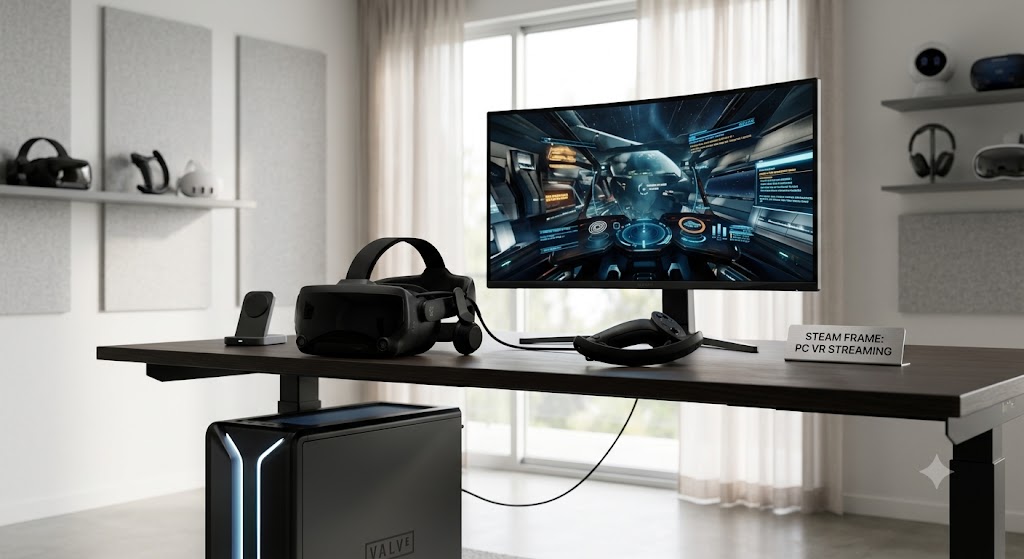
Valve confirmed in June 2026 that the Frame will ship “this summer,” after the same memory shortage that hit Meta and Apple forced repeated delays from its original early-2026 target. It’s designed as a hybrid: full standalone operation thanks to an integrated ARM chip, plus seamless wireless streaming from a gaming PC when you want the full Steam library.
That last part is the real headline. Steam Frame won’t distinguish between flat-screen games and VR titles, meaning it could become the first headset that doubles as a genuine PC gaming console, not just a VR accessory.
Worth noting honestly: Valve hasn’t finalized full specs or exact pricing yet, so treat anything beyond “it’s launching this summer” as still somewhat fluid.
What’s Actually New: The Trends Defining VR Systems in 2026
Beyond specific headsets, a few underlying shifts explain why this generation feels different from 2023 or 2024.
Eye tracking is now standard, not premium
Two years ago it was a flagship-only feature. In 2026, nearly every headset above $500 includes it for foveated rendering, UI navigation, and social avatar animation.
Micro-OLED has become the display of choice
The Vision Pro, Galaxy XR, Bigscreen Beyond 2, and PSVR2 all now use OLED-based panels rather than older LCD screens, delivering noticeably better contrast and color accuracy. Our explainer on VR headset technology breaks down exactly why this matters for image quality.
Standalone-plus-PC-streaming is the new normal
The Quest 3, Steam Frame, and Galaxy XR all function independently but can also stream PC VR content wirelessly. Tethered-only headsets are quickly becoming a niche product for sim racing and flight simulation enthusiasts specifically.
Tethered controllers are getting smarter, not just simpler
If precise input still matters to you for gaming, it’s worth reading our comparison of VR controllers before you commit to a platform.
The Numbers Behind the 2026 VR Boom
Numbers help cut through marketing noise, so here’s what the data actually says about where this market stands.
- More than 171 million people use VR worldwide, and that number is projected to reach 216 million by the end of 2026, according to industry tracking compiled by SQ Magazine.
- The global VR market was worth roughly $20.83 billion in 2025 and is forecast to hit $26.71 billion in 2026, a 28.2% jump, per Fortune Business Insights data.
- After a rough 2025, IDC forecasts headset shipments will rebound sharply in 2026 as delayed 2025 launches finally reach full availability.
- Meta still commands close to 80% of the dedicated VR headset market, even as competitors like Samsung and Valve chip away at the premium segment.
The takeaway isn’t just “VR is growing.” It’s that 2026 specifically is a rebound year after a rough 2025, which is exactly why so many genuinely new systems are landing at once. The detailed spec comparisons at knowledgelib.io are worth bookmarking if you want to track pricing as it shifts throughout the year.
Which VR System Should You Actually Buy?
Skip the spec sheets for a second and think about what you actually want to do with it.
You’re brand new to VR and want to try it without much risk. Get the Quest 3S. It’s $349, needs nothing else, and gives you full access to the biggest VR library that exists.
You want the best all-around gaming experience. The Quest 3 is still the sweet spot. If you want a head-to-head breakdown against other gaming-focused headsets, our top VR headsets for gaming comparison covers this in more depth.
You want serious mixed reality without Apple pricing. The Samsung Galaxy XR gives you 80% of the Vision Pro experience for half the cost.
Money genuinely isn’t the constraint and you want the best available. The Apple Vision Pro still leads on raw capability, especially for professional and productivity use cases.
You’re a PS5 owner who wants VR without buying a second ecosystem. PlayStation VR2 remains the clear, uncomplicated pick.
You want to wait for the most interesting device of the year. Hold off for Valve’s Steam Frame this summer, but be ready for pricing that could land anywhere between Quest and Galaxy XR territory.
For the full breakdown of every headset type currently available, our comprehensive guide to all types of VR headsets is the best starting point on the site.
Frequently Asked Questions
What is the latest VR system in 2026?
The most recently launched major VR system is the Samsung Galaxy XR, released in October 2025 as the first Android XR headset, alongside the M5-chip refresh of the Apple Vision Pro.
Is Meta Quest 4 available yet?
No. Multiple credible industry reports confirm Meta has pushed the Quest 4 to 2027 or later, and will instead release a lighter interim device before then.
What’s the best VR headset for beginners in 2026?
The Meta Quest 3S at $349 is the clearest starting point. It requires no PC or external hardware and runs the full Quest content library.
Is the Apple Vision Pro worth the price in 2026?
For most consumers, no, especially after the June 2026 price increase to $3,699. It remains the strongest choice specifically for professionals who need its desktop-class processing power.
The Bottom Line
VR systems in 2026 aren’t just incremental upgrades anymore; they represent a genuine platform shift. Android XR has arrived as a real competitor, Apple is doubling down on the premium end, and Valve is about to test whether PC gamers actually want a headset built around their existing Steam library.
If you need a system today, the Quest 3S or Quest 3 will not disappoint you. If you can wait, both the Galaxy XR’s next moves and the Steam Frame launch this summer are worth watching closely before you spend serious money.
Whichever direction you go, make sure you’re comparing full specs side by side rather than trusting a single review, and check our homepage for ongoing coverage as new VR systems continue to launch throughout the year.