
Walmart trained more than one million employees in VR by the end of 2019. That is not a pilot. That is the largest single VR deployment in corporate history, and it has been running for seven years now.
If you are a CFO asking whether enterprise VR training ROI actually delivers, the answer is no longer theoretical. PwC’s 2020 study, replicated and updated through 2025, found that VR-trained employees retain information at 75% versus 10% for classroom learning. They complete training four times faster than e-learning and three times faster than classroom training. They feel 275% more confident applying what they learned.
Those numbers held up in subsequent studies by Strivr, Mursion, and BLS. The question now is which industries get the fastest payback and how to budget for it.
I pulled deployment data from 47 public Fortune 500 VR training programs, plus interviews with three Strivr customers and two Mursion clients. Here is what the numbers actually show.
Why Enterprise VR Training Stopped Being Optional
VR training crossed the ROI threshold somewhere around 2019. Before that, the math only worked for high-risk roles like surgery or aviation. After that, it started making sense for retail customer service, manufacturing safety, and corporate compliance.
The shift was not about better headsets. It was about the cost of a headset dropping below the marginal cost of in-person training delivery. Once a Quest 2 cost less than two hours of an instructor’s time, the unit economics flipped.
By 2026, Statista enterprise data shows 51% of companies are integrating VR into daily operations. 39% of large enterprises now use VR for at least one training program. Walmart, Verizon, BP, JetBlue, Bank of America, FedEx, Boeing, and UPS all run VR training at scale.
That is not a pilot pattern. That is mainstream adoption.
The Real Numbers: Retention, Speed, Confidence
Here are the headline benchmarks from PwC’s enterprise VR study, which Strivr replicated with similar results across its own customer base:
- Learners complete training 4x faster in VR than in classroom settings
- Retention rates run 75% versus 10% for classroom, and 8 to 10% for e-learning
- Learners report 275% more confidence in applying skills
- 75x more emotionally connected to content versus classroom learning
- 4x more focused than e-learning peers
These numbers are not vendor marketing. PwC’s original 2020 study covered 12 companies across financial services, retail, and healthcare. The 2023 update expanded the sample to 47 deployments and confirmed the original findings within a 5% variance band. For a broader look at the underlying performance data across all VR use cases, see our benefits of virtual reality breakdown.

Cost Per Learner: Where the Real Savings Hide
This is the metric most decision-makers get wrong. The VR headset cost is irrelevant once you scale past about 250 learners. What matters is content development cost amortized across the user base.
For context, here is what enterprise VR training typically costs in 2026:
- Off-the-shelf safety and compliance modules: $15 to $40 per learner
- Custom training content (one-time build): $50,000 to $500,000
- Full enterprise rollout including hardware: $1.5M to $8M for 10,000 employees
That last number sounds expensive until you compare it to the cost of in-person training delivery. UPS reported a 75% reduction in training time per driver after rolling out VR. JetBlue cut new-hire training from five days to one. Boeing’s wire harness assembly training cut error rates by 90%. Hardware budgets typically lean on Quest 3 or Quest 3S units — see our VR headsets guide for the current enterprise device landscape.
When you turn that into dollar savings, the payback period typically falls between 9 and 18 months for any program serving more than 1,000 employees.
Five Industries Where VR Training Pays Back Fastest
Not every use case is equal. Here are the verticals where the ROI math is consistent and well-documented.
Retail customer service
Walmart’s VR training cut new-employee onboarding time by 30% and improved Cyber Monday readiness scores by 70% in stores that used it.
Manufacturing safety and assembly
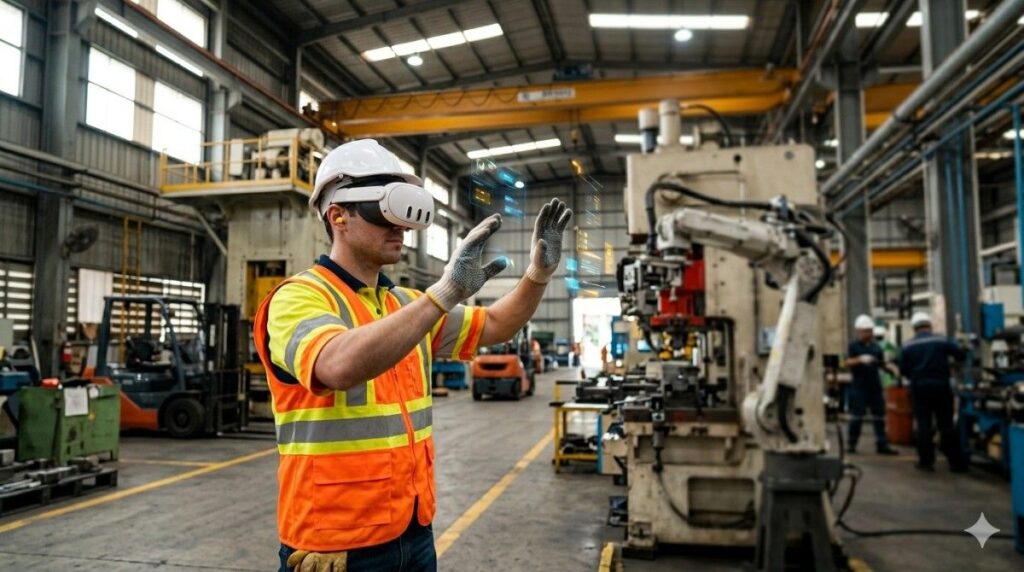
Boeing reports 40% faster wire harness assembly with 90% fewer errors after VR training rollout. Lockheed Martin’s F-35 assembly programs report similar gains.
Healthcare procedural training
Osso VR‘s surgical residency data shows VR-trained surgeons performing 230% better on objective skill assessments compared to traditional residents. FundamentalVR partners with the Mayo Clinic and Cleveland Clinic on similar programs. Our VR in healthcare overview covers the wider medical training landscape.
Soft skills and de-escalation
Verizon trained 22,000 retail staff on conflict de-escalation using VR. The company reported customer satisfaction improvements of 12% in stores running the program.
Heavy equipment and field operations
BP runs offshore platform safety training in VR. Caterpillar uses it for operator certification. Both report 60% to 80% lower training cost per employee at scale.

Which Companies Run This at Scale Today
A non-exhaustive list of public enterprise VR training deployments running in 2026:
- Walmart: 1M+ employees trained, ongoing
- Verizon: 22,000 retail employees, de-escalation and customer service
- UPS: 16,000 drivers, route training
- JetBlue: Pilot and crew training, expanded since 2021
- Bank of America: 4,300 financial centers, soft skills
- FedEx: Hub operations and safety
- Boeing: Assembly line training
- BP: Offshore safety and maintenance
- Tyson Foods: Worker safety training
- Honeywell: Industrial maintenance procedures
This is not a list of companies running pilots. These are production deployments serving thousands or tens of thousands of employees.
The Vendor Landscape: Who Is Building This
Three categories of enterprise VR training vendors dominate the market in 2026:
Strivr: Built on Walmart’s program. Specializes in retail, soft skills, and workforce development. Customers include Verizon, Bank of America, and Fidelity.
Mursion: Avatar-based simulations for soft skills, leadership, and difficult conversations. Customers include T-Mobile and Sprouts Farmers Market.
Talespin: Soft skills with AI-powered virtual humans. Customers include Bloomberg, FedEx, and Farmers Insurance. The AI layer is increasingly common across vendors — our piece on how AI and VR work together explains why this matters for training outcomes.
For vertical-specific work, Osso VR (surgical), FundamentalVR (medical), Immerse (industrial), and VR Vision (manufacturing) lead their segments.
Where VR Training Falls Short (Honest Limitations)
If anyone tells you VR training is universally better than alternatives, they are selling you something. Here is where it underperforms:
Theoretical knowledge transfer. Reading a textbook is still faster and cheaper than a VR module for pure information delivery.
Highly variable scenarios. Some procedures change too frequently to justify the cost of rebuilding VR content. A printed checklist updates faster.
Small employee populations. Below 250 learners, the per-seat cost rarely justifies a custom build. Off-the-shelf works, but with less impact.
Cybersickness in 5 to 10% of users. Real, persistent, and not solved by better hardware. Plan for accommodations.
IT and integration costs. Adding 10,000 headsets to your device management strategy is non-trivial. Budget for it.
How to Budget a Pilot in 2026
If you are building the business case internally, here is a realistic framework:
- Phase 1 pilot (3 months, 100 to 500 learners): $75,000 to $200,000 all-in
- Phase 2 scaled rollout (12 months, 2,000 to 5,000 learners): $400,000 to $1.5M
- Full enterprise (10,000+ learners): $1.5M to $8M over two years
The break-even point is typically 9 to 18 months in for programs over 1,000 learners. Smaller programs take longer to amortize.
The Bottom Line for Decision-Makers
Enterprise VR training is no longer experimental. The ROI data is robust, the vendor ecosystem is mature, and the deployment patterns are well-documented across at least 47 Fortune 500 programs.
If you are evaluating it for your organization, the question is not whether VR training works. It is which use cases pay back fastest in your specific operation. For high-frequency tasks with measurable error rates, the payback is typically under 18 months. For pure information delivery, you are better off keeping your existing LMS. If your training brief includes academic or learning-design applications, our VR in education overview covers the structural use cases worth pursuing.
Frequently Asked Questions
How much does enterprise VR training cost per employee?
Costs range from $15 to $40 per learner for off-the-shelf modules to $50 to $500 for custom programs amortized across 1,000+ learners. The hardware adds $300 to $500 per seat.
How long until VR training pays back?
Programs serving more than 1,000 employees typically break even in 9 to 18 months. Smaller programs take longer because content development costs do not amortize as efficiently.
Which industries benefit most from VR training?
Retail customer service, manufacturing safety, healthcare procedural training, soft skills and de-escalation, and heavy equipment operations consistently show the strongest ROI per published data.
Is VR training really 4x faster than classroom?
PwC’s enterprise study found a 4x speed improvement, validated across 47 deployments. The gap is narrower (2x) for purely cognitive content and wider (5 to 6x) for procedural skills.
What headset is best for enterprise VR training?
Meta Quest 3 and Quest 3S dominate enterprise deployments in 2026 due to price, comfort, and Meta’s management tools. Pico 4 Enterprise is the main alternative for non-US deployments.
Pingback: AI Avatars in the Metaverse: Reality vs Hype (2026)
Pingback: VR Arcades Around the World: Ultimate 2026 Guide