
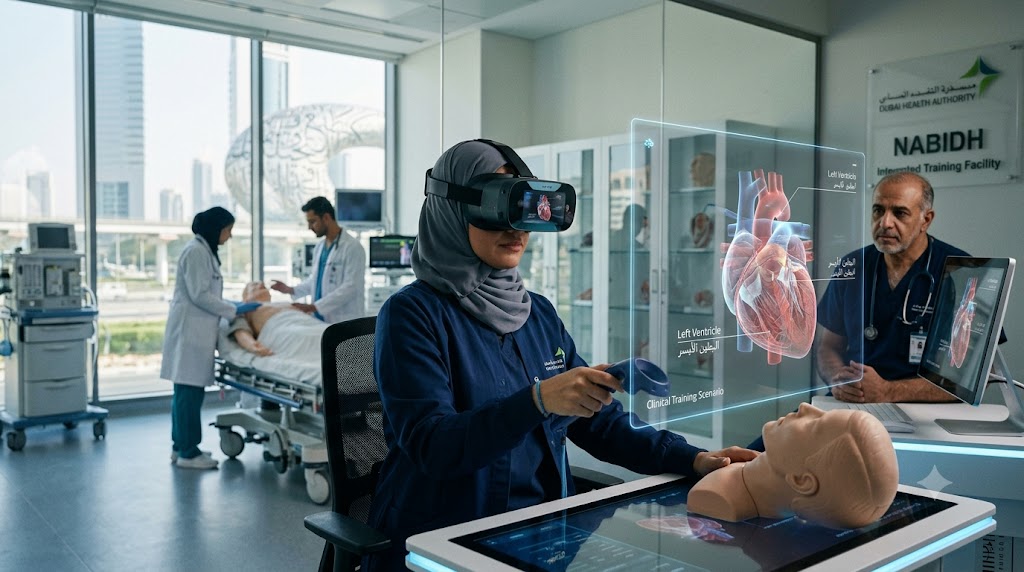
The Gulf healthcare market has a peculiar quality that does not get talked about enough in Western technology coverage: the distance between an announced initiative and an operational deployment is shorter here than almost anywhere in the developed world. When Dubai’s government decides something is a priority, the bureaucratic friction that slows equivalent programs in the UK’s NHS or Germany’s fragmented payer system tends to compress significantly. The result, for VR healthcare in Dubai and across the UAE, is that what might take five years to move from pilot to widespread deployment elsewhere is moving on a noticeably faster timeline.
To understand why VR healthcare in Dubai and the UAE is worth paying serious attention to in 2026, you need to understand the infrastructure it is sitting on top of, because the technology story here is inseparable from the policy story. The Future of Virtual Reality team has been tracking how regional technology strategies are shaping VR adoption globally, and the Gulf stands out as one of the most genuinely underreported stories in the space. Our VR health and wellness coverage explores the broader therapeutic and clinical dimensions in more depth.
Why VR Healthcare Adoption Moves Faster in the Gulf
One of the reasons VR healthcare in Dubai attracts attention beyond the Middle East is that the region operates under a different innovation model than many Western healthcare systems. In countries with highly decentralized healthcare networks, new technologies often move through multiple procurement layers, regional approvals, reimbursement evaluations, and pilot programs before reaching widespread adoption. The Gulf’s approach is often more centralized, allowing strategic priorities to move from announcement to implementation on a considerably shorter timeline.
Dubai’s healthcare ecosystem also benefits from being part of a broader smart-city strategy. Virtual reality is not being introduced into a disconnected environment. Instead, it sits alongside investments in artificial intelligence, telemedicine, cloud infrastructure, unified health records, and digital identity systems. Together, these create an environment where immersive healthcare technologies can be adopted more efficiently.
Another important factor is competition. The UAE has positioned itself as a global destination for healthcare services, and healthcare providers constantly compete to attract international patients. Technologies that improve training, patient outcomes, and healthcare experiences naturally receive greater attention in this environment.
Why the UAE Is Positioned for Faster VR Healthcare Adoption
| Factor | UAE Position |
| Healthcare Digitization | Very High |
| Unified Medical Records | Established |
| Government Innovation Support | Strong |
| Medical Tourism Demand | High |
| Procurement Speed | Fast |
| Digital Health Investment | Significant |
| VR Adoption Potential | High |
How VR Healthcare in Dubai Fits the UAE’s Larger Digital Strategy
Dubai’s approach to healthcare digitization did not begin with virtual reality. It began much earlier, with systematic infrastructure projects that have now created a foundation unusually well suited to the deployment of advanced healthcare technology.
The NABIDH platform (the National Unified Medical Record system) connects more than 1,500 healthcare facilities across Dubai and holds records for 9.5 million patients, accessible to over 90,000 providers. The Riayati platform stores 1.9 billion medical records for 9.5 million patients across 3,057 facilities. According to Appinventiv’s 2026 analysis of AI in UAE healthcare, the Dubai Health Authority has achieved a 98.55 percent digital completion rate across its processes and a 98.91 percent automation of internal operations. These are documented operational metrics, not targets in a strategy document.

According to Nova One Advisor’s UAE Digital Health Market report, the UAE digital health market was valued at $944.85 million in 2025 and is projected to reach $7.836 billion by 2035, growing at a CAGR of 23.56 percent. The healthcare IT sector within that market is expanding at a faster 13.2 percent CAGR, with AI-related healthcare applications among the fastest-growing categories. Dubai leads the UAE’s healthcare digital market in terms of technology implementation and public-private collaboration.
The UAE’s Healthcare Investment Scale
AED 118 billion has been invested in Dubai’s healthcare infrastructure and digital platforms. As documented by MedTech World’s analysis of the UAE’s healthcare boom, more than AED 10 billion was specifically directed at healthcare research and development by end 2025, and studies suggest the UAE could save up to $22 billion annually by 2030 through AI-powered healthcare systems.
According to Entrepreneur UAE’s 2026 healthcare outlook, AI-driven facilities in Dubai have reduced diagnostic errors by 40 percent and treatment wait times by 50 percent, which has contributed to the city attracting over 690,000 medical tourists annually. These numbers establish the broader context: this is a market investing in healthcare technology at significant scale, and virtual reality sits within a portfolio of immersive and AI-driven clinical tools the UAE is actively building out.
What Is Actually Being Deployed in UAE Healthcare Right Now
The honest picture of VR healthcare in Dubai and the UAE in 2026 is one of strong momentum in underlying infrastructure, early-stage VR-specific deployment, and a very active pipeline of international investment entering the region.
In February 2026, QuantumNexis, a subsidiary of Healthcare Triangle Inc., launched UAE operations in Meydan Free Zone to deliver clinically validated digital mental health solutions and an AI-powered Hospital Information System across GCC markets. The expansion explicitly aligns with the UAE’s NABIDH and Riayati national interoperability frameworks, targeting a UAE digital health market projected at $1.84 billion by 2030. Digital mental health platforms, which include VR-assisted therapy tools, are one of the fastest-moving segments in this market.
MedTech World Dubai 2026 took place in February at the Intercontinental Festival City Hotel, with major discussions around AI in healthcare at clinical readiness, precision diagnostics, digital mental health, and healthcare innovation broadly. VR-assisted training and therapy appeared across multiple exhibitor portfolios in that context, reflecting where institutional attention in Gulf healthcare innovation is currently concentrated.
Dubai’s SEHA Virtual Clinics and the broader Doctor for Every Citizen initiative have built significant telemedicine infrastructure. While telemedicine and VR are different technologies, they share the underlying infrastructure of connectivity, digital health records, and patient comfort with receiving care digitally, all of which create favorable conditions for VR healthcare adoption alongside existing telemedicine deployments.
Potential Applications of VR in UAE Healthcare
Although many current deployments focus on training and digital mental health, the long-term potential of VR healthcare extends much further.
Potential Healthcare Applications
| Application | Current Status | Potential Impact |
| Clinical Training | Active | Faster workforce development |
| Mental Health Therapy | Emerging | Increased treatment access |
| Surgical Planning | Early Adoption | Improved clinical precision |
| Rehabilitation | Pilot Stage | Better patient recovery outcomes |
| Pain Management | Experimental | Reduced reliance on medication |
| Patient Education | Growing Interest | Improved treatment understanding |
One particularly promising area is patient education. Healthcare providers often struggle to explain complex procedures using brochures, diagrams, or verbal consultations alone. Immersive environments can help patients visualize treatments, understand recovery pathways, and make more informed healthcare decisions.
Similarly, rehabilitation programmes may benefit from VR-based environments that encourage participation and improve patient engagement. These applications remain early-stage but align closely with broader healthcare modernization efforts already underway across the Gulf.
Staff Training and Medical Education in Gulf Hospitals
Healthcare workforce development is where VR adoption tends to move fastest in any system, because the ROI case is cleaner and the regulatory pathway simpler than for patient-facing therapeutics. In the Gulf specifically, this dynamic is reinforced by the region’s heavy reliance on internationally trained clinical staff, many of whom arrive in UAE healthcare facilities having trained on different equipment, with different protocols, in different systems.
VR training programs that replicate actual clinical environments, specific equipment, and Gulf-region protocols offer a practical solution to onboarding standardization at a scale that benefits from the region’s strong technology infrastructure. Dubai’s medical schools and clinical training programs, including those within Dubai Healthcare City, have been incorporating simulation technology into curricula, and VR simulation platforms represent a natural extension of the simulation-first training philosophy already established in this region.
The Comparison With Saudi Arabia’s Healthcare VR Ambitions
Any discussion of Gulf healthcare VR that does not acknowledge Saudi Arabia is incomplete. Saudi Vision 2030 includes an explicit commitment to healthcare system modernization. NEOM, the giga-project under development in the northwest of the country, has positioned its planned healthcare infrastructure as entirely digitally-first, with advanced simulation and AI diagnostics built into the system from initial design rather than retrofitted into existing facilities.
Abu Dhabi’s M42 Group, the AI-powered health company operating across 480 clinics serving international patients, announced strategic collaborations at the Dubai World Health Expo in September 2025 focused on combining global healthcare expertise with digital health innovation. As we have covered in our article on the future of virtual reality, the Gulf represents one of the most interesting emerging markets for VR technology across multiple sectors, and healthcare is among the most active.
Challenges Facing VR Healthcare in the UAE
Despite the momentum behind healthcare innovation, virtual reality adoption is not without obstacles.
Clinical validation remains one of the most important. Hospitals require evidence that immersive technologies deliver measurable improvements compared to traditional approaches. While enthusiasm for innovation is strong, healthcare decision-makers still expect outcomes backed by data.
Cost also remains a factor. Enterprise-grade VR deployments involve more than purchasing hardware. Software integration, staff training, maintenance, cybersecurity, and content development all contribute to total implementation costs.
Data governance presents another challenge. As immersive healthcare systems become more sophisticated, they may collect behavioral data, usage metrics, eye-tracking information, and other sensitive patient information. Healthcare providers must ensure these systems align with evolving privacy and security standards.
Finally, workforce readiness cannot be overlooked. Technology adoption succeeds when clinicians feel confident using new tools. Effective implementation requires organizational support, training programs, and realistic expectations regarding adoption timelines.
What the Future Looks Like for VR Healthcare in the UAE
International healthcare technology companies entering the GCC will bring VR healthcare tools as part of integrated digital health packages rather than as standalone VR deployments. Integrated tools that connect to NABIDH and the UAE’s unified health record infrastructure will have a clear advantage over standalone systems that create data silos.

The UAE’s position as a medical tourism destination, attracting over 690,000 medical tourists annually, creates an additional incentive to deploy VR in patient experience settings. For VR companies evaluating the Gulf as a market, the combination of government-backed investment, strong digital infrastructure, fast-moving procurement relative to Western healthcare systems, and an explicitly innovation-positive regulatory environment makes the UAE one of the most attractive international healthcare VR markets globally.
UAE Digital Health at a Glance
| Metric | Figure |
| Healthcare Infrastructure Investment | AED 118 Billion |
| Healthcare R&D Investment | AED 10 Billion+ |
| Medical Tourists Annually | 690,000+ |
| Facilities Connected Through NABIDH | 1,500+ |
| Medical Records Stored in Riayati | 1.9 Billion |
| Digital Health Market by 2035 | $7.836 Billion |
| Projected CAGR | 23.56% |
Key Takeaways
- VR healthcare in Dubai and the UAE sits within a digital health ecosystem structurally better prepared for advanced technology adoption than most comparable markets.
- NABIDH connects 1,500-plus facilities; Riayati stores 1.9 billion medical records. AED 118 billion has been invested in healthcare infrastructure.
- The UAE digital health market is growing at 23.56 percent annually toward $7.836 billion by 2035.
- Active international companies are specifically targeting the GCC for VR-assisted healthcare and digital mental health deployment.
- Saudi Arabia’s Vision 2030 and NEOM healthcare planning represent a significant parallel Gulf market developing alongside Dubai’s.
Frequently Asked Questions
Is VR being used in UAE healthcare?
Yes. VR and digital health tools are already being deployed across training, mental health support, and healthcare innovation initiatives. While large-scale clinical VR programs remain in development, the UAE has established much of the digital infrastructure needed for broader adoption.
What is the Dubai Health Authority’s digital strategy?
The Dubai Health Authority focuses on creating a connected healthcare ecosystem through initiatives such as NABIDH, which links healthcare providers through a unified patient record system. The broader strategy supports smart hospitals, AI-driven healthcare services, and advanced digital technologies.
How does the UAE compare to Saudi Arabia for VR adoption in healthcare?
Dubai currently has a more mature healthcare digitization framework, while Saudi Arabia is investing aggressively through Vision 2030 and NEOM. Both markets are expected to play major roles in the future of healthcare innovation across the Gulf.
What are the main benefits of VR healthcare in the UAE?
VR can improve clinical training, patient education, mental health support, rehabilitation programs, and medical simulation. It allows healthcare professionals and patients to engage with information in more immersive and interactive ways.
What challenges could slow VR healthcare adoption in Dubai?
The main challenges include clinical validation, implementation costs, cybersecurity requirements, workforce training, and integration with existing healthcare systems. Long-term adoption will depend on demonstrating measurable healthcare outcomes and operational benefits.
Further Reading
- Nova One Advisor — UAE Digital Health Market Size 2025 to 2035 — https://www.novaoneadvisor.com/report/uae-digital-health-market
- MedTech World — UAE’s $22 Billion Healthcare Boom — https://med-tech.world/news/uae-healthcare-22b-medtech-boom/
- Entrepreneur UAE — Healthcare Outlook 2026 — https://www.entrepreneur.com/en-ae/growth-strategies/healthcare-outlook-2026-balancing-human-touch-and-digital/501415
- Grand View Research — Virtual Reality in Healthcare Market Report — https://www.grandviewresearch.com/industry-analysis/virtual-reality-vr-healthcare-market-report
Pingback: VR Arcades Around the World: Ultimate 2026 Guide