
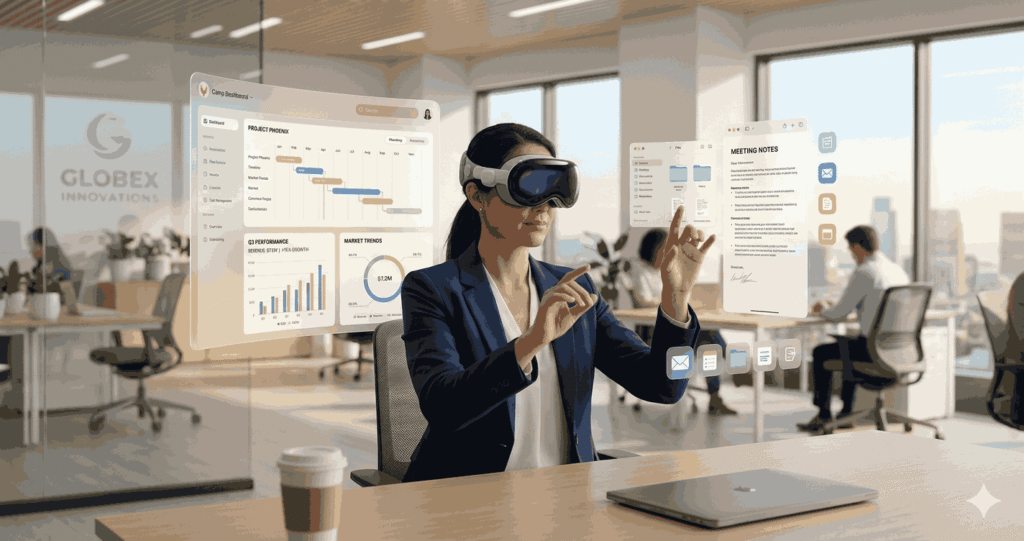
Spatial computing is the computing paradigm where digital content occupies and interacts with physical space, rather than appearing on a flat screen. The global spatial computing market was valued at $157.59 billion in 2025 and is projected to reach $201.93 billion in 2026 (Roots Analysis). Apple Vision Pro, Microsoft HoloLens 2, and Meta Quest all qualify as spatial computing devices. Here’s what that means in practice.
Apple chose its words carefully when it launched the Vision Pro.
They didn’t call it a VR headset. They didn’t call it a mixed reality device. They called it a spatial computer. And the term they chose reflects a shift that’s been building across the entire extended reality (XR) industry since 2022: the convergence of virtual reality, augmented reality, and artificial intelligence into a single computing platform where the interface isn’t a screen in front of you but the space around you.
Spatial computing is both a technology description and a strategic direction. Understanding the difference between those two things determines whether you evaluate it correctly.
For context on how VR technology led to spatial computing, see our complete history of VR and our overview of augmented reality, which is a core component of spatial computing platforms.
What Is Spatial Computing? The Clearest Definition
Answer: Spatial computing is any computing system that understands, maps, and interacts with three-dimensional physical space, allowing digital objects to exist and behave within that space rather than being confined to a flat-screen interface.
The term was coined by Simon Greenwold in his 2003 MIT thesis, where he defined it as ‘human interaction with a machine in which the machine retains and manipulates referents to real objects and spaces.’ In plain terms: the computer knows where you are, where things are around you, and can place digital content in relation to both.
A traditional computer screen presents content in a fixed 2D rectangle. A spatial computer presents content as objects that exist in your environment: a digital screen you can place on any wall, a 3D model of an engine component floating on your workbench, a surgical simulation overlaid precisely on a patient’s anatomy.
The key hardware enablers: Depth sensors, cameras, eye-tracking systems, and processors capable of simultaneously mapping an environment and rendering 3D content within it in real time. Apple Vision Pro uses 12 cameras, 5 sensors, and 6 microphones for this purpose. Microsoft HoloLens 2 uses a depth sensor array alongside holographic waveguide displays.
Spatial Computing vs VR vs AR vs Mixed Reality: What’s the Difference?
This causes genuine confusion in the industry. Here’s how the terms relate to each other.
| Technology | What It Does | Immersion Level | Example Device (2025) |
| Virtual Reality (VR) | Replaces your view entirely with a computer-generated environment | Full – blocks physical world | Meta Quest 3S ($299) |
| Augmented Reality (AR) | Overlays digital content onto your view of the real world | Partial – see real world plus digital | XREAL Air 2 Pro |
| Mixed Reality (MR) | Digital content interacts with and is anchored to physical objects | Blended – digital objects behave as real | Apple Vision Pro, HoloLens 2 |
| Extended Reality (XR) | Umbrella term for VR + AR + MR combined | Variable | Entire category |
| Spatial Computing | Computing paradigm using 3D space as the interface; includes all of XR plus AI and sensors | Variable | Apple Vision Pro, Meta Quest 3 (visionOS direction) |
VR takes you out of your environment completely. AR adds digital overlays on top of it. Mixed reality anchors digital objects to physical space so they behave like real objects. Spatial computing is the broader platform that enables all three, adding AI, voice, eye tracking, and real-time environmental understanding to the mix.

Apple Vision Pro: What It Actually Did for Spatial Computing
When Apple Vision Pro shipped in February 2024, it sold approximately 390,000 units in its launch year at $3,499, per IDC data. By any conventional metric, that’s a modest number for a company that ships tens of millions of iPhones. But the Vision Pro wasn’t primarily a volume play. It was a market positioning statement.
The Vision Pro established four things for the spatial computing market:
- That buyers will pay premium prices for high-fidelity spatial computing. The industry now knows the high-end ASP ceiling.
- That enterprise use cases justify the price far more quickly than consumer use cases. Enterprise adoption outpaced consumer from day one.
- That passthrough display quality is the defining differentiator in mixed reality. Every competitor has since invested in improving their passthrough fidelity.
- That spatial computing requires a new operating system architecture. visionOS is purpose-built for 3D spatial interfaces, not a port of iOS.
In April 2025, Apple integrated Apple Intelligence into Vision Pro via visionOS 2.4, adding AI-powered writing tools, image generation, and improved natural language search. In June 2025, they previewed visionOS 26 with persistent spatial widgets and new enterprise collaboration features.
Apple Vision Pro units dropped to approximately 85,000 in 2025 after production was halted at manufacturer Luxshare, per MacRumors. Despite the volume drop, the device’s influence on competitor hardware development was outsized. As Bloomberg reported in early 2026, Apple is now pivoting development focus toward smart glasses, with a target release of end-2026.
What Is the Spatial Computing Market Worth in 2025 and 2026?
The numbers vary significantly by how ‘spatial computing’ is defined, whether hardware only, hardware plus software, or the full ecosystem. Here are the major data points, with source attribution:
| Data Point | Figure | Source / Date |
| Global spatial computing market (full ecosystem) | $157.59B in 2025 | Roots Analysis, Nov 2025 |
| Spatial computing market (2026 projection) | $201.93B | Roots Analysis, Nov 2025 |
| Spatial computing market CAGR (2026-2035) | 21.96% | Roots Analysis, Nov 2025 |
| Spatial computing (hardware-only, 2025) | $2.55B | Mordor Intelligence, Aug 2025 |
| Services segment CAGR through 2030 | 44.02% | Mordor Intelligence, Aug 2025 |
| North America market share (2025) | 38.5% | Persistence Market Research |
| Hardware share of 2025 spatial computing revenue | 65-66.8% | Multiple sources, 2025 |
| XR headset shipment CAGR (2025-2029) | 38.6% | IDC, 2026 |
| Spatial computing market by 2032 | $511.55B (DataM) | OpenPR, April 2026 |
| Apple Vision Pro units shipped (2024 launch year) | 390,000 | IDC via MacRumors, Jan 2026 |
| Meta global XR market share (Q1 2025) | 50.8% | Treeview Studio, 2026 |
| XREAL market share (Q1 2025) | 12.1% | Treeview Studio, 2026 |
Market size estimates vary widely because different research firms include different categories under ‘spatial computing.’ The Roots Analysis $157B figure includes VR, AR, MR hardware, software, services, and related AI infrastructure. Mordor Intelligence’s $2.55B hardware-only figure is narrower. Both are valid depending on what you’re measuring.
Where Is Spatial Computing Actually Being Used in 2025-2026?
The industries driving real adoption right now are not gaming. They’re enterprise, healthcare, and manufacturing.
Healthcare: Surgical Training and Injection Simulation
In March 2025, Endo launched a spatial computing injection simulator built on Apple Vision Pro, providing a fully immersive mixed reality learning environment for healthcare providers. In September 2025, Purdue University opened a spatial computing hub built on Vision Pro technology for medical and engineering training. The healthcare sub-segment accounts for 14% of overall spatial computing revenue in 2025 (Roots Analysis).
This builds on a decade of VR in clinical settings. For the full picture, see our guide to VR in healthcare.
Manufacturing and Engineering: Digital Twins
In February 2025, Dassault Systemes partnered with Apple to integrate Vision Pro with their 3DEXPERIENCE platform, enabling engineers to interact with digital twin models in mixed reality. In March 2025, NVIDIA extended Omniverse through new Ansys, SAP, and Siemens connectors. In May 2025, HUMAIN and NVIDIA announced a 500-megawatt AI factory initiative aligned with Saudi Arabia’s Vision 2030, integrating spatial computing infrastructure at industrial scale.
Microsoft Azure continues to provide mixed reality services and digital twin infrastructure for enterprise clients, despite retiring Azure Remote Rendering in 2025. Enterprise spending on spatial computing services is growing at a 44% CAGR, faster than any other segment (Mordor Intelligence, 2025).
Education: From Flat Screens to Spatial Learning
The combination of spatial computing and education is one of the highest-conviction use cases in the market. For a detailed breakdown, see our article on VR in education, which covers the research evidence and current adoption rates.
Retail and E-Commerce
The spatial computing retail and e-commerce market was valued at $9.07 billion in 2025 and is projected to reach $11.26 billion in 2026 at a 24% CAGR (Research and Markets). In July 2024, SYKY Inc. launched an immersive spatial fashion experience on Apple Vision Pro using hand-and-eye-tracking to navigate virtual designer spaces. In January 2025, Infinite Reality acquired Obsess Inc. to expand immersive e-commerce capabilities.

The Competitive Landscape: Who Controls Spatial Computing in 2026
As of 2026, the spatial computing market is structured around four serious platforms:
Meta (Horizon OS):
Holds 50.8% market share in Q1 2025 (down from 74.6% for full-year 2024). Dominant through Quest headset ecosystem but increasingly focused on smart glasses after Ray-Ban Meta’s $2.15B revenue exceeded Quest hardware revenue for the first time in 2025. Exited enterprise Quest sales in February 2026.
Apple (visionOS):
Positioned at the high end. Shipped 390K Vision Pro units in 2024 launch year, 85K in 2025 after production halt. Primary focus shifting to smart glasses per Bloomberg (early 2026). Enterprise adoption stronger than consumer.
Google/Samsung (Android XR):
Google’s most serious spatial computing platform outside Meta and Apple. Samsung Galaxy XR shipped in October 2025 at $1,799, with approximately 40,000 units sold in 2025. Android XR represents the open-ecosystem alternative to Horizon OS and visionOS.
Microsoft (Azure + HoloLens):
Remains central to enterprise spatial computing through Azure Digital Twins, mixed reality cloud services, and broader XR infrastructure, despite stepping back from hardware development. Enterprise clients use Microsoft’s platform for factory floor maintenance, design review, and remote collaboration.
Patent filings in spatial computing surged 28% year-over-year in 2024-2025 (Mordor Intelligence), focusing on waveguide display technology, foveated rendering, and dynamic distributed compute. The patent activity suggests the next hardware generation will look significantly different from current form factors.
Spatial Computing Around the World
Adoption isn’t even across regions. Government initiatives, enterprise density, and consumer buying power all shape how spatial computing looks in practice depending on where you are.
- United States is the largest single spatial computing market by share at 38.5% of global revenue, driven by enterprise manufacturing, defense, and healthcare deployment concentrated around major tech hubs. The U.S. market alone was valued at $35.9 billion in 2023 and is projected to grow at a 17.7% CAGR through 2030, according to Grand View Research.
- Spatial Computing Market in Dubai and the UAE, where smart city initiatives are accelerating enterprise deployment
- Spatial Computing Market in Europe
- Spatial Computing Market in Asia, covering Japan, India, and Singapore
- Top Spatial Computing Companies of 2026, a full breakdown of every major player beyond the four platforms above
The Biggest Risks in Spatial Computing Right Now
Honest assessment: this market has real friction points.
Cost:
The average premium headset (Apple Vision Pro, HoloLens 2) still retails above $2,000, limiting enterprise deployment at scale and putting consumer adoption out of reach for most buyers.
Comfort and form factor:
Extended wear remains a challenge. Apple’s external battery pack approach acknowledges the weight problem. Significant engineering work is needed before spatial computing hardware is comfortable for 8-hour workdays.
Content and ecosystem maturity:
The spatial computing app ecosystem is significantly thinner than iOS or Android. Enterprise use cases are well-served; consumer use cases beyond media consumption and gaming remain underdeveloped.
Platform fragmentation:
Horizon OS, visionOS, and Android XR are not interoperable. Developers building spatial applications must choose a platform, reducing the addressable audience for any single title or enterprise deployment.
Market projection disagreements:
Spatial computing market size estimates range from $2.55B (hardware-only, Mordor Intelligence) to $157B (full ecosystem, Roots Analysis) in the same year. Anyone presenting a single number without defining their scope is presenting a misleading picture.
Frequently Asked Questions
What is spatial computing in simple terms?
Spatial computing is a way of interacting with computers where digital content exists in three-dimensional space around you, rather than on a flat screen. Instead of looking at a monitor, you see digital objects placed in your environment that you can interact with using your eyes, hands, and voice.
Is Apple Vision Pro spatial computing?
Yes. Apple explicitly positions Vision Pro as a spatial computer, not a VR or AR headset. It maps your physical environment and places digital content within it using mixed reality. It runs visionOS, an operating system designed from the ground up for three-dimensional spatial interfaces.
What is the difference between spatial computing and virtual reality?
VR replaces your view entirely with a digital environment. Spatial computing blends digital content with your physical environment and uses 3D space as the interface. All VR is a form of spatial computing, but most spatial computing devices, like HoloLens or Vision Pro, are mixed reality rather than pure VR.
Which industries are adopting spatial computing fastest in 2026?
Enterprise manufacturing, healthcare, and engineering are leading adoption based on ROI evidence. Surgical training, industrial digital twins, remote maintenance, and design review are the most developed use cases. Consumer applications in media and retail are growing but at a slower pace than enterprise.
What does the spatial computing market look like in 2026?
The global spatial computing market was valued at $157.59 billion in 2025 and is projected at $201.93 billion in 2026 (Roots Analysis). Meta holds approximately 50.8% of XR headset market share. Apple, Samsung, and Google are the major challengers. The services segment is growing at 44% CAGR, faster than hardware.
For the most current XR market data, Mordor Intelligence’s quarterly spatial computing industry report (mordorintelligence.com) and Treeview Studio’s XR statistics report (treeview.studio/blog) provide the most granular and frequently updated public data available.
Final Thoughts
Spatial computing has stopped needing to prove itself. It’s running operating rooms, industrial digital twins, and enterprise training programs today, not in some hypothetical future.
The wildly different market-size estimates you saw earlier ($2.55 billion to $157 billion) aren’t a sign this category is confused. They’re a sign it’s grown big enough that “spatial computing” now means different things depending on where you draw the line.
One thing is consistent across every estimate: enterprise is moving faster than consumer, services are growing faster than hardware, and Apple, Meta, Google, and Microsoft aren’t really fighting over headsets anymore. They’re fighting over who owns the operating layer beneath the next era of computing.
The risks, cost, comfort, and thin app ecosystems are real. But they’re engineering problems, not dead ends.
For ongoing coverage as this market moves, check our homepage.