
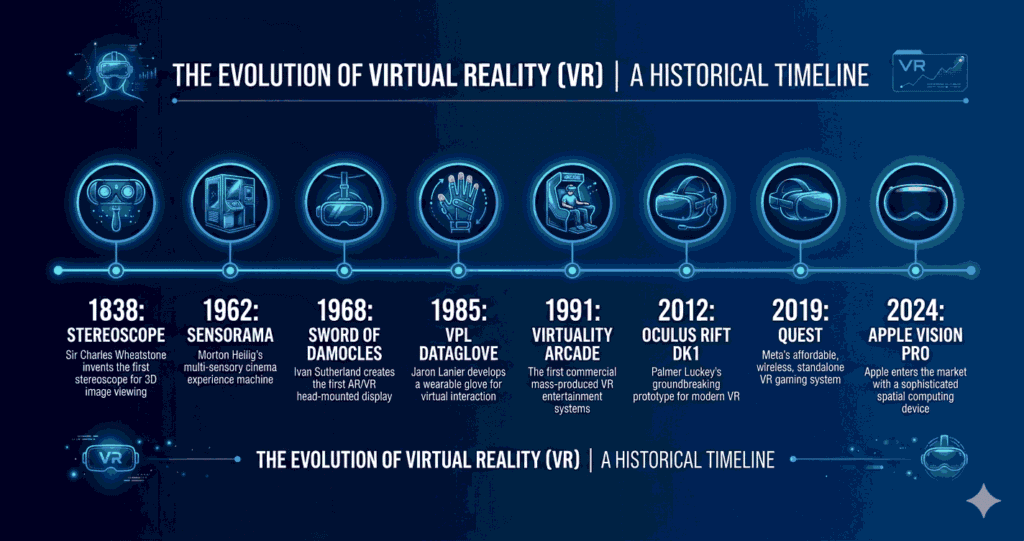
VR didn’t start with Meta or Oculus. The first head-mounted display was built in 1968. The first full-sensory immersive simulator launched in 1962. The term ‘virtual reality’ wasn’t coined until 1987. Here’s every milestone on the VR timeline that led to the device you’re wearing today.
Most people think the history of VR begins in 2016. It doesn’t. It begins in 1838 with a British physicist and two mirrors.
The VR evolution is nearly two centuries old, running through panoramic paintings, military flight simulators, academic research labs, failed consumer products, and one of the most influential Kickstarter campaigns ever launched. Understanding the full VR timeline tells you why modern headsets work the way they do, which problems the industry has already solved, and which battles are still being fought in hardware labs today.
Here is the complete history of virtual reality, structured decade by decade, with verified dates and real names attached to every milestone.
If you’re new to the technology itself, start with our guides on what virtual reality is and how VR works step by step before reading the history.
Why Does the History of VR Matter Right Now?
Answer: Because today’s hardware limitations all have historical explanations.
Motion sickness was documented in Virtuality Labs in 1991. Display latency was being solved at NASA’s Ames Research Center in 1985. Field-of-view restrictions were the central problem in Ivan Sutherland’s lab at MIT in 1968. Every frustration a modern VR developer or user encounters has been encountered before, often decades before, by researchers who left a paper trail.
The VR evolution is also a pattern. The technology has gone through at least three full hype cycles: the early 1990s boom and bust, the 2016 consumer launch and subsequent cooldown, and the current spatial computing wave beginning in 2024. Knowing the pattern helps you evaluate claims about where the industry is going with more accuracy.
The 1800s: Where the History of VR Actually Starts
1838: Sir Charles Wheatstone and the Stereoscope
Sir Charles Wheatstone described stereopsis in 1838 and built the first stereoscope, a device that presented each eye with a slightly different image to create the illusion of three-dimensional depth. He was awarded the Royal Medal of the Royal Society in 1840 for his work on binocular vision.
This is not just historical trivia. The stereoscope’s core principle sits inside every modern VR headset ever manufactured. The Meta Quest 3, the Sony PSVR2, the Apple Vision Pro, all of them deliver slightly different images to each eye to create perceived depth. Wheatstone figured that out in 1838.
As VR researcher and author Cornel Hillmann notes in UX for XR, understanding the perceptual basis of VR, particularly how the brain fuses binocular images, is essential to designing comfortable immersive experiences. That perceptual basis has not changed since Wheatstone’s time.
1895 to 1900: Panoramic Paintings and Environmental Presence
Before screens existed, artists created panoramic paintings designed to completely surround the viewer. Works like Franz Roubaud’s ‘Battle of Borodino’ (displayed from 1912) placed the audience at the center of a curved canvas, generating a primitive but intentional sense of environmental immersion.
This matters because it establishes that the desire to place a viewer inside an experience, rather than in front of it, predates electricity, let alone digital computing. VR is solving a human problem that humans have been trying to solve for centuries.

1900s to 1960s: Simulators, Science Fiction, and the First HMD
1929: Edwin Link and the First Flight Simulator
Edwin Albert Link built the Link Trainer at Link Aviation Devices in 1929. Known as the ‘Blue Box,’ it was the first commercially available flight simulator, designed to teach pilots instrument flying in all weather conditions without leaving the ground. The U.S. military purchased thousands of them. More than 500,000 pilots trained on Link Trainers, making it the first large-scale adoption of immersive simulation for performance-critical training.
Every current use case for VR in military training, surgical simulation, and industrial safety skills development traces a direct line back to Edwin Link’s Blue Box.
1935: Stanley Weinbaum Describes VR in Fiction
Stanley Weinbaum’s short story Pygmalion’s Spectacles (1935) described a pair of goggles that transported the wearer into a fictional world stimulating all five senses. It is widely cited as the first written conception of what we now call virtual reality. The story came 89 years before the Apple Vision Pro, but described the same end goal: complete sensory immersion in a computer-generated environment.
1960: Morton Heilig Patents the Telesphere Mask
Cinematographer Morton Heilig patented the Telesphere Mask in 1960, the first head-mounted display on record. It provided stereoscopic 3D images and binaural stereo sound but had no motion tracking. Heilig’s patent application described the device as providing ‘a complete sensation of reality.’ The Telesphere Mask is the earliest example of a device designed to be worn on the head to deliver immersive visual experience.
1962: The Sensorama, Full-Sensory VR Before Computers Existed
Heilig built the Sensorama in 1962, a mechanical arcade cabinet delivering 3D visuals, stereo sound, smell, wind, and seat vibration simultaneously. He produced six short films for it. The Sensorama was the first multi-sensory immersive experience system ever built, and it predated digital computing entirely.
Modern VR is still, in most configurations, a two-sense medium: visuals and audio. The Sensorama engaged at least four. Heilig considered it the ‘cinema of the future.’ He was right, just about a century early.
1965: Ivan Sutherland’s Ultimate Display
Ivan Sutherland’s 1965 paper ‘The Ultimate Display’ outlined a vision for a computer-controlled room indistinguishable from reality. Sutherland argued the computer display could make ‘a bullet that could kill, handcuffs that could constrain, and a chair that could support.’ The paper is one of the most cited documents in VR research history and remains a useful benchmark for evaluating how close current technology has come to the original vision.
1968: The Sword of Damocles, the First Computer-Connected HMD
Sutherland and his student Bob Sproull built the first head-mounted display connected directly to a computer in 1968. They named it the ‘Sword of Damocles’ because its weight required it to be suspended from the lab ceiling, positioned over the user’s head. It displayed simple wireframe rooms and tracked head movement to update the view in real time.
Primitive as it was, the Sword of Damocles established the foundational architecture that every modern VR headset still uses: a head-mounted display, real-time head tracking, and a computer rendering a 3D environment responsive to the user’s perspective. The engineering has changed. The architecture hasn’t.
The 1970s to 1980s: VR Gets a Name and a Commercial Market
1975: Myron Krueger and the First Interactive Virtual Environment
Computer scientist Myron Krueger developed Videoplace in 1975 and exhibited it at the Milwaukee Art Center. The system used video cameras, projectors, and computer graphics to detect and respond to user movements in real time. No headset required. Videoplace was the first interactive virtual environment designed for public use and became the conceptual foundation for modern markerless body-tracking systems.
1985: VPL Research, Jaron Lanier, and the Term ‘Virtual Reality’
Jaron Lanier and Thomas Zimmerman founded VPL Research in 1985, the first company to sell VR goggles and data gloves commercially. VPL’s EyePhone headset and DataGlove became the era’s defining VR products. Lanier popularized the term ‘virtual reality’ during this period, giving the emerging field the language it still uses today.
VPL licensed the DataGlove technology to Mattel, which released it as the Power Glove for the Nintendo Entertainment System in 1989. It sold over a million units. It was the first mass-market consumer VR peripheral ever sold.
1985: NASA’s VIEW Project Sets the Standard for HMD Optics
Scott Fisher led the redesign of the LEEP (Large Expanse Extra Perspective) optical system for NASA’s Ames Research Center in 1985, creating the VIEW (Virtual Interactive Environment Workstation). The LEEP optical system became the basis for most modern VR headset lens designs. NASA was solving wide-field-of-view display problems in 1985 that Meta and Apple hardware teams are still iterating on today.
1988: Autodesk Brings VR to the Personal Computer
The Cyberspace Project at Autodesk in 1988 became the first implementation of VR on a low-cost personal computer. Project leader Eric Gullichsen left in 1990 to found Sense8 Corporation, which developed the WorldToolKit VR SDK, the first SDK offering real-time 3D graphics with texture mapping on a PC. This was the first serious attempt to democratize VR development beyond government and corporate research labs.
The 1990s: VR’s First Rise, Its Cultural Peak, and Its Painful Fall
The 1990s represent the first full hype cycle in VR history. The technology made its way into mainstream culture through arcades, console announcements, and Hollywood films. It also crashed spectacularly.

1991: CAVE and Virtuality, the High Water Mark
Two major VR milestones arrived in 1991. First, Carolina Cruz-Neira, Daniel Sandin, and Thomas DeFanti at the Electronic Visualization Laboratory created the CAVE (Cave Automatic Virtual Environment), a multi-projected room-scale VR system allowing users to walk through a virtual environment and see their own bodies inside it. The CAVE was developed as Cruz-Neira’s Ph.D. thesis and became the gold standard for research-grade immersive VR for the next decade.
Second, Virtuality launched the first mass-produced VR entertainment system capable of supporting multiplayer networked gameplay. Virtuality units appeared in arcades globally and gave millions of consumers their first experience of interactive VR. The system’s quality was genuinely impressive for 1991.
1993 to 1995: Console VR Announces, Launches, and Fails
Sega announced SEGA VR for the Mega Drive in 1993 but never shipped it commercially. Internal testing reportedly showed users experiencing headaches, dizziness, and disorientation, and Sega cancelled the product. Nintendo released the Virtual Boy in 1995, a tabletop stereoscopic device displaying red-on-black monochrome images at low resolution. Nintendo discontinued it in 1996 after selling approximately 770,000 units, citing motion sickness complaints and commercial underperformance.
Display technology wasn’t ready. Frame rates were too low, resolution too limited, and motion-to-photon latency too high to deliver comfortable immersion. The hardware industry needed another decade.
1996 to 1999: The First VR Winter
Mainstream VR investment dried up after the console failures. Consumer headsets were expensive, uncomfortable, and technically underwhelming. The internet emerged as the dominant technology investment opportunity. VR retreated into military simulation contracts and university research labs, where it produced important work that received almost no public attention.
The 2000s: The Quiet Decade That Made 2012 Possible
Between 2000 and 2011, nothing significant happened in consumer VR. That’s exactly why this period matters.
MEMS sensors became cheap and precise enough for accurate, low-latency head tracking. OLED and LCD display panels improved resolution and refresh rates dramatically. GPU performance followed Moore’s Law into territory that made real-time 3D rendering feasible on consumer hardware. Smartphone manufacturing drove the cost of high-resolution small-form-factor displays down to commercially viable levels.
All of this happened without VR headlines. It was the infrastructure build. Without the 2000s technology maturation cycle, there is no 2012 Oculus Rift.
This infrastructure also enabled the development of modern augmented reality and the metaverse, which both depend on the same hardware advances.
2012 to 2016: The Oculus Revolution
August 2012: The Kickstarter That Restarted VR
On August 1, 2012, Palmer Luckey launched a Kickstarter campaign for the Oculus Rift, a wide-field-of-view VR headset targeting PC gamers. The campaign raised $2.4 million, ten times its $250,000 goal, in 30 days. Id Software co-founder John Carmack had already demoed an early prototype at E3 2012, providing instant technical credibility. The campaign attracted attention from every major technology publication simultaneously.
The Oculus Rift Development Kit 1 shipped in March 2013. It addressed the three problems that killed 1990s VR: display resolution high enough to reduce the ‘screen door effect,’ latency low enough to minimize motion sickness, and a price point ($300 for the developer kit) that put the hardware in reach of independent developers. It wasn’t a consumer product yet. It was a proof of concept that the concept was finally ready.
March 2014: Facebook Pays $2 Billion for Oculus
Mark Zuckerberg’s Facebook acquired Oculus VR in March 2014 for $2 billion in cash and stock. In his announcement, Zuckerberg described VR as ‘the next major computing and communication platform.’ The same year, Sony announced Project Morpheus (later PlayStation VR), and Google released Google Cardboard, a $15 smartphone-based VR viewer designed to give millions of people their first VR experience.
2016: The Year VR Shipped
The Oculus Rift CV1 launched on March 28, 2016. The HTC Vive, developed with Valve Software, launched in April 2016 with room-scale tracking allowing users to physically walk in VR. PlayStation VR launched in October 2016, bringing tethered VR to Sony’s console installed base. Microsoft shipped the HoloLens in 2016, the first commercially available mixed reality headset. VR had shipped.
The second hype cycle had also begun to cool. Hardware was expensive ($499 to $799 for the main platforms). PC requirements were demanding. Content libraries were thin. Consumer adoption rates were real but far below projections. VR was mainstream enough to be covered but not yet mainstream enough to be ubiquitous.

2017 to 2023: VR Goes Wireless and Reaches Mass Market Scale
2019: Meta Quest Changes the Game
Meta (then Oculus) shipped the Oculus Quest in May 2019, a standalone wireless headset with inside-out tracking at $399, no PC required, no external sensors, no cables. The Quest 2, released in October 2020 at $299, sold an estimated 20 million units by March 2023, making it the first VR headset to achieve genuine mass-market scale.
The Quest line answered the question that had blocked consumer adoption for a decade: how do you make VR as simple as putting on headphones? You remove every wire and external dependency. That solution now accounts for Meta holding 75.7% of global XR headset shipment volume as of 2025, per Mordor Intelligence data.
2020 to 2021: COVID Accelerates VR Adoption
The global pandemic created acute demand for virtual social presence and remote collaboration tools. Meta’s Reality Labs reported $5.1 billion in revenue in 2021, though operating losses in the division exceeded $10 billion, a ratio that illustrated both the strategic commitment and the long road to profitability.
VR found strong traction in healthcare during this period, particularly in remote therapy, surgical training, and rehabilitation, and in education, where VR classrooms offered an immersive alternative to flat-screen remote learning.
February 2023: Sony PSVR2 Sets the Technical Bar
Sony released the PlayStation VR2 in February 2023 at $549, delivering eye tracking, foveated rendering, adaptive triggers, and 4K resolution. It was the most technically capable consumer VR headset at launch, designed for Sony’s 40-million-unit PlayStation 5 installed base.
2024 to 2026: Spatial Computing and What Comes After VR Headsets
February 2024: Apple Ships the Vision Pro
Apple launched the Vision Pro in February 2024 at $3,499, the highest average selling price ever recorded for a consumer spatial computing device. Per IDC data published by MacRumors in January 2026, Apple shipped approximately 390,000 units in its launch year. Enterprise adoption significantly outpaced consumer adoption from day one.
The strategic signal: Apple did not call the Vision Pro a VR headset. They called it a spatial computer. That terminology shift indicates the broader industry trajectory: VR, AR, and MR are converging into a single computing paradigm. The headset is the computer, not a peripheral to one.
2025: Hardware Prices Drop, Competition Increases
Sony cut PSVR2 pricing to $399 in August 2025. Meta’s Quest 3S launched at $299 with eye tracking and high-resolution passthrough. Qualcomm began sampling the Snapdragon XR3 chipset in January 2026, targeting sub-$400 professional headsets. Samsung entered the market in October 2025 with Galaxy XR at $1,799 running Google’s Android XR operating system, representing Google’s most serious spatial computing platform play yet.
Meta’s Ray-Ban smart glasses sold over 2 million units with sales tripling in Q2 2025 per Wired, generating an estimated $2.15 billion in hardware revenue, more than Meta’s Quest headsets for the first time. Smart glasses are becoming a major category in the VR evolution.
Apple Vision Pro shipped 85,000 units in 2025 after production challenges, per IDC data. Despite modest shipment numbers, the product reset market expectations for display quality and passthrough fidelity across the entire competitive field.
2026: The Next Phase Begins
At MWC 2026, Lenovo unveiled adaptive AI device concepts and glasses-free 3D displays, signaling that spatial computing is expanding beyond headforms. In June 2025, Apple previewed visionOS 26 with persistent spatial widgets and deeper enterprise integrations. Google’s Android XR platform aims to bring open-ecosystem spatial computing to Samsung hardware and future OEM partners.
IDC projects approximately 87% year-over-year growth in XR headset shipments in 2026, following a temporary market contraction in 2025. The longer-term compound annual growth rate for XR units shipped is forecast at 38.6% between 2025 and 2029.
For the full picture on what VR headsets actually contain and how they work, see our VR headset technology explainer and our guide to the best VR experiences in 2026.

VR Market Data: 2025 and 2026 by the Numbers
Sources: IDC (2026), Mordor Intelligence (2026), Fortune Business Insights (2025), Treeview Studio (2026). Data cited with years on all figures.
| Metric | 2025 Data | 2026 Projection | Source |
| Global VR Market Size | $12.92 billion | $15.64 billion | Mordor Intelligence, Jan 2026 |
| XR Headset Shipment Growth | Approx. -12% (contraction) | +87% rebound | IDC, 2026 |
| Meta Quest Market Share | 75.7% of XR volume | Consolidating | Mordor Intelligence, 2026 |
| Apple Vision Pro Units Shipped | 85,000 (production halt) | TBC, new model TBA | IDC via MacRumors, Jan 2026 |
| Ray-Ban Meta Smart Glasses Revenue | $2.15B hardware revenue | Growing category | Treeview Studio, 2026 |
| Global VR Users | Approx. 80.6 million | 91.3 million by 2028 | Multiple sources, 2025 |
| Average SteamVR Session Length | 52 minutes | +7% YoY growth | Virtual Speech, 2025 |
| VR+AR Economic Value by 2030 | $1.9 trillion | Global GDP contribution | PwC, 2022 |
| XR Units CAGR (2025-2029) | 38.6% annually | Sustained growth | IDC, 2026 |
| North America VR Market Share | 37.36% of global | $9.3B by 2026 | Fortune Business Insights, 2025 |
What the VR Evolution Tells Us About Where It Goes Next
Three patterns repeat across the history of VR.
First: Every hype cycle ends with better hardware than the one before it. The 1990s crash left behind MEMS sensors, GPU improvements, and optical research that enabled the 2012 Oculus. The 2016-2018 slowdown left behind the engineering work that produced the wireless Quest. Today’s market consolidation will produce the lightweight smart glasses and sub-$400 high-fidelity headsets that the next growth wave runs on.
Second: Enterprise always precedes consumer. NASA was using VR in 1985. Surgical training programs adopted it in the mid-2000s. The military’s $11 billion in VR/AR training investment (U.S. alone) has been running for years. When enterprise VR matures, consumer VR follows with a cheaper, simplified version.
Third: The platform that simplifies the hardware wins. VPL Research’s commercial failure, Nintendo’s Virtual Boy disaster, and the 2016 consumer headset cooldown all share one cause: the hardware was too complicated for non-enthusiasts. The Quest’s success came from removing complexity. Apple’s spatial computing vision is about integrating VR into the daily computing workflow. The winner in the next cycle will be whichever company makes spatial computing feel normal.
For a deeper academic history of VR, see Jason Jerald’s The VR Book: Human-Centered Design for Virtual Reality (2016, Morgan & Claypool), which provides one of the most comprehensive scholarly histories of the medium.
Frequently Asked Questions
When was virtual reality invented?
The first head-mounted display was built in 1960 by Morton Heilig (Telesphere Mask) and the first computer-connected HMD was the Sword of Damocles in 1968. The term ‘virtual reality’ was popularized by Jaron Lanier at VPL Research in the mid-1980s. There is no single invention date; VR is a progression of technologies spanning nearly two centuries.
What was the first VR headset ever made?
Morton Heilig’s Telesphere Mask (1960) was the first patented HMD. Ivan Sutherland’s Sword of Damocles (1968) was the first HMD connected to a computer. The first consumer VR headset sold commercially was the Oculus Rift CV1 in March 2016, though developer kits shipped from 2013.
Why did VR fail in the 1990s?
Primarily because display technology wasn’t ready. Frame rates were too low to prevent motion sickness, resolution was insufficient to create convincing presence, and motion-to-photon latency was high enough to cause disorientation. The hardware industry needed another 15-plus years of display and sensor development before consumer VR became viable.
How has the history of VR shaped modern headsets?
Directly. Modern VR lens designs trace to NASA’s LEEP optics work in 1985. Inside-out tracking builds on Myron Krueger’s Videoplace (1975) and 2000s computer vision research. Standalone headsets solve the core problems that killed the 1990s market: latency, resolution, and hardware complexity. Every current feature has a documented historical predecessor.
What comes after VR headsets in the VR evolution?
Spatial computing is the direction the industry is moving. Apple’s Vision Pro, Meta’s smart glasses, and Samsung’s Android XR device all represent a convergence of VR, AR, and AI into a single computing layer worn on the face. The longer-term arc, per research from firms like IDC and Mordor Intelligence, points toward lightweight smart glasses replacing heavier headsets for everyday use by the late 2020s.
Interaction Design Foundation’s VR history overview (interaction-design.org) provides additional academic context for each era of VR development, with citations to primary research papers.
Pingback: What Happened to the Metaverse in 2026? The Full Story
Pingback: Best VR Experiences in London for 2026 (Full Guide)
Pingback: VR Arcades Around the World: Ultimate 2026 Guide