
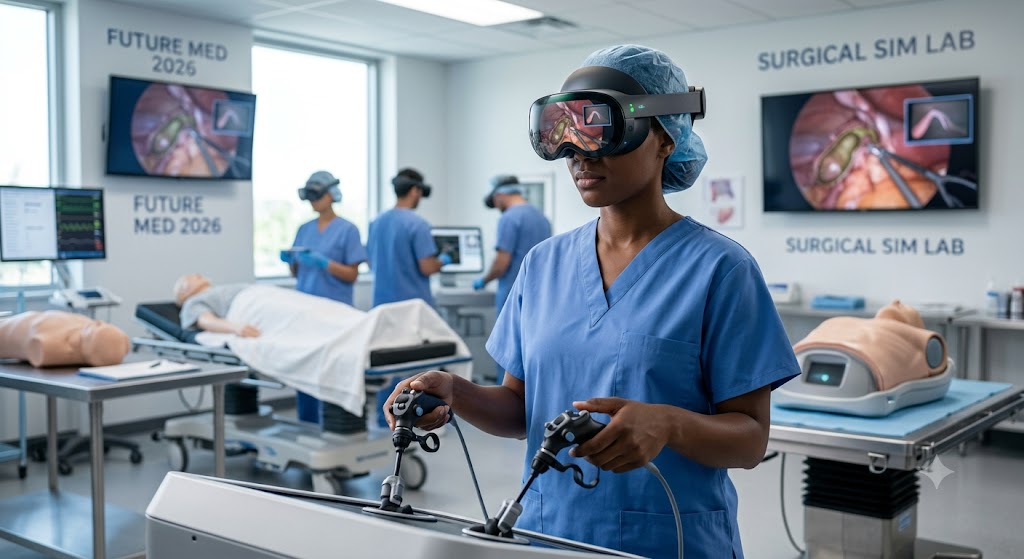
Some technologies arrive and spend a decade being described as the future. Virtual reality in healthcare spent a long time in that category. You would read breathless announcements about surgeons practicing in virtual worlds or patients managing chronic pain through headsets, and then nothing would materialize in the hospitals you knew. The future kept getting pushed forward.
That gap between announcement and reality has quietly closed. The global VR in healthcare market was valued at $5.62 billion in 2025 and is projected to reach $7.58 billion by the end of 2026, expanding toward $66.91 billion by 2034 at a compound annual growth rate of 31.3 percent, according to Fortune Business Insights. Those numbers represent real procurement decisions made by hospital administrators, not venture capital optimism. The shift from pilot project to standard clinical tool has happened faster than most people outside the industry realize, and the applications that drove it are worth understanding properly.

This is not a pitch for VR. It is a breakdown of what hospitals are actually doing with it, where the evidence is solid, and where the limitations are still real. For a broader picture of where immersive technology is heading, the team at Future of Virtual Reality tracks the full landscape. Our VR health and wellness coverage goes deeper on the therapeutic and clinical side specifically.
How Virtual Reality in Healthcare Actually Works
Before getting into specific use cases, it helps to understand why VR is particularly well-suited to medical environments. The technology replaces a person’s visual field with a computer-generated environment and tracks their head and body movement to update that environment in real time. What that means in clinical practice is that you can put a surgeon in an operating room that does not exist yet, put a patient’s nervous system on a beach they have never visited, or put a medical student inside an anatomy they could never afford to observe directly.
The technology delivers two types of value in healthcare. The first is VR as a training tool, where the headset helps a clinician learn something. The second is VR as a therapeutic, where the headset itself is part of the treatment. Both categories are growing fast, but they follow different regulatory paths. Training tools generally do not need FDA clearance. Therapeutics do, and the pipeline of FDA-authorized VR medical devices is now genuinely growing, as documented by VR Vision Group’s 2026 clinical overview.
Surgical Training and Simulation: Where the Evidence Is Strongest
If you had to pick one area where VR has the most robust, peer-reviewed evidence in healthcare, surgical training is probably it. Platforms like Osso VR, FundamentalVR, and Precision OS train surgeons on procedures with measurable, documented performance gains. Companies including Johnson and Johnson, Stryker, Zimmer Biomet, and Medtronic have integrated these platforms into their professional training programs. Surgeons practice on a virtual patient before they practice on a real one, and the data on how much that improves procedural accuracy is significant.
In October 2025, ophthalmologist Dr. Eric Rosenberg at SightMD performed what was reported as the world’s first cataract surgery assisted by Apple Vision Pro, using the ScopeXR platform to fuse a live microscope feed with pre-operative diagnostic data inside the headset. By April 2026, hundreds of cataract procedures had been completed with Vision Pro assistance. Mayo Clinic uses it specifically for surgical rehearsal and emergency response training. Boston Children’s Hospital built an application called CyranoHealth that trains nurses on infusion pump operation through immersive simulation. Cedars-Sinai deployed it for clinician empathy training, letting doctors experience medical conditions from the patient’s perspective.
According to VR Expert’s comprehensive 2026 healthcare report, VR medical training demonstrably improves confidence and preparedness among healthcare professionals when dealing with complex clinical scenarios. A key structural reason this matters right now is that global healthcare systems face critical clinician supply shortages, and VR training scales instruction without requiring proportional headcount or additional physical facility space.
VR for Pain Management: The Numbers Are Hard to Ignore
Pain management through VR works on a principle that is genuinely simple once you understand it: the brain has a finite amount of attention, and immersive virtual environments compete for that attention against pain signals. When the competition is strong enough, the pain signals lose.
Clinical studies have shown VR reduces pain intensity by 35 to 50 percent during burn wound care procedures, one of the most consistently painful clinical interventions in hospital settings, according to data compiled by Treeview Studio’s 2026 VR healthcare statistics report. EaseVRx, now branded as RelieVRx and FDA-authorized for chronic low back pain, has documented $200,000 in monthly cost savings and a 50 percent reduction in patient pain scores through reduced medication requirements in clinical deployments. Cedars-Sinai recorded a 24 percent drop in self-reported pain scores among hospitalized patients using therapeutic VR.

These applications cover burn care, IV insertions, labor and delivery, and chronic conditions including fibromyalgia, complex regional pain syndrome, neuropathic pain, and low back pain. Reimbursement remains the largest structural barrier to faster scaling, not clinical evidence or hardware availability. RelieVRx has Medicare coverage in certain pathways, but most VR pain therapy is still absorbed as a hospital operating expense rather than billed as a standard clinical service.
Physical Rehabilitation and Therapy
Rehabilitation is the third major pillar of VR in clinical healthcare, and it works differently from both training and pain management. In rehab applications, VR does not replace standard physical therapy exercises so much as gamify and contextualize them in ways that improve patient adherence and motivation.
Post-stroke patients using VR-based motor rehabilitation programs report higher motivation to complete repetitions, which matters enormously because repetition volume is directly correlated with neurological recovery. Speech therapy and language rehabilitation have shown similar patterns, with VR-based interaction scenarios allowing patients to practice conversational skills in settings they find less stressful than face-to-face sessions.
Vision therapy through VR has shown effectiveness for amblyopia and convergence insufficiency, conditions that previously required lengthy in-clinic sessions with specialist equipment. The ability to deliver standardized therapy through a consumer headset significantly changes the access equation for patients who cannot easily travel for regular appointments.
Mental Health: The Fastest-Growing Application Category
According to Grand View Research’s VR healthcare market analysis, the mental health therapy segment is projected to be the fastest-growing application within the healthcare VR market through 2034. The core mechanism is exposure therapy, where patients are gradually exposed to feared or anxiety-producing stimuli in a controlled virtual environment rather than in the real world. VR exposure therapy has solid clinical evidence behind it for phobias, social anxiety disorder, PTSD, and panic disorder.
The broader emotional health applications are expanding too. Cedars-Sinai’s empathy training program puts clinicians in a patient’s experiential perspective, which research suggests improves patient-centered care delivery. The intersection of AI and VR mental health tools is also moving quickly, which we cover in depth in our article on how AI and VR are creating smarter immersive experiences.
The Adoption Numbers in 2026
- Approximately 40 percent of healthcare providers globally are now using VR for patient treatment or staff training in some form.
- In the United States specifically, 70 percent of hospitals report using AR or VR tools for training and surgical support.
- The education and training segment holds the highest revenue share within VR healthcare at 28.96 percent in 2026.
- 82 percent of healthcare specialists surveyed agree that VR is a proficient tool for education; 62 percent of patients say they are open to trying VR as part of their care.
A commissioned Forrester Consulting study on behalf of Meta found that 75 percent of healthcare leaders report VR makes training and onboarding more realistic, and 81 percent anticipate future use cases for visual models and task instructions regardless of employee tenure, as detailed in Meta for Work’s healthcare technology report.
The Limitations Hospitals Are Actually Dealing With
Hardware weight is still a problem. Most advanced VR headsets weigh over 450 grams, which becomes uncomfortable during extended therapy sessions, particularly for elderly patients or anyone in post-operative recovery. Hygiene protocols between patients are operationally awkward. Battery life places a ceiling on session length that does not exist for most other medical equipment.
Integration with existing hospital IT infrastructure is a genuine challenge. VR systems that are not compatible with electronic health record platforms can create data silos or require manual documentation workarounds. Clinical validation is also procedure-specific. Strong evidence for VR in orthopedic surgical training does not automatically transfer to cardiac surgery or oncology procedures. Each application needs its own evidence base.
What to Expect Through the Rest of 2026
Reimbursement expansion is the single biggest unlock for faster adoption. The AI layer inside VR platforms is becoming meaningfully more sophisticated, with adaptive scenario generation and real-time performance analytics that make VR training significantly more valuable than static alternatives. The cost curve on hardware also continues to move in a favorable direction, with the Meta Quest 3S at $299 now serving as a credible clinical-quality deployment device at a price point that hospital IT budgets can absorb.
If you want to understand where VR technology is heading across all sectors, not just healthcare, the team at Future of Virtual Reality tracks the full landscape, and our VR health coverage goes deeper on therapeutic applications specifically.
Key Takeaways
- VR in healthcare is a $7.58 billion market in 2026, growing at 31.3 percent annually toward $66.91 billion by 2034.
- The strongest evidence is in surgical training and simulation, acute pain management, and physical rehabilitation.
- Mental health is the fastest-growing segment, led by VR exposure therapy for anxiety, phobias, and PTSD.
- Named deployments at Mayo Clinic, Cedars-Sinai, Boston Children’s Hospital, and GOSH confirm the technology is operational, not experimental.
- Primary obstacles: hardware comfort for extended sessions, incomplete reimbursement, and hospital IT integration complexity.
Frequently Asked Questions
How big is the VR in healthcare market in 2026?
The global VR in healthcare market is projected to reach $7.58 billion in 2026, growing from $5.62 billion in 2025. It is forecast to reach $66.91 billion by 2034 at a CAGR of 31.3 percent, according to Fortune Business Insights.
What are the main uses of virtual reality in hospitals?
The four main clinical applications are surgical training and simulation, pain management and distraction therapy, physical rehabilitation, and mental health therapy. Training and education currently holds the largest revenue share at nearly 29 percent.
Which hospitals are currently using VR?
Named deployments include Mayo Clinic (surgical rehearsal, emergency training), Cedars-Sinai (pain management, empathy training), Boston Children’s Hospital (nursing simulation), and Great Ormond Street Hospital (cardiac visualization).
Is VR approved by the FDA for medical use?
Yes, for certain specific applications. RelieVRx is FDA-authorized for chronic low back pain. Most VR training tools are not classified as medical devices and do not require FDA clearance.
Further Reading
- Fortune Business Insights — VR in Healthcare Market Size & Share, 2034 — https://www.fortunebusinessinsights.com/industry-reports/virtual-reality-vr-in-healthcare-market-101679
- Treeview Studio — VR in Healthcare: AR/VR Statistics & Market Data 2026 — https://treeview.studio/blog/virtual-reality-in-healthcare-market
- VR Vision Group — VR in Healthcare: 2026 Use Cases & Market Data — https://www.vrvisiongroup.com/vr-in-healthcare/
- Grand View Research — Virtual Reality in Healthcare Market Report, 2030 — https://www.grandviewresearch.com/industry-analysis/virtual-reality-vr-healthcare-market-report
Pingback: US Spatial Computing Market 2026: Size, Growth & Key Players