
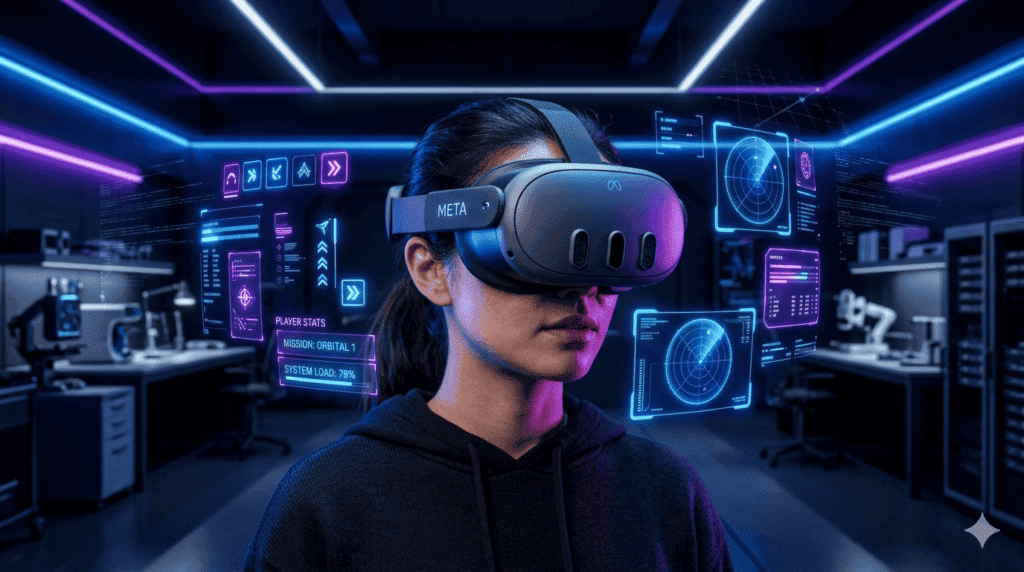
Most people spend a week reading reviews before buying a VR headset and still walk away confused. Not because the information is hard to find. Because most of it explains what the specs are, not what they mean. Resolution numbers. Refresh rates. Field of view angles. Nobody gives them context that actually helps you decide.
This guide does. From the display physics to the tracking algorithms to the lens designs reshaping the category in 2026, here is what a VR headset is actually doing and why each component matters.
TL;DR | A VR headset works by showing each eye a different high-resolution image, tracking your head movements in real time, and updating the display faster than your brain can detect the lag.
• The global VR market was valued at $67.66 billion in 2025 (HQSoftware, 2026). Headsets now range from $299 to $3,499.
• Pancake lenses have replaced Fresnel lenses in premium headsets, making devices lighter and more comfortable for long sessions.
• Refresh rate (Hz) matters as much as resolution. Below 90Hz, motion blur is visible. At 120Hz, movement feels natural.
• Standalone headsets (Meta Quest 3) need no PC. PC-tethered headsets (Valve Index) deliver higher visual fidelity for demanding content.
• Inside-out tracking means no external sensors needed. Six degrees of freedom (6DoF) is the minimum for meaningful VR immersion.
What Is a VR Headset? The Simple Answer, Then the Detail
A VR headset is a wearable display system that creates the illusion of physical presence in a computer-generated environment. That’s the simple answer.
The detail: to pull that off, the system has to show each eye a slightly different image to simulate natural depth perception, track your head movement in real time, and update the display fast enough that the delay between movement and image change is invisible to your brain. That delay is called motion-to-photon latency. At 20 milliseconds or above, your brain starts noticing. Below 15 milliseconds, most users can’t detect it at all.
When any of these three elements breaks down, motion sickness follows. Your visual system is receiving movement signals that don’t match what your inner ear senses. The brain’s response is predictable: it assumes something’s wrong. High-quality VR headset technology exists specifically to prevent that mismatch.
| The critical trio: matched binocular images + real-time tracking + sub-20ms latency. All three must work together. If one fails, the experience fails. |
How Do VR Headset Displays Work? Resolution vs Refresh Rate
Two numbers define more of your visual experience than any other spec: pixels per eye and refresh rate. Most reviews focus on the first and understate the second.
Resolution determines visual clarity. The HTC Vive Pro 2 delivers 2,448 x 2,448 pixels per eye, one of the highest in the consumer category. The Meta Quest 3 sits at 2,064 x 2,208 per eye. That’s a significant jump from the original Oculus Rift at 1,080 x 1,200. If you’ve used both generations, the difference is immediately obvious. The screen door effect, that visible pixel grid haunting early VR, disappears above roughly 1,800 x 1,800 per eye.
VR Headset Spec Comparison Table (2025-2026)
| Headset | Type | Resolution (per eye) | Refresh Rate | Price (2025) | Best For |
| Meta Quest 3 | Standalone/Hybrid | 2,064 x 2,208 | up to 120Hz | $499 | General consumers |
| Meta Quest 3S | Standalone | 1,832 x 1,920 | up to 120Hz | $299 | Budget/first-time buyers |
| PlayStation VR2 | Console-tethered | 2,000 x 2,040 | up to 120Hz | $549 | PS5 gaming |
| Apple Vision Pro | Standalone | 3,660 x 3,200 | up to 100Hz | $3,499 | Pro / spatial computing |
| Valve Index | PC-tethered | 1,440 x 1,600 | up to 144Hz | $999 | PC enthusiasts |
| HTC Vive Pro 2 | PC-tethered | 2,448 x 2,448 | up to 120Hz | $1,399 | Professionals |
| Pico 4 Enterprise | Standalone | 2,160 x 2,160 | up to 90Hz | $699 | Enterprise training |
Refresh rate is the spec that changes how VR feels. At 60Hz, motion blur is obvious. At 90Hz, movement begins to feel natural. At 120Hz and above, the jump crosses into something that genuinely fools the brain. The Meta Quest 3 supports 120Hz. The Valve Index pushes to 144Hz for users running high-end gaming PCs. Those numbers aren’t marketing. They’re the boundary line between comfortable extended use and headsets that cause headaches.
Micro-OLED and micro-LED displays are replacing LCD panels in premium devices. They deliver higher pixel density, true blacks, and wider color range. Apple Vision Pro uses micro-OLED at 3,660 x 3,200 per eye. The visual gap between it and any other consumer device is real. But so is the $3,499 price. Most users won’t need that level of clarity.

VR Goggles Lens Design: Why Pancake Lenses Changed Everything
Lenses are the component most buyers overlook. They shape your physical comfort over a two-hour session more than almost anything else in the spec sheet.
The older standard was Fresnel lenses: concentric ring-shaped optics that worked but created visible light artifacts in bright scenes, required the display to sit several inches from your eyes, and pushed the headset’s center of mass forward. After 90 minutes, that forward weight causes neck strain.
Pancake lenses fold the light path multiple times through a compact stack before it reaches your eye. The result is a thinner optical module, a display that sits closer to your face, and a noticeably better front-to-back balance. The Meta Quest 3 uses pancake lenses. The difference in comfort over a long session is immediate and real.
| “Latency is the most important number in VR. Get it below 20 milliseconds and the brain accepts the virtual world. Above it, the experience starts feeling wrong in a way users can’t always name but immediately feel.”
John Carmack | VR Pioneer | Former CTO, Meta Reality Labs Carmack has written extensively about latency requirements in VR since the early Oculus development days. This reflects his widely cited technical position on motion-to-photon latency thresholds. |
Varifocal displays adjust focal distance dynamically based on where your eyes are pointing, solving the vergence-accommodation conflict that causes eye strain in long sessions. This technology is in high-end research hardware now. Commercial versions are 12 to 18 months from a mainstream release as of 2026.
How Does VR Tracking Work? Inside-Out vs Outside-In
Motion tracking is what makes VR feel real rather than just look real. The difference between watching a 360-degree video and inhabiting a virtual world is whether the environment responds to you moving through it.

The difference between 3DoF and 6DoF is the single most important distinction in consumer VR. Three degrees of
freedom tracks rotation only: you can look around, but you can’t lean forward or step sideways. Six degrees of freedom tracks full positional movement in every direction. For any meaningful VR experience beyond passive 360-degree video, 6DoF is the minimum.
3DoF vs 6DoF Tracking: What Each Tracks
| Tracking Type | Head Rotation | Head Position | Controller Position | Typical Headsets | Best Use Case |
| 3DoF (basic) | Yes (all axes) | No | No (or limited) | Budget mobile headsets | 360° video, passive content |
| 6DoF (standard) | Yes (all axes) | Yes (full room-scale) | Yes | Meta Quest 3, PSVR2, Valve Index | Gaming, training, productivity |
Hand tracking without controllers is advancing fast. The Meta Quest 3 tracks bare-hand gestures reliably in most lighting conditions. The Valve Index controllers track individual finger movements with millimeter precision. That input fidelity transforms the experience from pointing at virtual objects to physically reaching out and interacting with them.
| Inside-out 6DoF tracking is the current consumer standard. No external sensors needed. Valve Index offers the highest-fidelity controller input for enthusiasts. Hand tracking is available without controllers on Quest 3. |
Standalone vs PC-Tethered VR Devices: Which One Do You Need?
The biggest practical question when choosing a VR headset isn’t about display specs. It’s whether you need a cable.
Standalone VR devices like the Meta Quest 3 and Pico 4 contain all the processing power inside the headset. No gaming PC required. Battery life typically runs 2 to 3 hours on the Quest 3. The Snapdragon XR2 Gen 2 chip handles mixed-reality passthrough alongside full 3D environments. For the overwhelming majority of users, this is more than sufficient.
PC-tethered headsets like the Valve Index connect to a desktop GPU for significantly more processing power. The full SteamVR library, thousands of titles, becomes available. Visual fidelity in demanding applications is noticeably higher. The trade-off is the cable, the setup requirement, and the cost of the gaming PC itself.
The practical middle ground: standalone headsets with PC streaming. The Quest 3 connects via USB-C or Air Link wireless streaming and operates as a full PC headset on demand. Standalone convenience for casual use. Gaming PC power when you need it. That flexibility is why Quest 3 became the default recommendation for most buyers in 2025.
Eye Tracking and Foveated Rendering: The Rendering Breakthrough
Eye tracking monitors exactly where your pupils point at any moment. Foveated rendering then applies maximum detail only to that precise region, reducing quality in your peripheral vision where you can’t distinguish it anyway. The computational saving is substantial.
Sony’s PlayStation VR2 includes eye tracking as standard. Meta Quest Pro includes it. When eye tracking pairs with a capable chipset, you get cleaner images with fewer frame drops in demanding scenes. It’s one of the genuinely impactful differentiators in premium headsets that review summaries tend to understate.
Is a VR Headset Safe? Motion Sickness, Eye Health, and Children
Motion sickness affects an estimated 25 to 40 percent of first-time VR users to some degree, according to published motion comfort research. Higher refresh rates and lower latency address this directly. Most users adapt with repeated exposure. For the subset that doesn’t, VR comfort remains limited regardless of headset quality.
Eye safety for adults is well-documented as low risk with normal use. Manufacturer recommendations consistently advise 30-minute break intervals for extended sessions. Meta recommends against headset use for children under 10. Eye strain from extended sessions is a real issue distinct from any longer-term risk; it responds well to breaks and proper headset fit.

FAQs
Q1. What is the difference between VR headsets and VR goggles?
Both terms describe the same category of device. ‘VR goggles’ is informal usage, while ‘VR headset’ typically implies a complete system with integrated audio, computing, and tracking. In practice, they’re interchangeable. Technical documentation and manufacturer specs use ‘headset.’
Q2. What resolution eliminates the screen door effect in VR?
Above approximately 1,800 x 1,800 pixels per eye, the visible pixel grid disappears for most users. The Meta Quest 3 at 2,064 x 2,208 per eye clears this threshold comfortably. Any major consumer headset shipping in 2024 or later should meet this minimum.
Q3. Do VR devices work with glasses?
Most modern headsets include adjustable IPD settings and clearance for standard glasses frames. The Meta Quest 3 fits most common frames. Third-party prescription lens inserts are available for major platforms at $30 to $80, providing a cleaner experience than wearing glasses inside the headset.
Q4. What is 6DoF and why does it matter?
Six degrees of freedom tracks both rotational and positional movement. You can lean, crouch, and step sideways, and the virtual world responds. Three degrees of freedom tracks rotation only. For any experience beyond passive 360-degree video, 6DoF is the minimum requirement for genuine immersion.
Q5. How long does a standalone VR headset battery last?
Typically 2 to 3 hours on a single charge. The Meta Quest 3 averages around 2.2 hours of active use. External battery packs that clip to the rear strap extend sessions to 4 to 5 hours. PC-tethered headsets draw power through the cable and have no battery constraint.